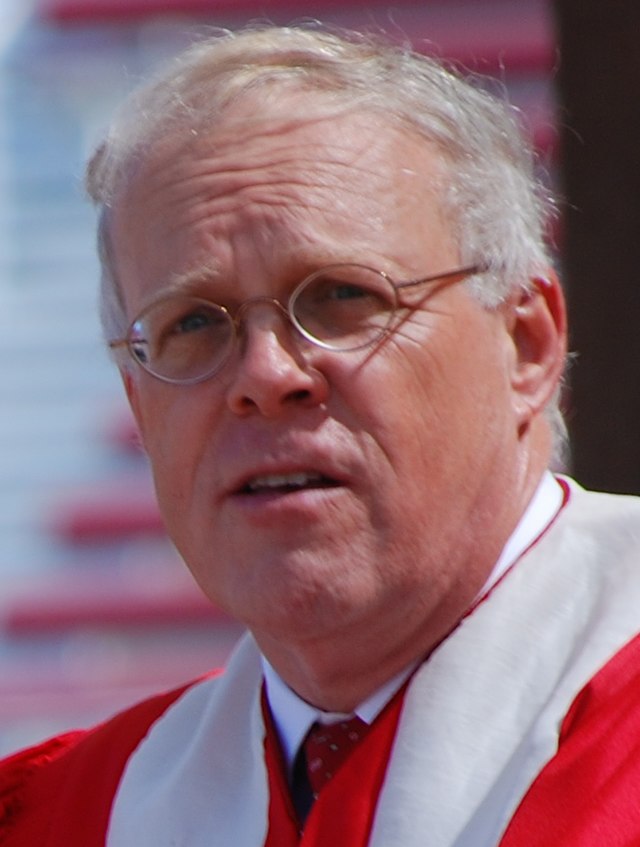
John L. Hennessy
American computer scientist and former president of Stanford UniversityWikipedia
18
MENTIONS
13
EPISODES
5
PODCASTS
Search complete. 18 mentions across 13 episodes found for "John L. Hennessy".
Nov 16, 2026

Harry ShumGUEST
I am here in Stanford.
Harry ShumGUEST
I really want to pay respect to John.
Harry ShumGUEST
And we tried to type John Hennessy.
Harry ShumGUEST
And then we actually end up with John Kennedy.
Harry ShumGUEST
And Google actually did it right.
Harry ShumGUEST
I guess Larry and Sergey did pay more attention to any name from Stanford.
25 MINS LATER
Harry ShumGUEST
So by leveraging that, it's going to be very powerful.
Harry ShumGUEST
So let me show you a couple of examples as entities.
Jen-Hsun HuangGUEST
And we actually had different fields.
Jen-Hsun HuangGUEST
But the problem, and in fact, this happened at Stanford, what's the beauty of RISC? What was the beauty of the work that John Hennessy did? The beauty of it is that you ought to think about compilers and microprocessor architectures harmoniously, co-designed, because otherwise you could end up creating a microprocessor that's super, super tight and everything is maximally optimized.
Jen-Hsun HuangGUEST
But unfortunately, it's hard to compile.
Jen-Hsun HuangGUEST
It's difficult, it's not compilable.
Jen-Hsun HuangGUEST
And so they created a simpler instruction set that exposed the simplicity to compilers so that compilers could do a better job generating code.
Jen-Hsun HuangGUEST
And it turns out a simpler machine co-designed with a compiler creates better performance than two systems that were optimized individually.
Jen-Hsun HuangGUEST
That's, you know, that's very Stanford, okay? And this is part of your heritage as all of your, and John Hennessy's, you know.
speaker_7ADVERTISER
Life is all about making decisions.
John LillyGUEST
Now that I have kids, I read more like three, a bunch of pages from each book, so not as many.
John LillyGUEST
I was an engineer here at Stanford, so an undergrad, and what I really wanted to do was build computers, so a little bit like the president, John Hennessy, I wanted to do faster and faster chips.
John LillyGUEST
And probably the biggest turning point in my career to that point had been a bunch of people helped me understand that it didn't really matter how fast computers would go if nobody wanted to use them.
John LillyGUEST
That led me to be one of the first, one of the early students here in the human computer interaction, led to much of the work at the design school.

David PattersonGUEST
So the power didn't change.
David PattersonGUEST
In fact, the textbooks that I did with John Hennessy, the first couple of editions, we didn't even talk about power because it really wasn't a problem for microprocessors.
David PattersonGUEST
Well, today, power is a problem for microprocessors and similarly with the slowing of Moore's law.
David PattersonGUEST
So for a company to come out with a new GPU or TPU to get more performance, they have to use a lot more power.
John LillyGUEST
The thing that I read at Stanford, the thing that changed my life in my, all my career.
John LillyGUEST
You know, when I came in to Stanford, I was really interested in the kind of stuff that John Hennessy was doing.
John LillyGUEST
The, and I'll, I'll talk about computer architecture, about how to make computers go fast, fast, fast.
John LillyGUEST
And then I had a couple of mentors at internships that I was at at Sun, which is not kind of where you think about HCI coming from, but also here at Stanford.
Donald KnuthGUEST
If you've got a good a good idea for how to replace the sentence, let me know.
Donald KnuthGUEST
But but John Hennessy and Dave Patterson.
Donald KnuthGUEST
Came up with with the second polyunsaturated computer in their book on computer architecture and is called Deluxe DLX.
Donald KnuthGUEST
And and that's, you know, five hundred and sixty.
Donald KnuthGUEST
That's I think I'm overstating that a little bit.
Donald KnuthGUEST
But but at the Siam meeting this summer, John Hennessy gave a talk.
Donald KnuthGUEST
I'd like to talk just before mine and and John, in his talk, went back 35 years with 40 years to the computers that were that were announced 40 years earlier, which when Siam was just founded, this was his 40th anniversary.
Donald KnuthGUEST
And so John pointed out that he looked at the specs of the computers and he point out that the computers have gotten better by nine orders of magnitude.

Eli CahanHOST
Why not?
Daniel GajardoGUEST
I've told John Hennessy explicitly and all my Hennessy team when I thank them, because what I do is a very risky thing.
Daniel GajardoGUEST
It's hard to start.
Daniel GajardoGUEST
It's slow.
3 more episodes mention John L. Hennessy.
Create an account to see the whole feed, search across every transcript, and follow the entities you care about.