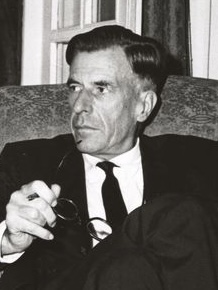
John Kenneth Galbraith
Canadian-American economist and diplomatWikipedia
48
MENTIONS
28
EPISODES
25
PODCASTS
Search complete. 48 mentions across 28 episodes found for "John Kenneth Galbraith".
Oct 29, 2026

Ashe in AmericaHOST
even aside from extreme examples people in general are hardly paragons of reason and often do not reach or maintain their beliefs by dispassionate assessments of the evidence they believe what they do especially on important political moral and religious issues as a result of unconscious biases predispositions prior emotional philosophical and political commitments and intuitions as well as a disinclination to exert the effort or risk the emotional discomfort involved in exposing themselves to contrary evidence and viewpoints.
Ashe in AmericaHOST
As John Kenneth Galbraith observed, faced with the choice between changing one's mind and proving that there is no need to do so, Almost everyone gets busy on the proof.
Ashe in AmericaHOST
Operating within an echo chamber while believing oneself to be well-informed and reasonable has become increasingly easy to do in the age of slanted news sources and targeted media constantly telling their constituencies what they want to hear.
Ashe in AmericaHOST
Of course, people with sincerely or even zealously held beliefs may make statements that are both untrue and inflict serious harm on others.

Heather Cox RichardsonHOST
After the oh look at the date actually after the the great crash of October 29 we're coming right up on it October 29 2029. the bottom fell out of the stock market and then it took the rest of the country and the rest of the world down in the great depression after that system which had been exacerbated by the fact that the republicans in control of the u.s government in the 1920s had decided to turn the government over to business And by the way, a little bit of a rabbit hole here.
Heather Cox RichardsonHOST
There is a great book called The Great Crash by John Kenneth Galbraith.
Heather Cox RichardsonHOST
If you want to read it, it's actually very, very short.
Heather Cox RichardsonHOST
It's a great read.

Tara DevlinGUEST
It's the selfishness.
Tara DevlinGUEST
Like John Kenneth Galbraith said, the modern conservative is engaged in mankind's oldest pursuit, the search for the superior moral justification for selfishness.
Tara DevlinGUEST
And there you go.
Tara DevlinGUEST
And that's what they are.

BillHOST
What kind of person entertains such a fantasy? And how do professionals in the bond market not understand that the U.S.
BillHOST
government cannot be forced to default on its debts, which are denominated in dollars? All of this is bizarre, and as John Kenneth Galbraith noted a long time ago, the conventional wisdom is very strong, especially when it's mythological in character, and there's nothing with more mythology around it than money.
BillHOST
Hedge funds are under pressure.
BillHOST
Hedge funds make loans.
Brian LupoHOST
Another consequence of the national banking system was to make it impossible from that date forward for the federal government to ever get out of debt.
Brian LupoHOST
please reread that statement it is not an exaggeration even friends of central banking are forced to admit this reality galbraith says gloomily quote rarely has economic circumstance managed more successfully to confound the most prudent and economic foresight in numerous years following the war the federal government the federal government ran a heavy surplus It could not pay off its debt, retire its securities, because to do so meant there would be no bonds to back the national banknotes.
Brian LupoHOST
To pay off the debt was to destroy the money supply.
Brian LupoHOST
As pointed out in a previous section, that is essentially the situation which exists today.

Duncan MacPhersonHOST
I mean, that book is timeless.
Duncan MacPhersonHOST
And the other one, which holds up today, was John Kenneth Galbraith.
Duncan MacPhersonHOST
He wrote a book called A Short History of Financial Euphoria.
Duncan MacPhersonHOST
Right.

Adrian WooldridgeGUEST
So I think America goes through a big revolution in the 1980s in terms of its version of capitalism.
Adrian WooldridgeGUEST
And you have this notion in America, I mean, John Kenneth Galbraith is a classic example of this, whereby you have this notion that we should have countervailing forces.
Adrian WooldridgeGUEST
You have the big company, you have big governments, and you have big trade unions, and they sort of balance each other out.
Adrian WooldridgeGUEST
But companies are not... pursuing short-term profits and they're not only pursuing short-term profits there's a in every you know you have three big companies as it were in every in every sort of area it's a much more stable version of capitalism yeah after the second world war and you could call it stakeholder i don't think galbraith term uses the term stakeholder but uh it's it's different from what happens after the 1980s it's not greed is good capitalism it's stability is good capitalism

Paul FitzgeraldGUEST
So Pat Robertson and his crowd.
Paul FitzgeraldGUEST
So at any rate, so we went and did a documentary and we got John Galbraith to talk about the arms race and the cost of it.
Paul FitzgeraldGUEST
And Paul Warnke, who had written the SALT II treaty.
Paul FitzgeraldGUEST
And they all loaned their time and they all said, this is a real issue for the United States.

Isabella WeberGUEST
So coming from this Chinese history perspective, trajectory, I started looking into this transition from war to post-war economy question.
Isabella WeberGUEST
And what I found was that at the end of World War II, economists from Frank Knight, who was the mentor of Milton Friedman, to Samuelson, who was the author of the most important textbook of the 20th century, To John Kenneth Galbraith, who is the most important institutionalist economist of the 20th century, all the way to Paul Sweezy, who is the most important Marxist American economist, they were all of one opinion, that when you were in this moment of transitioning from a war to a post-war economy, where you had scarcity in important areas, upstream sectors, such as steel, because during the war you had been using this, I mean, to the extent that was possible.
Isabella WeberGUEST
And now you try to build out different production structures because you no longer wanted to produce tanks, but you want to produce fridges and cars and whatever, right? So as a result of this retooling, you had bottlenecks in the free prices rain, what you get is price explosions and profit, I mean, profits shooting up.
Isabella WeberGUEST
And as a result of that, you get inflation.

Isabella WeberGUEST
So coming from this Chinese history perspective, I started looking into this transition from war to post-war economy question.
Isabella WeberGUEST
And what I found was that at the end of World War II, economists from Frank Knight, who was a mentor of Milton Friedman, to Samuelson, who was the author of the most important textbook of the 20th century, said, To John Kenneth Galbraith, who is the most important institutionalist economist of the 20th century, all the way to Paul Sweezy, who is the most important Marxist American economist, they were all of one opinion, that when you were in this moment of transitioning from a war to a post-war economy, where you had scarcity in important areas, upstream sectors, such as steel, because during the war you had been using this, I mean, to the extent that was possible.
Isabella WeberGUEST
And now you try to build out different production structures because you no longer wanted to produce tanks, but you want to produce fridges and cars and whatever, right? So as a result of this retooling, you had bottlenecks in the economy.
Isabella WeberGUEST
And when you have bottlenecks and you let production free prices rain, what you get is price explosions and profit, I mean, profits shooting up.
18 more episodes mention John Kenneth Galbraith.
Create an account to see the whole feed, search across every transcript, and follow the entities you care about.