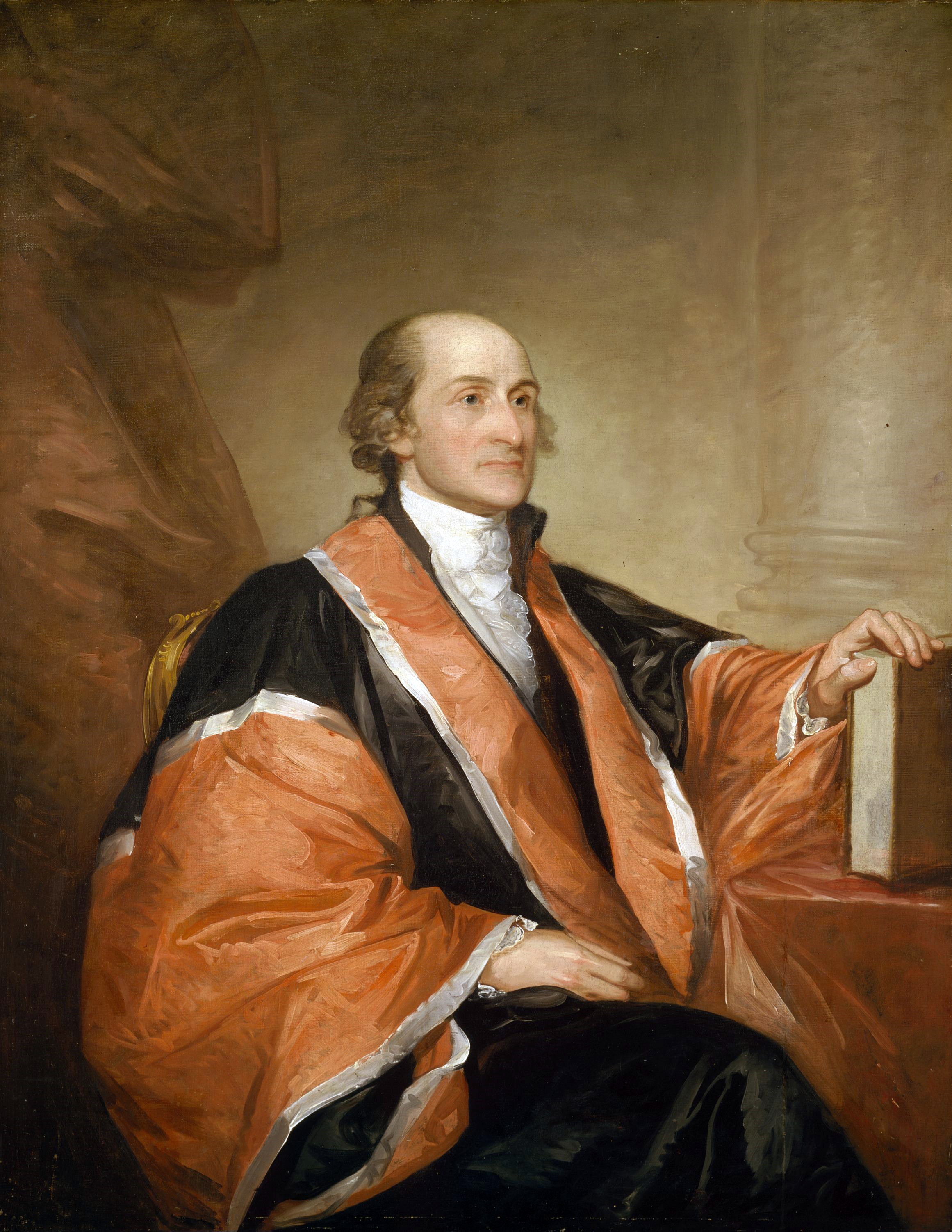
John Jay
Statesman and former President of the Continental CongressWikipedia
196
MENTIONS
95
EPISODES
62
PODCASTS
Search complete. 196 mentions across 95 episodes found for "John Jay".
Sep 11, 2026

David BartonGUEST
Uh, if, if you happen to be in Massachusetts or Connecticut, the Congregationalists run there.
David BartonGUEST
Uh, and so there, there are, are the Presbyterians in North Carolina, et cetera.
David BartonGUEST
And so what happened is George Whitefield, as he would travel all of these colonies sharing scriptures, preaching in all those colonies, you had people from different backgrounds of Christianity coming together, and they would often fight and have border wars with their other Christian colonies because they're like Europe.
David BartonGUEST
They're thinking that way.
22 MINS LATER
Daniel LapinHOST
But I do know that, uh, just a couple of miles from where we have grandchildren living in New Jersey is Paterson, New Jersey, which for all intents and purposes, is today a Muslim city.
Daniel LapinHOST
Uh, Michigan has, um, places that are, are Muslim cities.
Daniel LapinHOST
And it's not the same as saying there are a lot of Catholics living in that city, or there are a lot of Presbyterians living in that city, or there are a lot of Baptists.
Daniel LapinHOST
It's not the same, because none of those Christian faiths, or Jewish faiths for that matter, as far as I know, have any religious obligation to take over and to impose a system on everybody else, but Islam does.

Steve AbramowiczHOST
Check her out and subscribe at DefiantlyFreeOnX.
Steve AbramowiczHOST
Like the Federalist Papers before her with Publius for Alexander Hamilton, James Madison, and John Jay.
Steve AbramowiczHOST
Why? So they didn't get unalived by King George.
Steve AbramowiczHOST
Some of what we went through during COVID is worse than what he did.

Mark HallHOST
Now, this is the place where if you want to get out of jury duty, I'll tell you, just memorize one or two easy quotes.
Mark HallHOST
John Adams, second president of the United States, signer of the Declaration of Independence, and another fellow, John Jay, first Supreme Court chief justice, they both said almost word for word the same thing.
Mark HallHOST
that a juror has not just the right, but the obligation to judge, and here I quote, the facts and the law according to his own conscience.
Mark HallHOST
Understand that.

speaker_1NARRATOR
True, the wronged foreign officials could resort to state court.
speaker_1NARRATOR
But Secretary of Foreign Affairs John Jay cautioned that the federal government does not appear to be vested with any judicial powers competent to the cognizance and judgment of such cases.
speaker_1NARRATOR
Other leading figures were similarly troubled that the articles failed to provide for the case of offenses against the law of nations and consequently left it in the power of any indiscreet member to embroil the Confederacy with foreign nations.
speaker_1NARRATOR
The new Constitution equipped the federal government to deal with this problem.

Paul EngelHOST
Today we're talking about understanding our rights because our understanding is crucial to defending and asserting our rights.
Paul EngelHOST
It's one of the reasons why John Jay said every member of the state diligently to read and study the Constitution of this country, teach the rising generation to be free.
Paul EngelHOST
But it's reading is one thing.
Paul EngelHOST
Studying is another thing because studying is an attempt to understand.

JudyNARRATOR
It was he who, in a bold, plain hand, inscribed on the great sheet of parchment the name of each state, as the delegations came forward, one after another, in geographical order, and affixed their signatures to the precious document which was to found the government of the United States.
JudyNARRATOR
hamilton returned to new york determined to use his utmost powers to secure the ratification of the constitution as the best attainable means of averting the dangers of disunion although cordially supported by john jay and edward livingstone hamilton in the fight for ratification in new york was the natural leader he found arrayed against him the whole influence of governor clinton and the dominant party in new york politics clinton was not absolutely opposed to union but he attached to it so many reservations that for practical purposes he was an opponent of the new constitution the battle over ratification began on the question of the choice of delegates to the state convention it was in this field that hamilton fought the great fight with his pen which has left to posterity the fine exposition of the constitution known as the federalist A society was formed in the city of New York to resist the adoption of the Constitution, and articles soon began to appear in the local press criticizing and opposing it.
JudyNARRATOR
Preparing a vigorous letter while gliding down the Hudson in reply to some of the first points of the opposition, Hamilton soon extended the project into a series of strong papers, which appeared twice a week for 20 weeks over the signature of Publius.
JudyNARRATOR
he secured the aid of madison and jay who wrote some of the papers but the project was hamilton's the majority of the papers were written by him and to him has been justly given the credit of the well-knit and powerful arguments afterwards printed under the title of the taking up point by point the provisions of the new constitution hamilton by skilful argument drawn from the closest abstract reasoning the recent experience of the states and the history of foreign countries sought to show that the new constitution was based upon sound principles of government that it was well calculated to carry out these principles and that its acceptance was practically the only course open to the american people to insure for themselves the benefits of liberty prosperity and peace The Federalist, although a purely political argument, has survived the occasion which called it forth as one of the master documents of political writing.
1 HR 36 MINS LATER
JudyNARRATOR
When Great Britain issued the first orders in Council, directing the seizure of all vessels loaded with French produce, Hamilton declared the British order an outrage, and urged the fortification of the seaports and the raising of troops.
JudyNARRATOR
He exerted himself, however, to restrain popular passion and preserve peace.
JudyNARRATOR
he suggested to washington that a special mission be sent to london to treat with the british government the idea was cordially accepted by washington he desired to send hamilton but the virginia party headed by madison and monroe strongly opposed the appointment they were embittered by recent party conflicts and regarded hamilton as too friendly to british interests chief justice john jay of new york was then recommended by hamilton for the mission opposition was made even to jay but the nomination was confirmed april nineteenth seventeen ninety four and hamilton himself drew the outline of the instructions with which jay sailed from new york the conflict over the treaty which jay brought back in the following winter was one of the most bitter ever waged in american politics the contracting parties to the treaty the united states and great britain looked at the situation from widely different points of view jay secured the promise of the withdrawal of the british troops from the frontier posts and an agreement to compensate americans for losses through british privateering the last was an important concession because it covertly admitted the british position in regard to privateering to be in conflict with international law Some important commercial concessions were also made by Great Britain, which were regarded at London as purely gratuitous.
JudyNARRATOR
But the treaty failed to secure any compensation for the claims of American citizens for Negroes and other property carried away by the British troops, and American vessels were forbidden carrying to Europe, from English ports or even from the United States, coffee and the other chief colonial products.

speaker_2NARRATOR
Name one of the writers.
speaker_0NARRATOR
John Jay.
speaker_0NARRATOR
What
speaker_1HOST
are the two parts of the U.S. Congress?
speaker_4NARRATOR
Name one of the writers.
speaker_5NARRATOR
John Jay.
speaker_5NARRATOR
John Jay.
speaker_4NARRATOR
Benjamin Franklin is famous for many things.
speaker_4NARRATOR
Name one.

Branden RappGUEST
Alexander Hamilton was an abolitionist.
Branden RappGUEST
John Jay was an abolitionist.
Branden RappGUEST
Madison was a slave owner, but he abhorred the idea of slavery.
Branden RappGUEST
Madison was very closely related to Jefferson in his thinking.

Scott HortonHOST
That's the same year that Catherine the Great took Crimea, right? Very true.
Scott HortonHOST
I remember that because it's the same year that John Jay and Benjamin Franklin and John Adams negotiated the end of the American Revolution.
Scott HortonHOST
Oh, no
Elizabeth LaneGUEST
way.
85 more episodes mention John Jay.
Create an account to see the whole feed, search across every transcript, and follow the entities you care about.