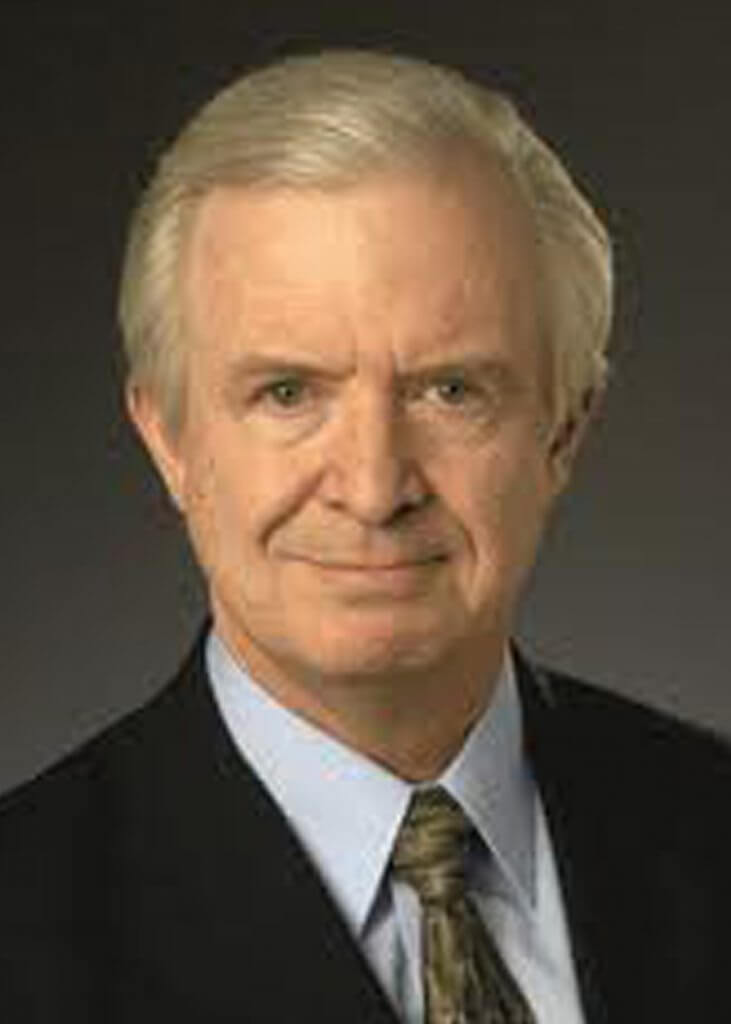
John J. Nance
American pilot and attorney
13
APPEARANCES
7
PODCASTS
Nov 17, 2026


Gio BenitezHOST
John, it is great to see you, but my goodness, what do you make of the nationwide ground stop that we saw and then the blame game that has followed?

John NanceGUEST
What we need to be figuring out here is precisely everything that happened in the exact sequence it happened, even down to nanoseconds, because what was presented to the people who control the air traffic control system was a conundrum, and they decided that they would go ahead and stop the airplanes from getting in the air.
John NanceGUEST
But it's very important to know whether or not they use the right reasoning, because it's going to happen again.
Gio BenitezHOST
John, the question I keep getting is, could something like this happen again? What do you say?
Gio BenitezHOST
John, it is great to see you, but my goodness, what do you make of the nationwide ground stop that we saw and then the blame game that has followed?
John NanceGUEST
yeah the blame game is useless absolutely a waste of everybody's time what we need to be figuring out here is precisely everything that happened in the exact sequence that happened even down down to nanoseconds because the what was presented to the people who control the uh air traffic control system uh was a conundrum and they decided that they would go ahead and stop the airplanes from getting in the air and that was the shutdown now was that right or wrong as far as blame is concerned nobody cares but it's very important to know whether or not they use the right reasoning because it's going to happen again and that i think is pretty clear
Gio BenitezHOST
john the question i keep getting is could something like this happen again what do you say
John NanceGUEST
i say yes it can and it's going to be that way for some time to come however the decisional capability in other words the criteria that they use in the master control center uh out in the washington area uh to say okay this has gone too far we need to put it on the ground or we need to stop the departures uh that is really subject to a lot of review again not for purposes of blame because that's useless but for purposes of knowing if they went down the right road and should they do it that way again this equipment is a patchwork quilt it's really uh very very regrettable the way things have been accreted into this system over time and that's why you really can't guarantee in any way that it's not going to happen again
DianeHOST
How vulnerable is this system if local problems like that can trigger these kinds of nationwide issues?
John NanceGUEST
Diane, if you look at it on the basis of understanding that this has been a patchwork quilt of a modernization here and there and a few tweaks over here and different software, et cetera, over the last number of decades, then you can realize how creaky it is and how vulnerable it is to having one single point failure cascade, if you will.
John NanceGUEST
we need a new system we have for a long long time and and i don't disagree with the idea that whatever number of billions of dollars we've got to put into it needs to be spent because you can see the incredible disruption as geo was talking about the the lives the money all the things that have been disrupted as a direct result of this totally unnecessary if we had a system that really coordinated itself perfectly
DianeHOST
Why does it take so long to recover from a shutdown like this?


Stephanie RamosHOST
Can you give us some insight into how that could overwhelm the air traffic control system?
John NanceGUEST
Well, basically what you're dealing with anytime you deal with air safety is an assessment of risk.
John NanceGUEST
And safety is provided by a situation where the whole system will not accept an acceleration of risk.
John NanceGUEST
There were a couple of things going on in terms of these servers and the routers that were not communicating properly, that were giving probably false signals on the radar.
Stephanie RamosHOST
So what should the priorities be when it comes to fixing this outdated system?

David MuirHOST
So just explain for those of us, including me, watching this unfold, if there is a communications issue, even for the flights that are currently in the air, then what happens then in the cockpit?
John NanceGUEST
In the cockpit, if you have a total blackout, so you're not talking to anybody, then you basically review where your flight plan says you're going to go, when you're going to come out of altitude, and you follow that.
John NanceGUEST
It's mostly unprecedented as far as normal aviation is concerned, but certainly all pilots in that environment know what to do.
John NanceGUEST
If there is some communication, and that's what I'm assuming here for the sake of argument, if there's some communication, then a lot of the information back and forth could be handed back and forth on other frequencies, and you'll get people started out at altitude when they're getting ready to descend.
John NanceGUEST
Well, it may be a piecemeal put together situation depending on what's working and what isn't.
John NanceGUEST
I'm having a hard time fathoming a situation in which the ARTCC, as it's called, Air Route Traffic Control Centers, are completely blanked out.

David MuirHOST
If there is a communications issue, even for the flights that are currently in the air, then what happens then in the cockpit?
John NanceGUEST
In the cockpit, if you have a total blackout, so you're not talking to anybody, then you basically review where your flight plan says you're going to go, when you're going to come out of altitude, and you follow that.
John NanceGUEST
It's mostly unprecedented as far as normal aviation is concerned, but Certainly all pilots in that environment know what to do.
John NanceGUEST
If there is some communication, and that's what I'm assuming here for the sake of argument, if there's some communication, then a lot of the information back and forth could be handed back and forth on other frequencies, and you'll get people started out at altitude when they're getting ready to descend.
John NanceGUEST
Well, it may be a piecemeal put together situation depending on what's working and what isn't.
John NanceGUEST
I'm having a hard time fathoming a situation in which the ARTCC, as it's called, Air Route Traffic Control Centers, are completely blanked out.
John NanceGUEST
You may pull the tail off, basically, and here we have some damage to the vertical fin, uh, the, uh, rudder, which you would not necessarily expect to see in a situation like this.
John NanceGUEST
But if this airplane came screaming out of the sky at some of the figures that, uh, that have been, uh, postured, which, uh, is up to mach one, uh, then the other question is how in the world would anybody be able to dish this airplane out successfully without hitting the ground? It...
John NanceGUEST
You're gonna have to have a lot of experience as a pilot, and it may be that the two guys in the back who are, were deadheading, uh, could have done that.
John NanceGUEST
But to start with, of course, the, uh, idea of inca- uh, incapa- pardon me, incapacitating the captain by stabbing him, uh, that seems a little bit, um, I don't know.

Lars LarsonHOST
Last issue, how can America safeguard itself? We're gonna have co- you know, armored cockpits, but what happens when one of the people in the cockpit may have decided to try to, to carry out a new 9/11? How do we safeguard against that?


Dan BonginoHOST
So we went in there and scrapped and throughout that entire thing and said, "Fellas, ladies, you better come back with a new model 'cause as you know," 'cause you probably saw a lot of this, "leadership sets the priorities" and the priorities were just all over the map.
John NanceGUEST
Well, I've said this a lot before at Townhall and in other places that the FBI is a... it's very much a top-down driven organization, right? And elections matter.
John NanceGUEST
So whoever's in the White House, uh, has a direct impact on, uh, the, the other, you know, functions of the executive apparatus, right? So, uh, whoever's in the White House determines who the attorney general is gonna be.
8 MINS LATER
speaker_16UNKNOWN
Very, very active physically and has always had a very sharp mind, a retired major general from the Air Force, PhD from MIT.

Nancy GraceHOST
It really doesn't take a rocket scientist, pardon my pun, to figure out something is way off with this story.
John NanceGUEST
Uh, the, the theories surrounding, you know, well, these people are, are committing suicide, it just, it just doesn't, uh, it just doesn't hold investigative water.
John NanceGUEST
There are a lot of unanswered questions, uh, especially in, um, Casias' uh, case.
John NanceGUEST
Uh, in fact, her husband said that, uh, part of her story was that she was going to return home to get her ID badge when, in fact, he saw her with the ID badge in the vehicle, so that makes no sense.
John NanceGUEST
And of course, as, as you've already mentioned, the, the, um, cell phones, the smartphones being, uh, reset to factory settings.

Nancy GraceHOST
How much time did we lose chasing down a false lead that was planted in a murder-kidnap case?
John NanceGUEST
Well, again, assuming that story is true, I mean, I don't know if you can calculate, uh, the, the, the actual, uh, time loss in terms of manpower, resources, uh, all of that type of investigative, uh, capability that was squandered following this false lead.
John NanceGUEST
And I would also add that just because no one has been formally, uh, charged or arrested, uh, doesn't invalidate the, the story either.
John NanceGUEST
It could be that, um, there, there isn't enough evidence [clears throat] to support, uh, a, a charge at this point with regard to planting false evidence.
22 MINS LATER
Nancy GraceHOST
At that scene, anyway, it really doesn't take a rocket scientist, pardon my pun, to figure out something is way off with this story.
John NanceGUEST
The theories surrounding, you know, while these people are committing suicide, it just doesn't hold investigative water.
John NanceGUEST
uh in fact her husband said that part of her story was that she was going to return home to get her id badge when in fact he saw her with the id badge in the vehicle so that makes no sense and of course as you've already mentioned the the cell phones the smartphones being reset to factory settings all these things indicate that she she didn't necessarily intend to take her life, but that she could have been in fear for her safety in some form or fashion and maybe was attempting to escape.
45 MINS LATER
John NanceGUEST
well taken in the aggregate i think it's undeniable that something nefarious is occurring and by the way we haven't really touched on this yet but there's historical perspective on this as well in the 1950s a number of scientists associated with the manhattan project disappeared, died under mysterious circumstances.
John NanceGUEST
Well, when you're talking about anti-gravity or field propulsion systems, you're, you're not really talking about pushing a craft through space.
John NanceGUEST
I'm sure there are other people that could address that in much more technical terms than, than I can.
John NanceGUEST
But essentially, a space-time bubble is created around the craft if such technology is actually available.
John NanceGUEST
And so you're actually moving, uh, warping, uh, space and time around the craft.

speaker_3HOST
If you've had a Bigfoot sighting and would like to be a guest, please go to mybigfootsighting.com and let me know.
John NanceGUEST
I ran over there to see the deer, and I was looking at it, and I thought, "Oh, man, I smell something awful." And, uh, then I realized the wind was to my back.
9 MINS LATER
speaker_7UNKNOWN
Centra, live every day.