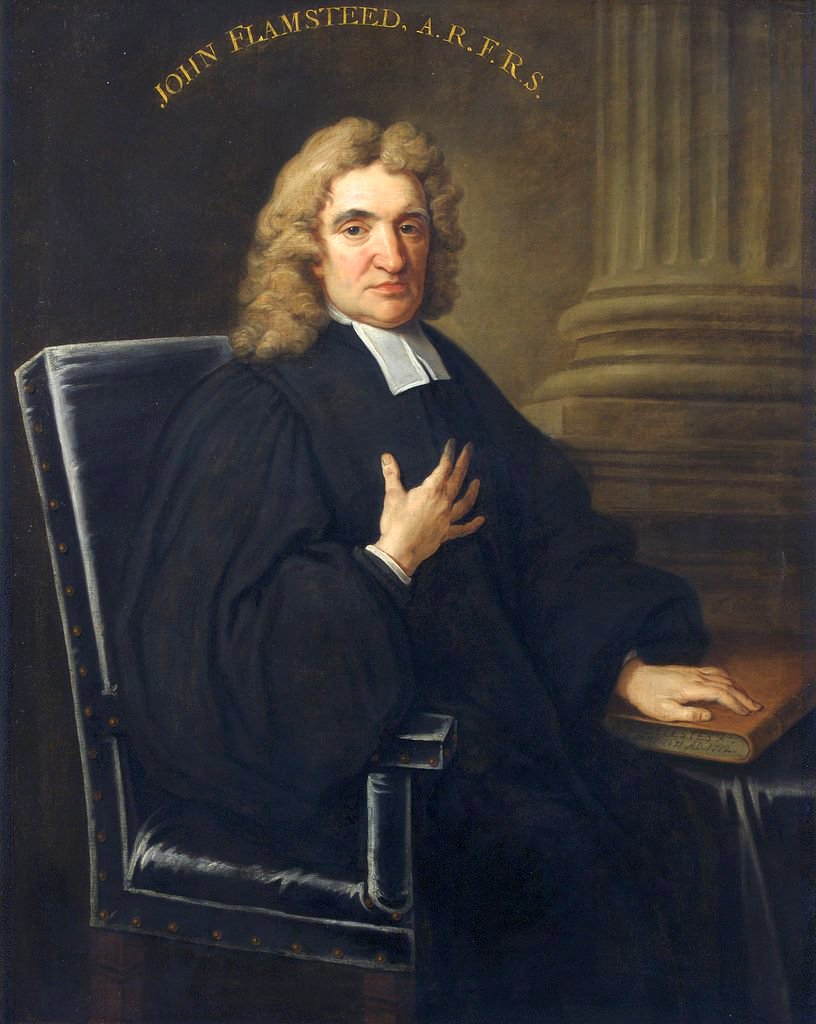
John Flamsteed
English astronomerWikipedia
8
MENTIONS
5
EPISODES
5
PODCASTS
Search complete. 8 mentions across 5 episodes found for "John Flamsteed".
Oct 10, 2026
Saturday Matinee: Short History Of…
J
20:32John HopkinsNARRATOR
The method depends on an enormous amount of precise astronomical data, and that data does not yet exist.
J
20:42John HopkinsNARRATOR
Among those consulted is British astronomer John Flamsteed, who argues that though the system is solid in theory, without far more accurate observations of the heavens, it just can't work.
J
20:54John HopkinsNARRATOR
And so in 1675, under the orders of King Charles II, the Royal Observatory Greenwich is established with a clear purpose of improving navigation by measuring the heavens.
J
21:07John HopkinsNARRATOR
Under Flamsteed, the first astronomer royal, they begin the painstaking work of mapping the stars.
J
23:09John HopkinsNARRATOR
It works, but it's not easy.
J
23:13John HopkinsNARRATOR
Worse still, the work required to make it practical takes decades.
J
23:19John HopkinsNARRATOR
John Flamsteed spends more than 40 years compiling the necessary observations with sufficient accuracy.
J
23:26John HopkinsNARRATOR
Others will continue the work after him, refining and expanding the data.
Episode 12: Cassiopeia - Cassiopeia vs Makeda
D
28:53DianaHOST
There is exactly one candidate.
D
28:56DianaHOST
John Flamsteed, the first Astronomer Royal of England, recorded a sixth magnitude star in approximately the right position in 1680.
D
29:06DianaHOST
He cataloged it as 3 Cassiopeia.
D
29:10DianaHOST
No star currently exists at that position.
History of England, from the Accession of James II - (Volume 1, Chapter 03)-Thomas Babington Macaulay
D
297:18Dilini JayasingheNARRATOR
No duty shrank from toil, peril, and exile in the cause of science.
D
297:23Dilini JayasingheNARRATOR
While he on the rock of St. Helena mapped the constellations of the southern hemisphere, our national observatory was rising at Greenwich, and John Flamsteed, the first Astronomer Royal, was commencing that long series of observations which is never mentioned without respect and gratitude in any part of the globe.
D
297:45Dilini JayasingheNARRATOR
But the glory of these men, eminent as they were, is cast into the shade by the transcendent lustre of one immortal name.
D
297:54Dilini JayasingheNARRATOR
In Isaac Newton, two kinds of intellectual power, which have little in common and which are not often found together in a very high degree of vigour, but which nevertheless are equally necessary in the most sublime departments of physics, were united as they have never been united before or since.
P
Unknown podcast
History of England, from the Accession of James II - (Volume 1, Chapter 03)-Thomas Babington Macaulay
Sep 28 · 1 Mention
D
284:46Delaney ChysinkNARRATOR
Nor did he shrink from toil, peril and exile in the cause of science.
D
284:51Delaney ChysinkNARRATOR
While he, on the rock of St. Helena, mapped the constellations of the southern hemisphere, our National Observatory was rising at Greenwich, and John Flamsteed, the first Astronomer Royal, was commencing that long series of observations which is never mentioned without respect and gratitude in any part of the globe.
D
285:13Delaney ChysinkNARRATOR
But the glory of these men, eminent as they were, is cast into the shade by the transcendent lustre of one immortal name.
D
285:22Delaney ChysinkNARRATOR
In Isaac Newton, two kinds of intellectual power, which have little in common and which are not often found together in a very high degree of vigor, but which nevertheless are equally necessary in the most sublime departments of physics, were united as they have never been united before or since.
P
Unknown podcast
Who Were the Druids? Rethinking Rome’s View of Celtic Priests
Sep 12 · 3 Mentions
S
9:08speaker_1UNKNOWN
Yet he was no solitary genius.
S
9:11speaker_1UNKNOWN
John Flamsteed's accurate star charts were indispensable to him, and James Bradley's observations later confirmed Newton's predictions about light and refraction.
S
9:22speaker_1UNKNOWN
Flamsteed himself founded Britain's first professional observatory at Greenwich in sixteen seventy-five, turning the Royal Society's astronomical ambitions into a tangible institution.
S
9:34speaker_1UNKNOWN
He built an array of brass instruments for precise measurements, which later helped Sir Isaac Newton compute the Earth's rotation and obliquity.
S
9:42speaker_1UNKNOWN
The observatory's data fed back to navigators, improving sea charts and the long-sought longitude solution, an endeavor that John Harrison would solve in seventeen sixty-one with his marine chronometer, a device so reliable it finally gave Britain unrivaled maritime supremacy.
S
10:36speaker_1UNKNOWN
Another notable member was Edmond Halley, who made a living on the seas before settling into academia.
S
10:42speaker_1UNKNOWN
In seventeen and five, he used Newtonian mechanics to predict the return of his eponymous comet, confirming that celestial bodies obeyed predictable laws rather than random divinity or caprice, a striking demonstration of the power of scientific reasoning.
S
10:58speaker_1UNKNOWN
He also held the post of Astronomer Royal after Flamsteed, and he was a key figure in early navigation theory that guided British ships across uncharted waters.