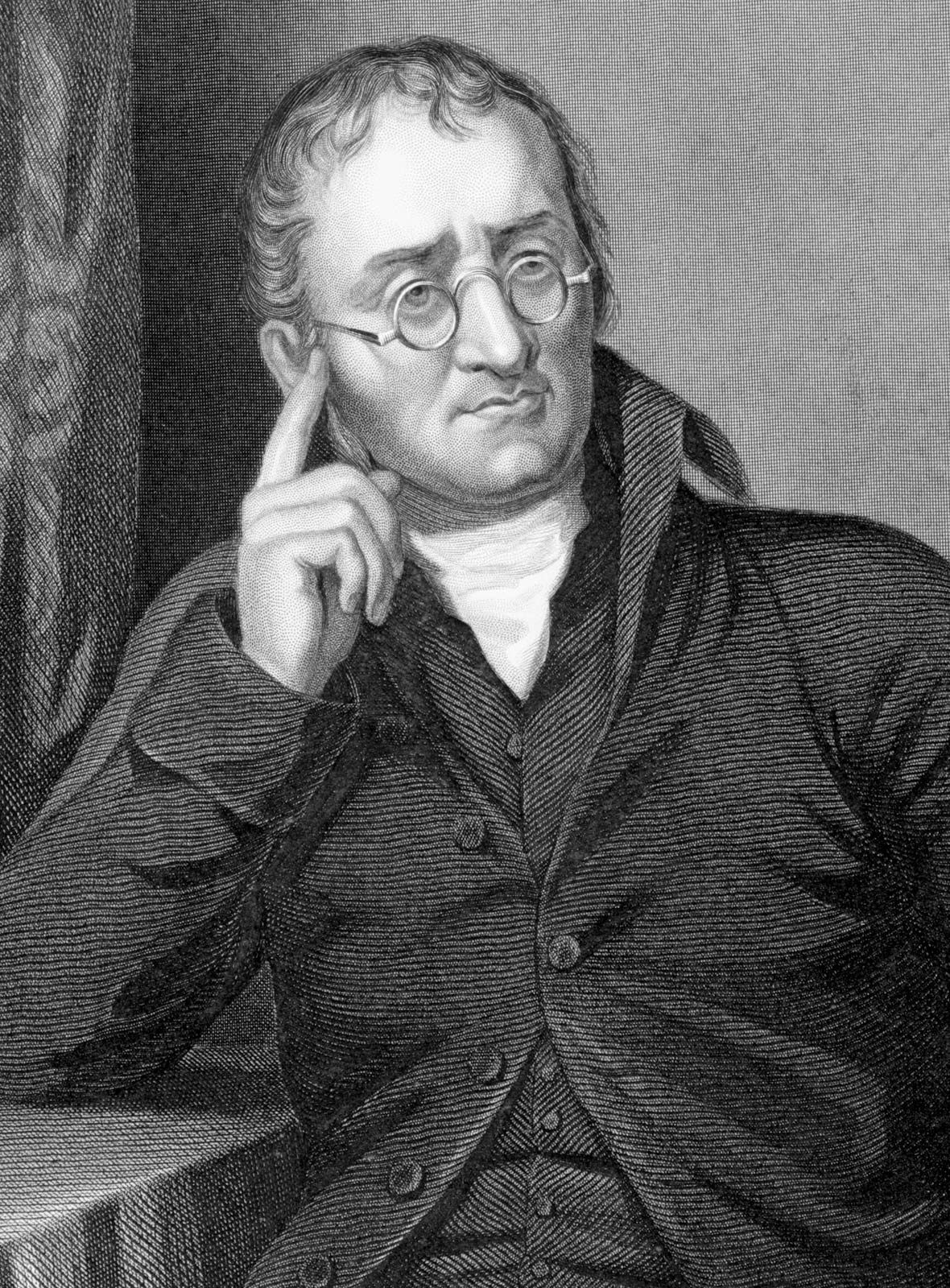
John Dalton
English chemist and physicistWikipedia
49
MENTIONS
20
EPISODES
15
PODCASTS
Search complete. 49 mentions across 20 episodes found for "John Dalton".
Oct 26, 2026

Dave FarinaHOST
Democritus, a Greek philosopher, was the first to propose that matter is comprised of fundamental, indivisible particles, which he called atomos.
Dave FarinaHOST
though this marks the first time matter was viewed in this way it was more of a philosophy than real science and no supporting evidence was gathered for a long time until John Dalton came along and provided the first empirical evidence that atoms exist he proposed that compounds consist of different types of atoms in whole number ratios and that chemical reactions involve the rearrangement of those atoms to give new combinations This idea explained certain observations.
Dave FarinaHOST
For example, when a sample of water was split into hydrogen and oxygen, the result was always one ninth hydrogen and eight ninths oxygen by mass.
Dave FarinaHOST
With atomic theory, this makes perfect sense if we understand that water is made up of tiny identical water molecules that all have the same exact number of hydrogen and oxygen atoms.
Dave FarinaHOST
then no matter how much water there is it will always have the same ratio of hydrogen to oxygen by number of atoms and therefore also by mass it also explained the way certain elements combined to form different compounds If carbon reacts completely with either a certain mass of oxygen or precisely double that mass of oxygen, that probably means every single carbon atom is bonding to either exactly one or exactly two oxygen atoms.
Dave FarinaHOST
This was the first solid evidence that atoms exist.
Dave FarinaHOST
However, we soon discovered that Dalton's atoms were not the fundamental, indivisible units of matter that Democritus envisioned.
Dave FarinaHOST
J.J. Thomson showed that the atom must consist of smaller particles when he discovered the electron.
Dave FarinaHOST
So it is factually true that atoms exist.
Dave FarinaHOST
But nevertheless, in the context of the history of science, the idea of atoms was a model that John Dalton used to explain things about the numerical ratios, different amounts of mass that are reacting and things like that.
Dave FarinaHOST
So they're models.
Dave FarinaHOST
They're constructs.

Laurie Ann WaldenNARRATOR
That theory is indeed nothing more than the elaboration of Lavoisier's own principle.
Laurie Ann WaldenNARRATOR
John Dalton, 1766-1844, a Manchester Quaker, published in eighteen ten his new system of chemical philosophy where highly important conclusions are drawn both from lavoisier's facts and from experimental results of other chemists of these dalton gave an account and an explanation which has ever since been the soul of all chemical reasoning this explanation is known as his atomic theory the two facts of which dalton's theory is an explanation are as follows first lavoisier's fact that the total weight of substances remains always the same be they combined in ever so many different ways second that all substances be they in large or in small quantities combine with each other or separate from each other in definite and fixed proportions the theory of dalton was that these combinations take place between independent particles of matter which are indestructible and indivisible These atoms of the various elements have definite weights which are responsible for the proportion in which they are found to combine.
Laurie Ann WaldenNARRATOR
These facts of proportion in combination, or chemical affinity, could not be accounted for by the theory which regards matter as continuous, but only by the opposite theory, that it is discrete, i.e., divided up into particles.
Laurie Ann WaldenNARRATOR
Philosophical Corollaries These strictly scientific theories associated with the name of Laplace, Lavoisier, and Dalton tended to strengthen in the popular estimation the philosophical conclusions of writers like Holbach.

Addison AndersonNARRATOR
Aristotle, for instance, disagreed completely, stating instead that matter was made of four elements, earth, wind, water, and fire, and most later scientists followed suit.
Addison AndersonNARRATOR
Atoms would remain all but forgotten until 1808, when a Quaker teacher named John Dalton sought to challenge Aristotelian theory.
Addison AndersonNARRATOR
Whereas Democritus' atomism had been purely theoretical, Dalton showed that common substances always broke down into the same elements in the same proportions.
Addison AndersonNARRATOR
He concluded that the various compounds were combinations of atoms of different elements, each of a particular size and mass, that could neither be created nor destroyed.
Addison AndersonNARRATOR
Though he received many honors for his work, as a Quaker, Dalton lived modestly until the end of his days.
Addison AndersonNARRATOR
Atomic theory was now accepted by the scientific community, but the next major advancement would not come until nearly a century later with the physicist J.J. Thomson's 1897 discovery of the electron.
Addison AndersonNARRATOR
In what we might call the chocolate chip cookie model of the atom, he showed atoms as uniformly packed spheres of positive matter filled with negatively charged electrons.

Blaine Aiden McCoyNARRATOR
It was not until 1808, however, that this atomic theory was really put on a firm foundation.
Blaine Aiden McCoyNARRATOR
In that year, the English chemist John Dalton, 1766 to 1844, published a book in which he discussed atoms in detail.
Blaine Aiden McCoyNARRATOR
Every element, he suggested, was made up of its own type of atoms.
Blaine Aiden McCoyNARRATOR
The atoms of one element were different from the atoms of every other element.
Blaine Aiden McCoyNARRATOR
The chief difference between the various atoms lay in their mass or weight.
Blaine Aiden McCoyNARRATOR
Dalton was the first to try to determine what these masses might be.
Blaine Aiden McCoyNARRATOR
He could not work out the actual masses in ounces or grams, for atoms were far too tiny to weigh with any of his instruments.
Blaine Aiden McCoyNARRATOR
He could, however, determine their relative weights, that is, how much more massive one kind of atom might be than another.

Jeevan MatharuHOST
A strong example comes from the development of atomic theory in physics.
Jeevan MatharuHOST
In the 19th century, John Dalton proposed that atoms were indivisible, solid particles, the fundamental building blocks of matter.
Jeevan MatharuHOST
However, it was later revised when J.J. Thompson discovered the electron, showing that atoms were not indivisible after all.
Jeevan MatharuHOST
Further developments by Ernest Rutherford and Niels Bohr revealed a structured atom with a nucleus and orbiting electrons.

Arvin AshHOST
This is a simple idea, but it laid the foundation for some of the greatest scientific discoveries that followed.
Arvin AshHOST
Fast forward to the early 19th century when John Dalton, an English chemist, took the idea further.
Arvin AshHOST
Dalton described atoms as small, hard spheres that were indivisible, with identical atoms for each element.
Arvin AshHOST
It was a step forward, but the idea of atoms being indivisible wouldn't hold up for long.
Arvin AshHOST
In the late 1800s, J.J. Thompson discovered something shocking.
Dave FarinaHOST
It's an interesting snapshot.
Dave FarinaHOST
It's like going back to John Dalton or something, and wow, he's figuring out how to prove that atoms exist and things like that.
Dave FarinaHOST
But it's like...
Dave FarinaHOST
You're trying to attack modern evolutionary biology by looking at ancient history at this point, right? Darwin would have no idea what's going on.
10 more episodes mention John Dalton.
Create an account to see the whole feed, search across every transcript, and follow the entities you care about.