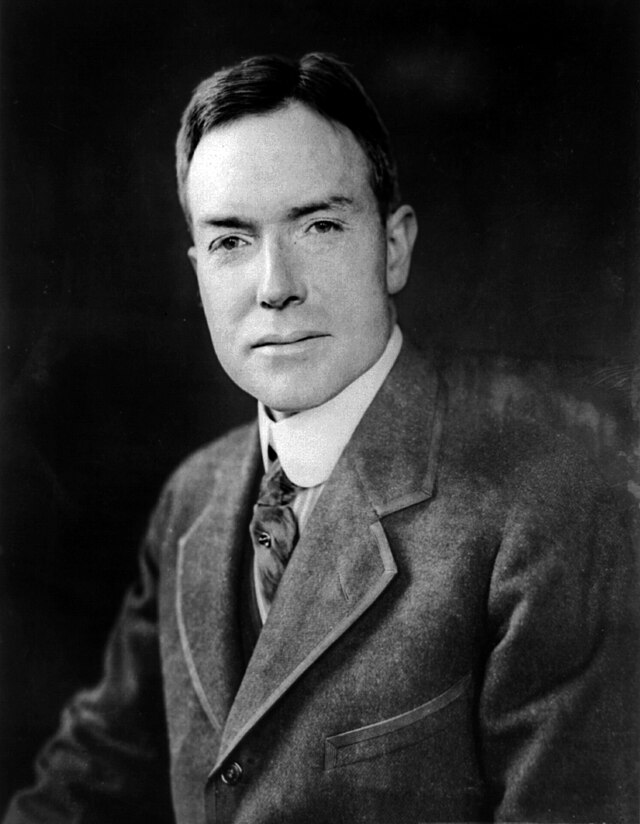
John D. Rockefeller Jr.
American financier ‧ John D. Rockefeller's sonWikipedia
56
MENTIONS
17
EPISODES
17
PODCASTS
Search complete. 56 mentions across 17 episodes found for "John D. Rockefeller Jr.".
Oct 21, 2026

Roland RamblerHOST
Sitting idle among the combustion engines, I had ample occasion to survey the valley and appreciate the sheer geographic mathematics of its real estate.
Roland RamblerHOST
Jackson Hole generally encompasses the broad valley and satellite hamlets like Moose, Teton Village and Wilson, and it owes its current layout to the grand, secretive land purchases of John D. Rockefeller Jr.
Roland RamblerHOST
A century ago, he quietly acquired vast tracts to protect the dramatic views of the Teton Range from commercial sprawl.
Roland RamblerHOST
He succeeded immensely, ensuring that roughly 97% of Teton County remains untamed public land today.
8 MINS LATER
Roland RamblerHOST
Long before monetary policy dominated the agenda, Jackson Lake Lodge had already established a reputation for high-stakes diplomacy.
Roland RamblerHOST
In 1989, Secretary of State James Baker and Soviet Foreign Minister Eduard Shevardnadze bypassed the grand palaces of Europe to sign a historic treaty in the lodge carpenter shop at a wooden desk known ever since as the Peace Table.
Roland RamblerHOST
Back in our hotel room in Jackson, looking out at the freezing rain on the pavement, I started reading up on the history of Jackson Hole, specifically John D. Rockefeller Jr.'s role in shaping the landscape outside.
Roland RamblerHOST
Rockefeller lived with the paradox of his family's Standard Oil legacy, a fortune built on ruthless monopoly that he channeled into massive civic and conservation projects.

GuyHOST
And you can see both outcomes in some of America's most famous family fortunes.
GuyHOST
John D. Rockefeller Jr. locked his family's money into irrevocable trusts in 1934, and that family has kept billions intact across hundreds of members ever since.
GuyHOST
By contrast, Cornelius Vanderbilt left 95% of his estate to one son and four grandsons with no trusts and no restrictions whatsoever, purely on faith in their judgment.
GuyHOST
His son actually doubled it past $200 million by 1885.
GuyHOST
But the generations after that, the ones handed money they didn't work for and couldn't explain, converted it into mansions and divorces and eventually nothing.
GuyHOST
So that's just to say that you need to pass down that market wisdom too while you're here.
GuyHOST
And that goes for everyone, not just the Rockefellers and Vanderbilts of this world.
GuyHOST
The people who lose fortunes in crypto lose them to impatience, chasing dead narratives, oversized positions, or failing to put the structures in place that really secure the wealth over time.

Rob WestHOST
Just don't ask wealth to tell you who you are.
Rob WestHOST
As John D. Rockefeller Jr. once put it, "The poorest man I know is the man who has nothing but money." Wealth makes a poor identity.
Rob WestHOST
But to be known by God, to belong to Christ, to have your life hidden with him, that's a treasure no financial loss can touch and no amount of money could ever buy.
Rob WestHOST
I hope that's encouraging to you today.

Rob WestHOST
Just don't ask wealth to tell you who you are.
Rob WestHOST
As John D. Rockefeller Jr. once put it, "The poorest man I know is the man who has nothing but money." Wealth makes a poor identity.
Rob WestHOST
But to be known by God, to belong to Christ, to have your life hidden with Him, that's a treasure no financial loss can touch and no amount of money could ever buy.
Rob WestHOST
I hope that's encouraging to you today.

Chris TerrillNARRATOR
Why? Well, because of a reverend and a Rockefeller.
Chris TerrillNARRATOR
Yep, in the 1920s, Reverend Goodwin of Williamsburg convinced John D. Rockefeller Jr. to help preserve the heritage of Colonial Williamsburg.
Chris TerrillNARRATOR
So plans were made to create this one-of-a-kind, unique, open-air outdoor living history museum.
Chris TerrillNARRATOR
About 500 buildings have been restored or recreated, all centered along Duke of Gloucester Street, which was the original main street of Williamsburg.

Bill WilsonSOUNDBITE_SPEAKER
So well on its way.
Bill WilsonSOUNDBITE_SPEAKER
And it seems to me that somehow he was tied up with the Rockefeller family and their charity.
Bill WilsonSOUNDBITE_SPEAKER
and if you want to we'll call up the Rockefeller offices and see if there is such a man and if there is is
Bill WilsonSOUNDBITE_SPEAKER
he
Bill WilsonSOUNDBITE_SPEAKER
alive
Bill WilsonSOUNDBITE_SPEAKER
and will he see us would
Bill WilsonSOUNDBITE_SPEAKER
you like me
Bill WilsonSOUNDBITE_SPEAKER
to do that well I haven't tried the Rockefeller offices so I said well sure give him a

Rebecca ShoreHOST
"My dad gave the eulogy at Owney's funeral." That was in 1965, and two years later, the long and immensely profitable era of illegal gambling came to an end.
Rebecca ShoreHOST
A new governor, Winthrop Rockefeller, son of philanthropist John D. Rockefeller Junior and brother of New York Governor Nelson Rockefeller, took office.
Rebecca ShoreHOST
Though he'd reportedly promised Hurst Senior and many other legislators that he would sign a bill legalizing gambling, he then broke his word and vetoed the bill.
Rebecca ShoreHOST
Soon afterward, the state police raided all the gambling clubs and casinos in Hot Springs.

Greg KoabelHOST
Like many other politicians before and since, King had no trouble finding lucrative work in the private sector.
Greg KoabelHOST
His reputation as an expert on labor relations brought him to the attention of industrialist John D. Rockefeller Jr. Rockefeller managed the empire built by his father, Rockefeller Sr., who, although retired, still actively managed his investment portfolio and was the richest man in the United States The sprawling Rockefeller empire included everything from oil to railways to mining and medical research.
Greg KoabelHOST
But as powerful as the Rockefellers were, John Jr. faced a serious public relations problem.
Greg KoabelHOST
As in Canada, there was growing popular resentment in the United States directed at the barons who exercised monopoly power over certain industries.
7 MINS LATER
Greg KoabelHOST
The Liberals were divided between Laurier loyalists and Union defectors looking to return to the fold, between Western farmers seeking free trade and established Montreal industrialists married to the protectionist tariff, and between anglophone imperialists in the West and the party's empire-skeptic base in Quebec.
Greg KoabelHOST
Considering the multiple fissures within the party, Defoe found himself asking, Will the resulting party be anything more than an organized hypocrisy dedicated to getting and holding office? He was especially unimpressed by William Lyon Mackenzie King's candidacy.
Greg KoabelHOST
King would do well to go back to working for John D. Rockefeller, Defoe wrote.
Greg KoabelHOST
There is no future for him in Canada.

Tanisha FordGUEST
cities and most states in the country.
Tanisha FordGUEST
So it was, you know, these stories about the beguiling Molly Moon and the playboy, you know, maverick son of John D. Rockefeller Jr. that really added a certain kind of spice to these stories about the fundraising.
Tanisha FordGUEST
So I wanted to chronicle all of that and to imagine what it would be like for for an African-American woman like Molly Moon to endure so much.
Tanisha FordGUEST
And I think that the reason why she did it was in part because, let's just be clear, she did have a penchant for the glamour of it all and the celebrity of it all, but she also had a deep commitment to racial justice.
7 more episodes mention John D. Rockefeller Jr..
Create an account to see the whole feed, search across every transcript, and follow the entities you care about.