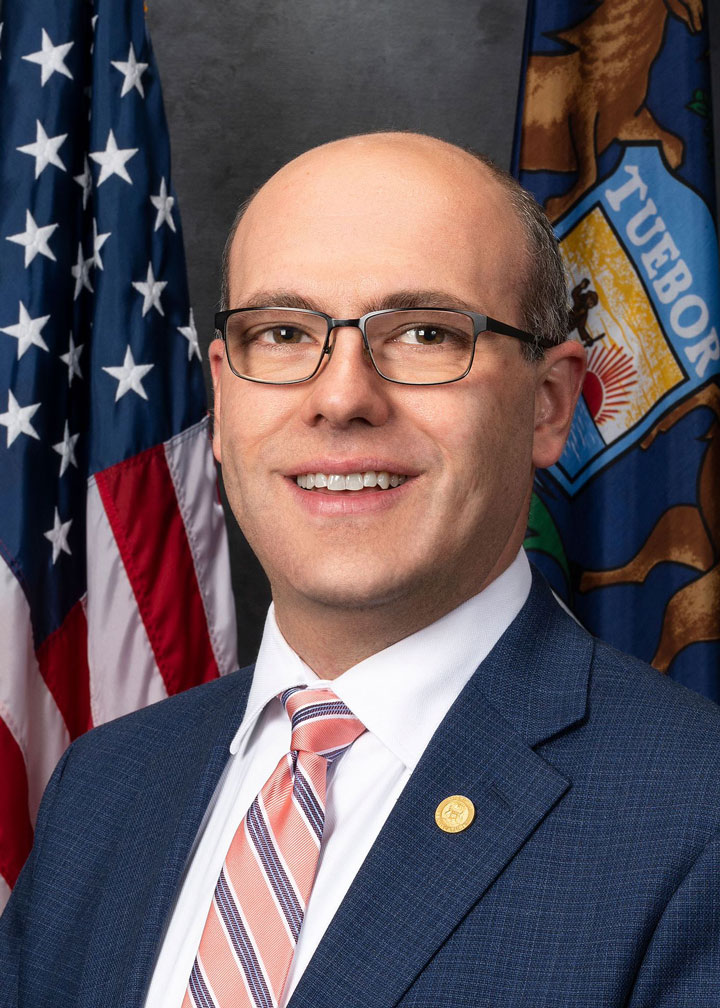
John Cherry
Member of the Michigan Senate
5
APPEARANCES
5
PODCASTS
Jul 17, 2026

speaker_0HOST
As Groundswell's own founders, John and Joanna Cherry, told Patrick on the festival's 10th anniversary, it's the exact fight they've built the whole thing to avoid.
John CherryGUEST
I think at the time people suspected that it was no-till versus, everything was versus something, versus organic, or that somehow there was going to be a different tribe.
John CherryGUEST
Anyway, what we want to do is persuade people who are already farming conventionally not shaming them into thinking they're doing it wrong.


1:48
When you started all those years ago, did you think it would end up being as big and as important to the industry as it is now? No,
John CherryGUEST
There's a bloke called No-Till Bill from Australia, No-Till Bill, and he was over here doing something, and I got him round and we were in the pub talking, and we had a run-up to cereals, and he said... why doesn't cereals have a no-till section? And it was, you know, and he'd managed to convert most of Western Australia to farm in this no-till way.
John CherryGUEST
And he rang up cereals and said, why haven't you got a no-till section? And it's kind of just, he thought, yeah, maybe we can take cereals on and do a kind of no-till version.


1:48
When you started all those years ago, did you think it would end up being as big and as important to the industry as it is now? No,
John CherryGUEST
There's a bloke called No-Till Bill from Australia, No-Till Bill, and he was over here doing something, and I got him round and we were in the pub talking, and we had a run-up to cereals, and he said... why doesn't cereals have a no-till section? And it was, you know, and he'd managed to convert most of Western Australia to farm in this no-till way.
John CherryGUEST
And he rang up cereals and said, why haven't you got a no-till section? And it's kind of just, he thought, yeah, maybe we can take cereals on and do a kind of no-till version.

speaker_7NARRATOR
He's the deputy chief medical officer at the Australian Antarctic Division.
John CherryGUEST
So I've had a, a couple of opportunities to work in Antarctica, uh, on the ground, uh, both for summer seasons and a winter season, where you're physically isolated for up to nine months of the year, where, uh, you know, if something goes wrong, you can't get in or out.
John CherryGUEST
So I mentioned the, the winter isolation, nine months of physical isolation over winter.
John CherryGUEST
Uh, i- in order to support that, we have a pretty unique medical model internationally, which is a, a generalist, uh, medical model where we have a, a generalist doctor at each station who's provides generalist medical, surgical, anesthetic, and dental care of their expeditionary team.
John CherryGUEST
But they also, you know, uh, collect the blood and, and, and run the blood tests with the point-of-care testing devices that we have.
John CherryGUEST
Uh, they a- are trained on how to take, uh, x-rays, uh, and, uh, medical imaging.
speaker_7NARRATOR
The studies that have been run out of the Australian Antarctic Program test things like cognition, fatigue, metabolic health, and medical measurement in tough conditions.


Trevor HallHOST
But what were those key factors that drove these partners to step in at that stage? And how does this kind of structure the position of Perpetual for the next phase of construction and development?
John CherryGUEST
So yeah, financing is obviously a critical part of the project, right? So we need to raise the money to build this.
John CherryGUEST
So I'll talk about the big picture financing, kind of come back to these most recent investments.
John CherryGUEST
So this past spring, this past February, actually, we put out a updated project economics study, where it looks like it's about $2.2 billion to build the project.
John CherryGUEST
So Over the last several months, we have gone out and raised over $700 million in equity, and the most recent rounds being the Agnico and the JP Morgan investments have come in.
John CherryGUEST
In parallel with that, we're in the process of working on a $2 billion financing package with the U.S. Export-Import Bank.
15 MINS LATER
Trevor HallHOST
Are we starting to see sentiment kind of shift towards the need to resupply minerals, provide economic jobs with resource development? You know, How do you express that sentiment shift or have you seen a sentiment shift? I think it's something