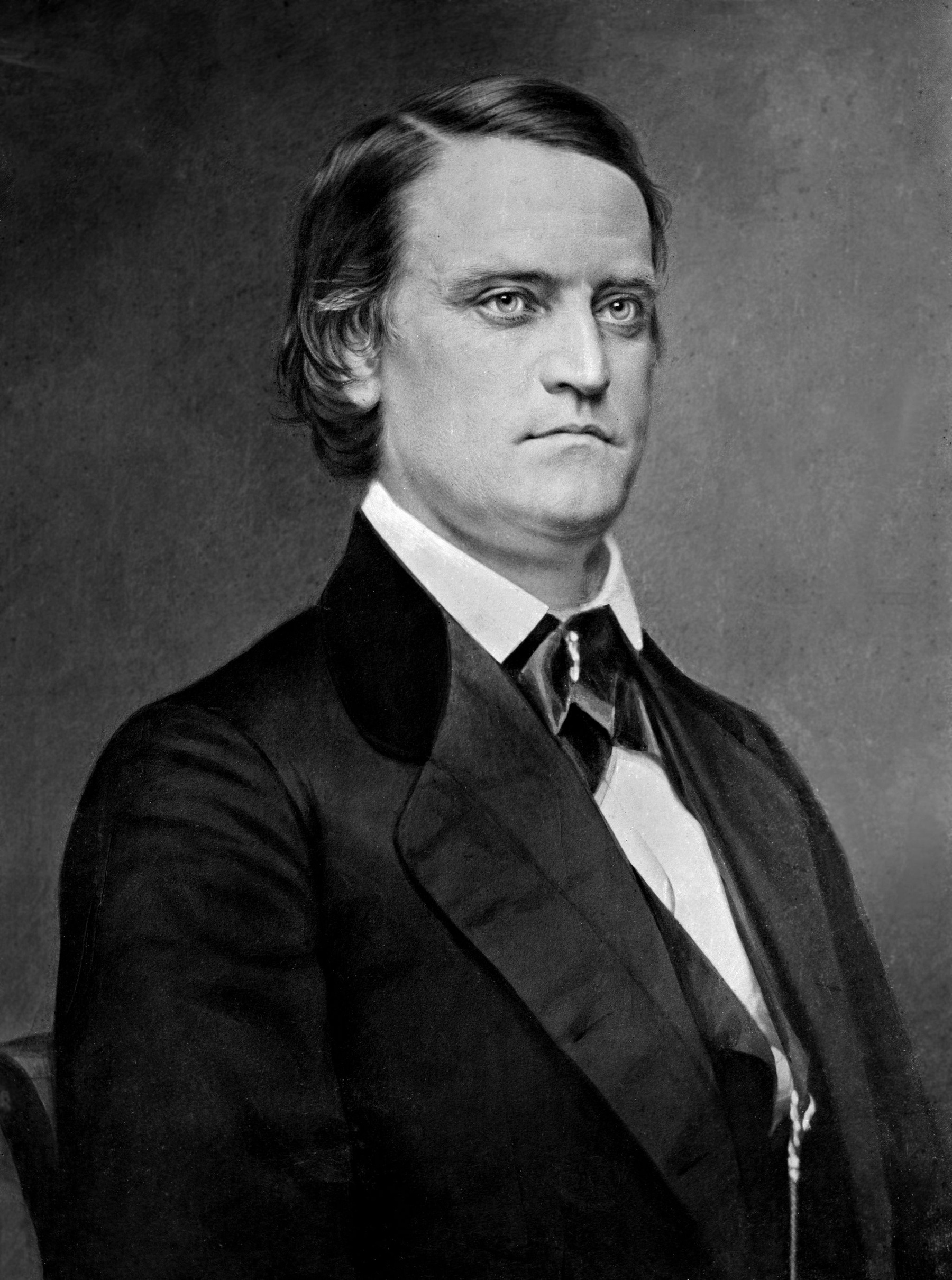
John C. Breckinridge
Former Vice President of the United StatesWikipedia
30
MENTIONS
15
EPISODES
15
PODCASTS
Search complete. 30 mentions across 15 episodes found for "John C. Breckinridge".
Nov 6, 2026

MBHOST
You know, something tells me the NFL can afford it.
MBHOST
Today's highlight in history, this date in 1860, former Illinois Congressman Abraham Lincoln of the Republican Party was elected president of the United States as he defeated John Breckinridge, John Bell, and Stephen Douglas.
MBHOST
Sally Field is 80 today.
MBHOST
Mama says.

Mark BaileyHOST
But first, as we always do, Let us tell you about what this day has meant and what it means, at least to some people.
Mark BaileyHOST
This day in 1860, former Illinois Congressman Abraham Lincoln of the Republican Party elected President of the United States and defeated John Breckinridge, John Bell, and Stephen Douglas.
Mark BaileyHOST
1861, James Naismith, the inventor of basketball, was born in Almonte, Ontario, Canada.
Mark BaileyHOST
In 1888, Republican presidential candidate Benjamin Harrison won the electoral vote over incumbent Democrat Grover Cleveland.

JosieHOST
Tune in to hear all the obituaries from this week during Journal Gazette Obituaries Review Sundays at 12 p.m. and 6 p.m. and Mondays at 3 a.m. We will now read the weekender section from the Friday, November 6th Journal-Gazette, beginning with Today in History.
JosieHOST
On November 6th, 1860, former Illinois Congressman Abraham Lincoln of the Republican Party was elected President of the United States as he defeated John Breckinridge, John Bell, and Stephen Douglas.
JosieHOST
In 1861, an unopposed Jefferson Davis was elected to a six-year term as president of the Confederate States of America after serving much of the year as its provisional president.
JosieHOST
In 1888, Republican presidential candidate Benjamin Harrison won the electoral vote over incumbent Democrat Grover Cleveland, despite Cleveland gaining 90,000 more total votes.

Toby GibbsCORRESPONDENT
Lincoln won the presidency on November 6, 1860 in a four-way race.
Toby GibbsCORRESPONDENT
He defeated Democrat Stephen Douglas, Southern Democrat John C. Breckinridge of Kentucky, and Constitutional Union candidate John Bell.
Toby GibbsCORRESPONDENT
On November 8, 1955, Kentucky voters approved a state constitutional amendment to lower the voting age from 21 to 18.
Toby GibbsCORRESPONDENT
16 years before a federal amendment did the same thing nationally.

Finn J.D. JohnHOST
Good morning, Oregon.
Finn J.D. JohnHOST
I'm Finn J.D. John, FJ at OffBeatOregon.com, and this is the daily OffBeat Oregon History Podcast.
Finn J.D. JohnHOST
Thanks for downloading, and I sure hope you enjoy the show today.
Finn J.D. JohnHOST
This story was first published on December 21st of 2014.
Finn J.D. JohnHOST
But for some of the delegates, Douglass wasn't extreme enough on the slavery question.
Finn J.D. JohnHOST
They wanted an outright pro-slavery candidate, and they wanted one badly enough that they walked out of the nominating convention after it became clear that Douglass would win and formed their own party, the Constitutional Democrats, also known as the Southern Democrats.
Finn J.D. JohnHOST
Then they nominated their own ticket for the big house, John Breckinridge of Kentucky for president and Joseph Lane of our fair state for vice.
Finn J.D. JohnHOST
So far so uneventful from a constitutional standpoint.

Katie GibneyNARRATOR
The division into two irreconcilable factions was unchanged.
Katie GibneyNARRATOR
uncompromising delegates from the South withdrew to Richmond, nominating John C. Breckinridge of Kentucky for president, and put forth a platform asserting the rights of slave owners in the territories and the duty of the federal government to protect them.
Katie GibneyNARRATOR
The delegates who remained at Baltimore nominated Douglass and endorsed his doctrine of squatter sovereignty.
Katie GibneyNARRATOR
THE CONSTITUTIONAL UNION PARTY while the democratic party was being disrupted a fragment of the former whig party known as the constitutional unionists held a convention at baltimore and selected national candidates john bell from tennessee and edward everett from massachusetts a melancholy interest attached to this assembly it was mainly composed of old men whose political views were those of clay and webster cherished leaders now dead and gone in their platform they sought to exercise the evil spirit of partisanship by inviting their fellow-citizens to support the constitution of the country the union of the states and the enforcement of the laws The party that campaigned on this grand sentiment only drew laughter from the Democrats and derision from the Republicans, and polled less than one-fourth the votes.

DangHOST
Okay.
BangHOST
He supported John C. Breckinridge, who was a Southern Democrat candidate in the 1860 election.
BangHOST
But after old Abe won, Morgan wrote to his brother Thomas that he hoped Kentucky would stay in the Union.
BangHOST
He said Lincoln ought to be given a fair trial as president.

Brandon B.NARRATOR
firmly resolved that freedom should henceforth spread her aegis over the whole country, and slavery be left to remain as the makers of the Constitution intended, in the states then already cursed by its baneful presence.
Brandon B.NARRATOR
The result of the ensuing election, of November 6th, 1860, was that Mr. Lincoln received 491,275 over Mr. Douglas, 1,018,499 over Mr. Breckinridge, and 1,275,821 over Mr.
Brandon B.NARRATOR
Bell.
Brandon B.NARRATOR
And the electoral vote, subsequently proclaimed by Congress, was, for Abraham Lincoln of Illinois, 180, for John C. Breckinridge of Kentucky, 72, for John Bell of Tennessee, 39, for Stephen A. Douglas of Illinois, 12.
Brandon B.NARRATOR
The following states cast their electoral votes for Mr. Lincoln.
Brandon B.NARRATOR
The intention of the American people in electing Abraham Lincoln to be their chief magistrate was to restrict the extension of slavery in the territories and to abrogate its political power which had threatened to become perpetual the consequences of that election have been widely different from what was anticipated Possibly the people of the north would have permitted themselves to be governed by their apprehensions rather than their sentiments, had they foreseen that the insanity of their southern brethren would culminate in the terrible conflict which devastated the land.
9 MINS LATER
Brandon B.NARRATOR
In short, the news of Mr. Lincoln's election was not a month old before the spirit of secession in South Carolina, the hotbed of treason ever since the promulgation of the federal constitution, began to assume proportions most startling to the loyal people of the land.
Brandon B.NARRATOR
Mr. Douglas had been the favorite of the Democratic Convention which had originally assembled at Charleston.

Peter SlinnHOST
1860.
Peter SlinnHOST
OK. Abraham Lincoln versus Stephen Douglas versus John Breckinridge versus John Bell.
Peter SlinnHOST
You write in the book that by the 1850s, the American experiment was in grave jeopardy, economic interests competing with moral beliefs.
Dana BashGUEST
What
Peter SlinnHOST
So Abraham Lincoln ended up with 180 electoral votes.
Peter SlinnHOST
He won 18 states, all the northern states.
Peter SlinnHOST
John Breckinridge had 72 electoral votes.
Peter SlinnHOST
John Bell, 39.

Lynn ThompsonNARRATOR
Grant's total strength was over 100,000 men, but less than 50,000 were actually engaged in the struggle.
Lynn ThompsonNARRATOR
Lee now had A.P. Hill, supported by Breckenridge, on his south flank next to the Chickahominy, opposite Hancock and Wright.
Lynn ThompsonNARRATOR
hoke's division straddled the cold harbor road with gen joseph kershaw's division just north of hoke then anderson and gen richard ewell's corps these total strength consisted of less than sixty thousand men but only about half were involved in the action of june three it rained all night the night of june two toward morning the heavy rain died to a soft sticky mist that held the area in clammy fingers the first gray streaks of dawn warned of the approach of a scorching sun that would turn the rain-soaked plain with its myriad streams and swamps into a steaming cauldron promptly at four thirty the three corps jumped off to the attack knowing nothing of the strength of the confederate positions they would have to face the corps commanders had ignored grant's telegraphed order of the previous afternoon and no proper reconnaissance was made the average soldier saw little in any battle in the civil war and even less at cold harbor because of the terrain but as the first yellow rays of the sun shifted the gray mists most of the union soldiers could see the main line of confederate intrenchments across the open spaces in front of them a tracing of raw earth that had been turned up like a huge furrow along a line of uneven ridges looking empty but strangely ominous here and there bright regimental colors perched insolently on the dirt hills suddenly it seemed the line was dotted with black slouch hats and glistening bayonets yellow sheets of flame flashed from end to end then disappeared in a heavy cloud of smoke regiment after regiment exploded into action with a metallic roar gigantic crashes of artillery split the air shells screamed overhead like a pack of banshees exploding in clouds of earth horses and men the noise roared to a crescendo with a volume of sound that left the men dazed and confused one veteran said it was more like a volcanic blast than a battle it was over in less than thirty minutes but seven thousand killed and wounded union soldiers were left lying in the sun between the trenches said one general sadly in that little period more men fell bleeding as they advanced than in any other like period of time throughout the war those not already killed or wounded threw themselves on the ground and desperately heaved up little mounds of earth in front of them with bayonets spoons cups and broken canteens they could neither advance nor retreat nothing standing could live long in that hail of lead and iron they just dug in and stayed there a peculiar thing about the battle came to light afterwards the three corps commanders sent identical telegrams to grant's headquarters each accusing the other of not supporting him in the attack later it was discovered what had actually happened hancock on the left had veered to his left because of the heavy fire from there and the peculiarities of the terrain wright in the center had gone straight ahead and smith on the right bore off to his right because of swamps and ravines so the farther they advanced the more separated they became and the more their flanks were left open to a deadly cross-fire no other major assault was attempted by either army although the troops stayed in the hot filthy trenches until june twelfth with constant nerve-racking sharpshooting and skirmishing from june one to twelve the union losses totaled twelve thousand seven hundred confederate losses were estimated at between one thousand five hundred and two thousand cold harbor proved to be lee's last major victory in the field and although it was a military zero so far as grant was concerned it turned out to be one of the most important and significant battles fought during the civil war the results of this battle changed the course of the war in the east from a war of maneuver to a war of siege it also influenced the strategy and tactics of future wars by showing that well selected well-manned intrenchments adequately supported by artillery were practically impregnable to frontal assaults on june five grant decided to bypass richmond cross the james and attack petersburg an important railway center twenty-five miles south of the confederate capital this would still keep lee's army pinned down and if successful would cut communications between richmond and the rest of the confederacy on june sixth he withdrew warren's five corps from the lines and used it to secure the passages across the chickahominy and down to the james on june seventh he sent sheridan with two divisions of cavalry back into the shenandoah valley against early to counter this lee was forced to send general wade hampton's cavalry after sheridan which in effect left lee without adequate cavalry during the night of june twelfth grant secretly moved all the troops out of the trenches at cold harbor without lee's being aware of the move until the following morning and by june sixteenth the army of the potomac of over a hundred thousand men five thousand wagons two thousand eight hundred head of cattle and twenty five thousand horses and mules were all safely across the james river richmond was saved for another ten months fort harrison in the predawn darkness of september twenty ninth grant quietly slipped general david burney's xth corps and general edward orde's eighteenth corps back across the james in a surprise move against the outer defenses of richmond the primary purpose was to prevent lee from reinforcing early in the shenandoah valley if however any weakness was discovered it could be exploited fully and it might force lee to weaken some part of the petersburg line shortly after daybreak general george stannard's division of the eighteenth corps successfully stormed heavily armed but badly undermanned fort harrison on the varina road general hiram burnham commanding the leading brigade was killed in the assault and the union forces renamed the captured fort foriam a mile and a half farther north general adalbert ames's division of the xth corps was repulsed in a similar attack on another fortification fort gilmer on the new market road general lee regarded the loss of fort harrison as serious enough to demand his personal attention the next day with reinforcements rushed from petersburg he directed several vigorous assaults against the fort however the union forces had closed in the rear and strengthened it and armed with new repeating rifles successfully beat back the attacks and inflicted heavy losses on the confederates the fall of fort harrison forced lee to draw back that part of his outer line and to build new intrenchments to compensate for the loss it also forced him to extend his line north of the james thus weakening his already dangerously undermanned defences in front of petersburg the union forces to protect their position further and to neutralize confederate gunboats constructed fort brady a few miles south of fort burnham harrison on a high bluff overlooking the james river no further serious efforts were made to enter richmond from the north side of the james and the two armies faced each other in these respective positions until grant finally broke lee's lines at petersburg on april one eighteen sixty five forcing the confederates to abandon richmond section v of richmond national battlefield park virginia by joseph p collin the final struggle for richmond eighteen sixty four sixty five section v richmond falls spring came gently to richmond that year of eighteen sixty five the winter had been long and hard after a cold wet march sunday april second dawned mild and pleasant the green buds on the trees and the bright new grass put the breath of seed-time in the air sap flowed warm in the lilac and the magnolia under a rich blue sky the people strolled leisurely to church amid the cheerful music of the bells and the soft murmur of the james river falls in st paul's episcopal church at the corner of ninth and grace streets jefferson davis sat in the family pew listening to the sermon the sexton walked up the aisle and handed him a message from general lee i advise that all preparation be made for leaving richmond to-night davis arose quietly and left the church walked a block down ninth street to his office in the war department and gave the necessary orders for evacuation late in the afternoon the official order was posted then pandemonium reigned trunks boxes bundles of every description were piled on the sidewalks and in the streets wagons carts buggies anything that had wheels and could move were loaded and raced through the city to fight their way across mayo's bridge in the mad rush to cross the james and flee south a frantic mob trampled each other without mercy and jammed the streets leading to the railroad stations only to be turned back by soldiers bayonets the few trains that would manage to leave were reserved for government officials archives the treasury and military personnel early in the evening the character of the crowds began to change from a city of less than thirty-eight thousand before the war richmond now had over a hundred thousand people jammed into every available nook and cranny they had come by the thousands to work for the various government departments and in the munitions factories refugees from the many battles fought in virginia had poured in as well as the sick and wounded followed inevitably by deserters spies criminals gamblers speculators and derelicts of every kind and now the cheap hotels saloons and gambling dens began to empty their customers into the streets many of them half drunk all semblance of law and order disappeared when the guards at the state penitentiary fled the prisoners broke loose to roam the city at will the provost guard took the prisoners of war from libby prison down the river to be exchanged this left only the local defense brigade consisting of government and munitions workers but most of them were required in government buildings to pack and burn records some guarded the railroad depots while others were engaged in destruction assignments the order had been given to burn all tobacco and cotton that could not be removed by tossing flaming balls of tar into the warehouses along the river front in the meantime mayor mayo and the city council had appointed a committee in each ward to see that all liquor was destroyed and shortly after midnight they set to work casks and barrels of the finest southern bourbons were rolled to the curbs the tops smashed open and left to drain like flies around honey the mobs swarmed and fought their way into the streets where the whisky flowed like water men women and children clawing and screaming scooped it up with bare hands or used pails cups basins bottles anything that would hold the amber liquid they used rags on sticks dipped in whisky for torches and went howling through the city in search of food and plunder like a pack of mad wolves looting killing burning the soft night sky became pink then turned a dull red the blaze from the chaco warehouse at thirteenth and cary streets where ten thousand hogsheads of tobacco was put to the torch flew skyward as if shot from a huge blow-torch the flames quickly spread to the franklin paper mills and the gallejo flour mills ten stories high higher and higher they soared and then widened until it seemed a red-hot sea of fire would engulf the whole city a faint hot breeze began to stir from the southeast scattering burning embers through the streets and alleys and houses powder magazines and arsenals let go with a whooshing boom thousands of bullets and shells tore through buildings and plowed up the streets shells exploded high in the smoke cascading a metal spray over the area followed by the rattle of bursting cartridges in one great metallic roar just before daybreak a deafening explosion from the james river signaled the destruction of the confederate warships and the navy yard richmond was now one vast inferno of flame noise smoke and trembling earth the roaring fire swept northwestward from the river front hungrily devouring the two railroad depots all the banks flour and paper mills and hotels warehouses stores and houses by the hundreds about dawn a large crowd gathered in front of the huge government commissary at fourteenth and cary streets on the eastern edge of the fire the doors were thrown open and the government clerks began an orderly distribution of the supplies then the drunken mob joined the crowd barrels of hams bacon flour molasses sugar coffee and tea were rolled into the streets or thrown from windows women ran screaming through the flames waving sides of bacon and whole hams wheelbarrows were filled and trundled away when the building finally caught fire from the whisky torches the mob swarmed into other sections of the doomed city where the few remaining clothing jewelry and furniture stores were ruthlessly looted and burned a casket factory was broken into the caskets loaded with plunder and carried through the streets and the fiendish rabble roared on unchecked as the drunken night reeled into morning the few remaining regiments of general kershaw's brigade which had been guarding the lines east of richmond galloped into the city on their way south to join lee in his retreat to appomattox they had to fight their way through the howling mob to reach mayo's bridge as the rear guard clattered over general m w gary shouted all over good-bye blower to hell the barrels of tar placed along the bridge were promptly put to the torch soon tall flames shot high into the air and with the two railroad bridges already burning the three high arched structures were like blazing arrows pointing to the very gates of hell then down osborne turnpike and into main street trotted the fourth massachusetts cavalry when the smoke and heat blocked their path they turned into fourteenth street passed fire engines blazing in the street and proceeded up the hill to capitol square where a tragic scene awaited them like a green oasis in a veritable desert of fire and destruction the sloping lawn around the capitol was jammed with frightened people seeking safety from the flames family groups trying desperately to stay together huddled under the linden trees for protection from the burning sparks piles of furniture were scattered in every direction beds chairs settees paintings silverware gilt framed mirrors the few possessions left the family heirlooms the treasures faithfully passed down from generation to generation in the background the massive white columns of the capitol designed by thomas jefferson as a replica of the famous maison calais at nimes stood guard over the huddled masses below the soldiers in blue quickly dispersed the mobs at bayonet point guards were immediately placed to prevent further looting the fire was contained by blowing up buildings in its path to create a fire lane leaving the main part to burn itself out by nightfall everything was under control but most of the business and industrial section of the city was gone the stars shone down that night on the smoldering ruins of more than seven hundred buildings gaunt chimneys stood naked against the black velvet sky a federal officer picking his way through thousands of pieces of white granite columns and marble facades that littered the streets to inspect the guard noted that the silence of death brooded over the city occasionally a shell exploded somewhere in the ruins then it was quiet again a week later lee surrendered to grant at appomattox court house virginia the war was over the park richmond national battlefield park was established on july fourteenth nineteen forty four as authorized by act of congress the property was originally acquired by a group of public spirited virginians who donated it to the commonwealth of virginia in nineteen thirty two the park occupies nearly eight hundred acres of land in ten widely separated parcels included are some six acres in chimborazo park on east broad street site of chimborazo hospital during the civil war a complete tour of the battlefields requires a fifty seven mile drive which is outlined on the map in this booklet we suggest that you begin at the main visitor center in chimborazo park thirty two fifteen east broad street richmond where museum exhibits and an audio-visual program are available to enhance your appreciation of this battlefield area markers maps and interpretive devices along the tour will help you to understand the military operations you will see parts of the fields of combat massive forts and intricate field fortifications two houses on the battlefields have wartime associations the watt house general fitz john porter's headquarters and the garthright house union field hospital End of section 5.
Lynn ThompsonNARRATOR
End of Richmond National Battlefield Park, Virginia by Joseph P. Cullen
5 more episodes mention John C. Breckinridge.
Create an account to see the whole feed, search across every transcript, and follow the entities you care about.