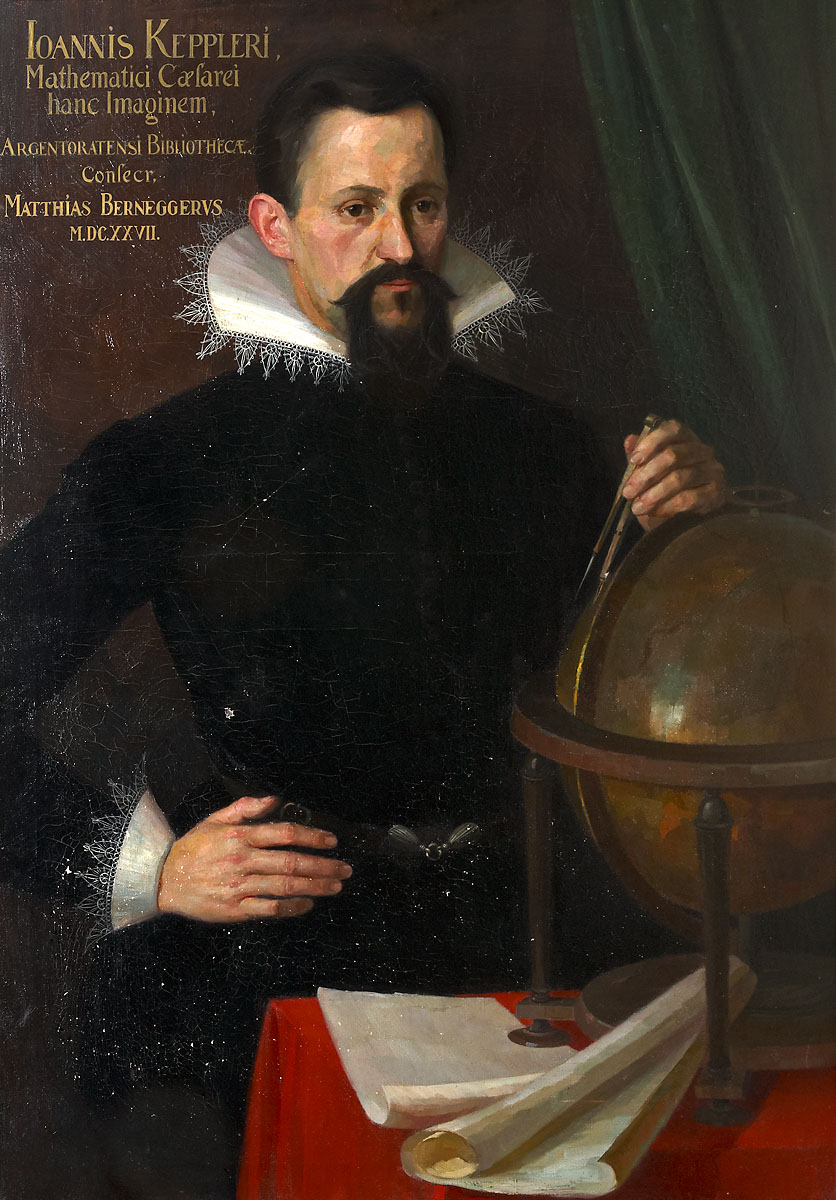
Johannes Kepler
German polymath and astronomerWikipedia
191
MENTIONS
67
EPISODES
57
PODCASTS
Search complete. 191 mentions across 67 episodes found for "Johannes Kepler".
Sep 24, 2026

Gabrielle BirchakHOST
In the 17th century, this wasn't just abstract math.
Gabrielle BirchakHOST
Johannes Kepler was currently trying to use regular polyhedra to map out the orbits of the planets around the Sun.
Gabrielle BirchakHOST
By discovering this invariant property of polyhedron, Descartes had unlocked a tool that lent mathematical credibility to the heliocentric Copernican model.
Gabrielle BirchakHOST
Just a few years prior, Galileo had been put under house arrest by the Catholic Church for advocating heliocentrism, and Giordano Bruno had been burned at the stake.

CJHOST
Jesus, there's more.
Scott Edwin WilliamsHOST
[laughs] He had an apprentice called Johannes Kepler.
Scott Edwin WilliamsHOST
Very famous, very famous astronomer in his own right.
Scott Edwin WilliamsHOST
Okay? Brilliant guy.

Vanessa RichardsonHOST
Fludd paid a steeper price.
Vanessa RichardsonHOST
His public defense of a mystical, magical view of the universe dragged him into a years-long feud with some of the sharpest scientific minds of the age, including the astronomer Johannes Kepler.
Vanessa RichardsonHOST
His reputation never recovered.
Vanessa RichardsonHOST
It's a strange thing to stake your name on.

Pamela NagamiNARRATOR
That he rejected the Copernican theory with scorn is an exaggeration, but he never accepted it, notwithstanding arguments that the best astronomers of his time found convincing, and the longer he lived, the more unfavourable became his opinion of its merits.
Pamela NagamiNARRATOR
And it is certain that Tycho Brahe's wonderful mass of observations with the splendid generalizations based on them by Kepler are never mentioned in his writings.
Pamela NagamiNARRATOR
Now, what really ruined Aristotelianism was the heliocentric astronomy, as Bruno perfectly saw.
Pamela NagamiNARRATOR
And ignorance of this left Bacon after all in the bonds of medieval philosophy.
6 MINS LATER
Pamela NagamiNARRATOR
thus his prodigious powers would have been much more usefully devoted to moral philosophy as it is the essays alone remain to show what great things he might have done by limiting himself to the subjects with which they deal the famous logical and physical treatises the novum organum and the de augmentis notwithstanding their wealth and splendour of language are to us at the present day less living than the fragments of early greek thought than most of plato than much of aristotle than atomism as expounded by lucretius macaulay rests his claim of the highest place among philosophers for bacon not on his inductive theory to which the historian rightly denies any novelty but on the new purpose and direction that the search for knowledge is assumed to have received from his teaching on this view the whole of modern science has been created by the desire to convert nature into an instrument for the satisfaction of human wants an ambition dating from the publication of the noam organum the claim will not stand for two reasons The first is that the great movement of modern science began at least half a century before Bacon's birth, growing rapidly during his life, but without his knowledge, and continuing its course without being perceptibly accelerated by his intervention ever since.
Pamela NagamiNARRATOR
The one man of science who most commonly passes for his disciple is Robert Boyle, 1627-1691. but boyle did not read the noam organum before he was thirty whereas residing at florence before fifteen he received a powerful stimulus from the study of galileo and his chemistry was based on the atomic theory which bacon rejected the second reason for not accepting macaulay's claim is that in modern europe no less than in ancient greece the great advances in science have only been made by those who loved knowledge for its own sake or if the expression be preferred simply for the gratification of their intellectual curiosity No doubt their discoveries have added enormously to the utilities of life, but such advantages have been gained on the sole condition of not making them the primary end in view.
Pamela NagamiNARRATOR
The labours of Bacon's own contemporaries, Kepler and Gilbert, have led to the navigation of the sea by lunar distances, and to the various industrial applications of electromagnetism, but they were undertaken without a dream of these remote results and in our own day the greatest of scientific triumphs which is the theory of evolution was neither worked out with any hope of material benefits to mankind nor has it offered any prospect of them as yet the same may be said of modern sidereal astronomy from the humanist point of view it would not be easy to justify the enormous expenditure of energy money and time that this science has absorbed the schoolmen have been much ridiculed for discussing the question how many angels could dance on the point of a needle but as a purely speculative problem it surely merits as much attention as the total number of the stars the rates of their velocities or the law of their distribution through space a schoolman might even have urged in justification of his curiosity that some of us might feel a reasonable curiosity about the exact size if size they have of beings with whom we hope to associate one day whereas by the confession of the astronomers themselves neither we nor our descendants can ever hope to verify by direct measurement the precarious guesses of their science in this branch of celestial statics and dynamics section two section three of history of modern philosophy by alfred william ben this librivox recording is in the public domain chapter i the philosophical renaissance part three thomas hobbes It has been shown that one momentous effect of the Copernican astronomy as interpreted by Giordano Bruno was to reverse the relative importance ascribed in Aristotle's philosophy to the two great categories of power and act, giving to power a value and dignity of which it had been stripped by the judgment of Plato and Aristotle.
Pamela NagamiNARRATOR
Even Epicurus, when he rehabilitated infinite space, had been careful as a moralist to urge the expediency of placing a close limitation on human desires, denouncing the excesses of avarice and ambition more mildly, but not less decisively than the contemporary Stoic school.

Jason LisleHOST
It was Copernicus that revitalized the idea that the earth orbits the sun, what we call the heliocentric solar system.
Jason LisleHOST
In the early 1600s, the creation scientist Johannes Kepler discovered the true nature of the orbits of the planets.
Jason LisleHOST
Using data recorded by Tycho Brahe, Kepler found that planets orbit the sun in ellipses, not perfect circles as had been previously thought.
Jason LisleHOST
Consequently, a planet is slightly closer to the sun at times and slightly farther at other times.
Jason LisleHOST
Furthermore, Kepler discovered the precise mathematical details by which a planet speeds up when closer to the Sun and slows down when farther away in its orbit.
Jason LisleHOST
Kepler also found the exact mathematical relationship between a planet's orbital period and its average distance from the Sun.
Jason LisleHOST
Namely, the period squared is proportional to the distance cubed.
Jason LisleHOST
These mathematical discoveries allowed astronomers to refine their calculations of the positions of the planets with much higher precision and accuracy than had been possible in the past.

speaker_2NARRATOR
In Europe, the question surfaced much later.
speaker_2NARRATOR
In 1611, the German astronomer Johannes Kepler wrote a short essay called The Six-Cornered Snowflake, in which he wondered why snow crystals always have six sides.
speaker_2NARRATOR
He wrote it as a New Year's gift for a patron, and it is a playful piece, but the question at its center was a serious one.
speaker_2NARRATOR
He compared snowflakes to honeycombs and to stacked spheres, circling the problem from several sides.
speaker_2NARRATOR
Kepler could not explain the hexagonal symmetry with the science available to him, and he said so plainly.
speaker_2NARRATOR
But his question anticipated the field of crystallography by more than two centuries.
speaker_2NARRATOR
His thoughts about how small round particles might pack together were remarkably close to the modern idea of atoms arranged in a lattice.
1 HR 36 MINS LATER
speaker_2NARRATOR
The complexity of snow as a material continues to reveal new discoveries, including recent findings about how snow crystals can conduct heat and how the microstructure of the snowpack evolves over time.

speaker_0HOST
As we just mentioned, Isaac Newton, that was one.
speaker_0HOST
And in addition to that, how about Johannes Kepler? Kepler was a person very faithful to scientific evidence, even when it challenged his own beliefs.
speaker_0HOST
Look it up for yourself.
speaker_0HOST
One day he was teaching a geometry class, and while he was drawing a very simple diagram, it suddenly hit him.
speaker_0HOST
And this is not merely by chance.
speaker_0HOST
This is actually God answering my years of prayers.
speaker_0HOST
That is from Johannes Kepler.
speaker_0HOST
Earlier, I mentioned Isaac Newton.

John MitchinsonHOST
We don't know whether he met Shakespeare, but certainly attended first performances of Shakespeare plays.
John MitchinsonHOST
He meets Johann Kepler, the great astronomer.
John MitchinsonHOST
on a visit to Denmark.
John MitchinsonHOST
He fights with the Earl of Essex in the siege of Cadiz.

speaker_1HOST
Yes.
speaker_1HOST
Johannes Kepler himself complained bitterly that the great Jupiter-Saturn conjunction in 1563 occurred a full month later than the traditional tables predicted.
speaker_0HOST
That's a massive margin of error.
speaker_1HOST
On top of that, they had no capacity for empirical testing, no double-blind studies, no statistical analysis to verify if every man with Venus opposite Saturn was actually hated by his wife.

ChaseHOST
Keep this to yourself.
ChaseHOST
Can you do something, like, useful? Give me the temperature! Oh my God, I'm getting it! Okay, it's a little hot, but it doesn't even get close to the other Keplers.
ChaseHOST
I look at you, Kepler-10b, 69c, or any other.
ChaseHOST
Damn, it was me who named them.
57 more episodes mention Johannes Kepler.
Create an account to see the whole feed, search across every transcript, and follow the entities you care about.