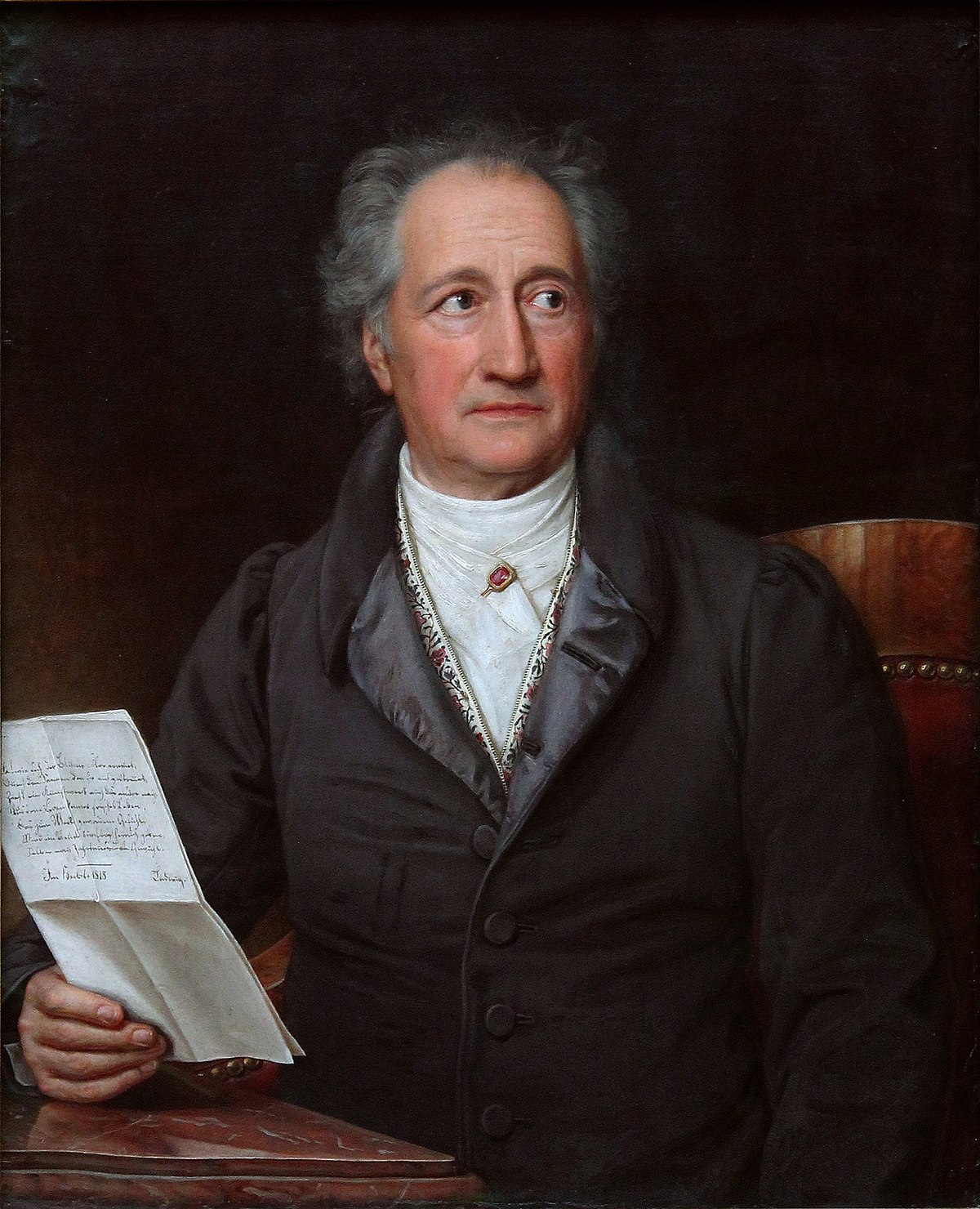
Johann Wolfgang von Goethe
WriterWikipedia
968
MENTIONS
331
EPISODES
257
PODCASTS
Search complete. 968 mentions across 331 episodes found for "Johann Wolfgang von Goethe".
Oct 28, 2026

Pete QuiñonesHOST
Though the law in these countries forbade Jews to settle in their boundaries, yet the princes and rulers kept a number of privileged Jews at their courts.
Pete QuiñonesHOST
According to Goethe, the status of court Jew was introduced by the emperors of Germany during the Thirty Years' War.
Pete QuiñonesHOST
Be that as it may, it is an undoubted fact that pretty well every state in Germany throughout the 17th and 18th century had its court Jew or Jews upon whose support the finances of the land depended.
Pete QuiñonesHOST
A few examples by way of illustration.

speaker_1NARRATOR
Weimar was hallowed in his eyes by its earlier literary and musical associations.
speaker_1NARRATOR
It had harbored Goethe and Schiller and been sanctified in the young musician's sight by the labors of Liszt.
speaker_1NARRATOR
his munich friend the tenor heinrich zeller who had coached wagner rolls with him had settled there and a young soprano pauline de anha the daughter of a bavarian general with strong musical enthusiasm soon followed him in proper course she was to become richard strauss's wife a high-spirited outspoken lady never disposed to mince words a source of innumerable yarns and witticisms and who saw to it that her celebrated husband carefully towed the mark pauline strauss was in every way a chapter by herself and when not very long after his death she followed him to the grave it seemed only a benign provision of fate that she should not too long survive him strauss almost instantly infused a new blood into the artistic life of weimar where he settled in eighteen eighty nine and remained till eighteen ninety four the worthy old court kapellmeister edward lassen was sensible enough to allow his energetic new associate complete freedom of action true the artistic means at his disposal were relatively modest and at first they might well have given the ambitious newcomer pause the orchestra then contained only six first violins there was a painfully superannuated little chorus and most of the leading singers had seen better days but the conductor from munich was disturbed by none of these apparent handicaps in bayreuth he had already learned the proper way of producing wagner and even when the means were limited he tolerated no concessions all wagnerian performances had to be done without cuts or at least with a minimum of curtailments a wisecrack began to go the rounds what is richard strauss doing to which the reply was strauss is opening cuts the mouldy old settings were replaced by new ones and once when there was insufficient funds to buy new stage appointments strauss approached the grand duke with the plea that he might lay out of his own pocket a thousand marks to freshen the settings to the credit of the ruler it should be told that he refused the offer and disbursed the sum himself but strauss's reforms were far from ending there he once confessed that in his comprehensive job he was not only conductor but coach scene painter stage manager and tailor in short a thorough-going he threw himself heart and soul into the job so much so that in spite of a small stage and limited means he produced in the presence of none other than cosima wagner a lohengrin that deeply gripped her he had symphonic concerts as well as operas to occupy him at one of the former he transported his hearers with the world premiere of his don juan the date deserves to be noted november eleventh eighteen eighty nine that same year he had composed another tone poem death and transfiguration and on june twenty one eighteen eighty nine he permitted an audience in nearby eisenach to hear it the work is programme music if you will but the idea that it originally set out to illustrate the poem about the man dying in a necessitous little room and after his death struggles translated to supernal glories is wrong moreover the long-accepted notion that the music is based on lines by alexander ritter is fallacious for in the first place the composer did not aim to illustrate his friend's word picture and in the second ritter wrote the poem only after becoming acquainted with the score this is what explains a certain incongruity between ritter's verses and the tones which in reality were never conceived in slavish illustration of them hanslick wrong as usual was to write misleadingly once again a previously printed poem makes it certain that the listener cannot go awry for the music follows this poetic programme step by step quite as in a ballet scenario and he spoke of the score as a gruesome combat of dissonances in which the wood-wind howls in runs of chromatic thirds while the brass growls and all the strings rage by this time accustomed to such critical nonsense the composer did not suffer himself to be troubled what disturbed him much more was that his old champion von beulau gave indications of no longer seeing eye to eye with him at beulau's suggestion strauss had revised and newly instrumented macbeth but the piece was to continue a step-child soon he was increasing his output of songs and enriching leader singers with such treasures as rua maenzela cecilie heimliche auforderung and morgan while only a few short years ahead lay traum durch die dämmerung nachtsgesang and schlagende herzen to delight nearly two generations of recitalists strauss had always been blessed with a robust health unlike wagner for instance he never suffered from exacerbated nerves and violent extremes of unbalanced mood but at the period of which we speak he did experience one of his rare periods of illness what between his guest engagements his rehearsals the strain of composing attending to details of publication and myriad other obligations of a travelling conductor and virtuoso he came down in may eighteen ninety one with a menacing grip which sent him to bed and threatened serious complications he was resigned to anything even if he did confess dying would not be in itself so bad but first i should like to be able to conduct he recovered and had his wish in eighteen ninety two but in the summer he was sick once more this time with pneumonia now it looked as if one lung were seriously threatened he was granted the vacation he requested from november eighteen ninety two to july of the succeeding year taking some works and sketches he started on the advice of his physicians for the south the convalescent with a finished opera libretto in his baggage went to repair his health in italy greece and egypt in egypt he recovered completely in the anhalter railway station berlin he was to see for the last time the mortally sick von bulow likewise journeying to egypt in a last effort to repair his shattered constitution poor bulow was not to survive the trip the wiry frame of strauss helped him over any threat of tuberculosis and not only defied any peril to his lungs but seemed actually to renew his creative powers the libretto which occupied his attention was that of his opera guntram the first and least known of his productions for the lyric stage Guthrum is without question a stiefkind among Richard Strauss's operas.
speaker_1NARRATOR
The average Strauss enthusiast's acquaintance with its music may be said to be confined to the brief phrase from it cited in the section called The Hero's Works of Peace in the tone poem Ein Heldenleben.

Will TannerHOST
Dabney, describing this in his Virginia, the New Dominion, writes, quote, Despite his lifelong military career, Lee was well-read in ancient and modern languages, as well as in the English classics.
Will TannerHOST
Some of his correspondence is sprinkled with quotations from Voltaire and Cervantes, Shakespeare and Goethe.
Will TannerHOST
At Washington College, he astonished students of Greek by addressing them in that language.
Will TannerHOST
He questioned a student of Spanish so narrowly concerning his course that the youth suddenly became aware that Lee knew more Spanish than he did.

Pete QuiñonesHOST
Though the law in these countries forbade Jews to settle in their boundaries, yet the princes and rulers kept a number of privileged Jews at their courts.
Pete QuiñonesHOST
According to Goethe, the status of court Jew was introduced by the emperors of Germany during the Thirty Years' War.
Pete QuiñonesHOST
Be that as it may, it is an undoubted fact that pretty well every state in Germany throughout the 17th and 18th century had its court Jew or Jews upon whose support the finances of the land depended.
Pete QuiñonesHOST
A few examples by way of illustration.

Tom StoppardGUEST
So the names on this poster, it went like this.
Tom StoppardGUEST
Moliere, Goethe, Racine, Corneille, Brecht, Stoppard, Chekhov.
Tom StoppardGUEST
Oh, my
Charlie RoseHOST
God.

Nick JubberGUEST
So it's only sort of later as those stories have been sort of, as that sort of initial phase has sort of drained away, that then we see poets taking up the idea of the vampire.
Nick JubberGUEST
And a lot of very well-known poets like Goethe and Coleridge and Lord Byron.
Nick JubberGUEST
Byron in his 1813 poem, The Gaior, he wrote about the vampire.
Nick JubberGUEST
In fact, if I can...

ExpatriateNARRATOR
Undoubtedly, there is a difficulty in applying such a phrase as sum futas aion to the divine life at all.
ExpatriateNARRATOR
but it seems allowable to use words properly only applicable to human life with reference to the divine in a passage like this where in thought the contrast is drawn between the former as an ion sumphutas indeed but not alka sumphutas and the latter verily an ion in the wider sense an alka sumphutas coeval with its eternal power to prompt and aid and certainly the word in its most literal sense seems to suit this idea of a sacred impulse an aid like a wafting wind breathed down from heaven i put forward this conjecture without confidence and merely as one more endeavour to elucidate a passage of more than usual interest which is allowed to be dubious hitherto to make it refer to the life or condition of the speaker seems to me difficult to translate it the time coextensive with the war almost impossible whether my own conjecture is any better you decant for the feeling of the whole passage it might not be amiss to compare goethe's vindication of the honour and toil that await the old in song doch ins bekannte seitanspiel mit mut in anmut einzugreifen nach einem selbstgesteckten ziel mit holdem ehren hinzuschweifen das alte herrn ist eure pflicht with respect to the translation my object has been throughout to be if possible readable i have sacrificed much that scholars might fairly desiderate reproduction of the original metres preservation of strophe and anti strophe and so forth on this ground that i found my own metrical skill insufficient to satisfy even myself in such a task i have little doubt that certain parts cassandra's earlier ravings for instance or the wrath of the furies would be most fitly rendered in prose like that of the analogous passages of king lear and macbeth but here too after a struggle i resign the conflict it is easy to write prose it is impossible to write that prose the anapastic systems have been mostly rendered in octosyllabic metre where dactylic feet were predominant in the original i have sometimes adopted the heroic quatrain sometimes loose and irregular but always rhyming measures the earlier part of the third chorus of the agamemnon i have endeavoured to reproduce in that arrangement of octosyllabic verses used with such admirable effect by mr swinburne in the prologue and epilogue of songs before sunrise the iambic dialogue has been rendered into such blank verse or rhyming couplets as i could command the trochaic passages into rhyming verse of greater length any coincidences that may be found between other translations and the present may claim to be for the most part accidental whatever has been consciously adopted from elsewhere has been acknowledged in a footnote unless so familiar as to have become common property thus i have not thought it necessary to avow obvious obligations to shakespeare nor to ascribe the airy rings of the vulture's flight in the first chorus of the agamemnon to johnson nor the sleep of swords that fine rendering of the homeric calceas upnos to kingsley nor the rhythm of one choric passage in the libation-bearers to w morris such things are public property now part of this translation i e the agamemnon having been already published i have had for that part the advantage of public criticism i have carefully considered all such criticism so far as it has reached me and have removed i hope all positive errors that have been detected those critics who have complained rather of the general faults of the translation such for example as diffuseness or a modern tone than of particular errors will i hope believe my assurance that their words have been duly weighed if i have not recast the translation to the extent their criticism demanded it is neither from doubting its substantial truth nor the seriousness of the fault but i am not sanguine after various attempts of my being able to translate in a closer and more pregnant style it is not a question of how the thing could be done best in the abstract it is unfortunately the more limited and painful question how a particular individual can do it least imperfectly my main obligations in the matter of aeschylus are expressed in the dedication in addition i am indebted to the rev w a fearon assistant master of winchester for revising a large part of the agamemnon to mr c keegan paul for useful criticisms mainly though not wholly on the same play to mr a o prickard fellow and lecturer of new college oxford for incidental assistance throughout the work particularly in the libation bearers and the furies to mr c b phillips assistant master of winchester who has gone over the whole translation with care to mr d s margoliouth fellow of new college oxford who has helped me especially with several difficulties in the furies other friends will i doubt not accept the general acknowledgment of their aid i cannot however leave unspecified my gratitude to mr f r benson and the rest of the oxford company who last year performed the agamemnon on the stage for the practical insight they afforded their audience into the spectacular as well as the literary and dramatic merit of that noblest of poems e d a m winchester march eighteen eighty one preface to the second edition in republishing the house of atreus i have striven to remove the flaws to which private or public criticism called my attention a grave mistranslation of the furies line to sixteen has i hope been banished mr a o prickard and professor margoliot independently detected and denounced it to me i now plead with orestes miasma decpluton pele kronos caphaire panta giraskon i may be permitted to add a statement of the general principle that i have followed in making alterations errors in scholarship i have endeavoured to remove where the english has been criticised i have always considered and often obeyed the criticism sometimes i have resisted it in obedience to a higher law for example several critics objected to the use of the word i have retained it as used by shakespeare and therefore fitted for tragic poetry though no longer in ordinary use with regard to the form of the translation i had not made any serious change were i now attempting the thing for the first time i should not throw so much of the first chorus of the agamemnon into quatrains but in this as in other cases that which was originally difficult to do has become almost impossible to undo and do again the previous translation stands like an erring and prohibitory ghost micet eselfis tade phonon ed a m winchester october eighteen ninety nine end of author's prefaces recording by expatriate in bangor Part 1 of Agamemnon by Aeschylus, translated by Edmund Doidge Anderson Moorshead, 1849-1912.
ExpatriateNARRATOR
This LibriVox recording is in the public domain.
ExpatriateNARRATOR
Recording by Expatriate in Bangor, Maine.

Bruce PirieNARRATOR
Give me, oh give youth's passions unconfined the rush of joy that felt almost like pain.
Bruce PirieNARRATOR
Goethe.
Bruce PirieNARRATOR
Archibald Cameron of Lochiel, son of a Highland chief who had wedded a daughter of France, was but four years old when he lost his mother.
Bruce PirieNARRATOR
Brought up by his father, who was, in the language of the scriptures, a valiant hunter in the sight of God, ever since ten years old he had followed him in the chase of the roebuck and other wild beasts, scaling the highest mountains, swimming the icy torrents, making his couch on the wet sod with no covering but his plaid, no roof but the vault of heaven.

Thorsten PolleitHOST
Only then one can recognize whether one is living in freedom or not, and whether freedom is being taken away secretly or quite openly.
Thorsten PolleitHOST
As Johann Wolfgang von Goethe, 1749-1832, already said, none are more hopelessly enslaved than those who falsely believe they are free.
Thorsten PolleitHOST
Therefore, once again, regarding the understanding of freedom, the American economist and social philosopher Murray Newton Rothbard, 1926-1995, explained by logical means that every human being fully and completely owns himself and does not belong to other persons or to the king, emperor or state, that each person therefore has self-ownership.
Thorsten PolleitHOST
Rothbard justifies precisely this freedom through the so-called non-aggression principle, which is also grounded in logic.

Brett BogartHOST
But to try to have some, grandiose prediction of what's going to happen beyond what I'm in control of in my own attitudes and behaviors seems beyond anything that I've experienced is actually within my control.
James SullivanGUEST
What's the philosophical, you're the philosopher, philosophical, who's the, is it Goethe or somebody like that who, now this is where I'm going to show my ignorance.
James SullivanGUEST
You're going to expose my ignorance.
James SullivanGUEST
No, negative capability.
321 more episodes mention Johann Wolfgang von Goethe.
Create an account to see the whole feed, search across every transcript, and follow the entities you care about.