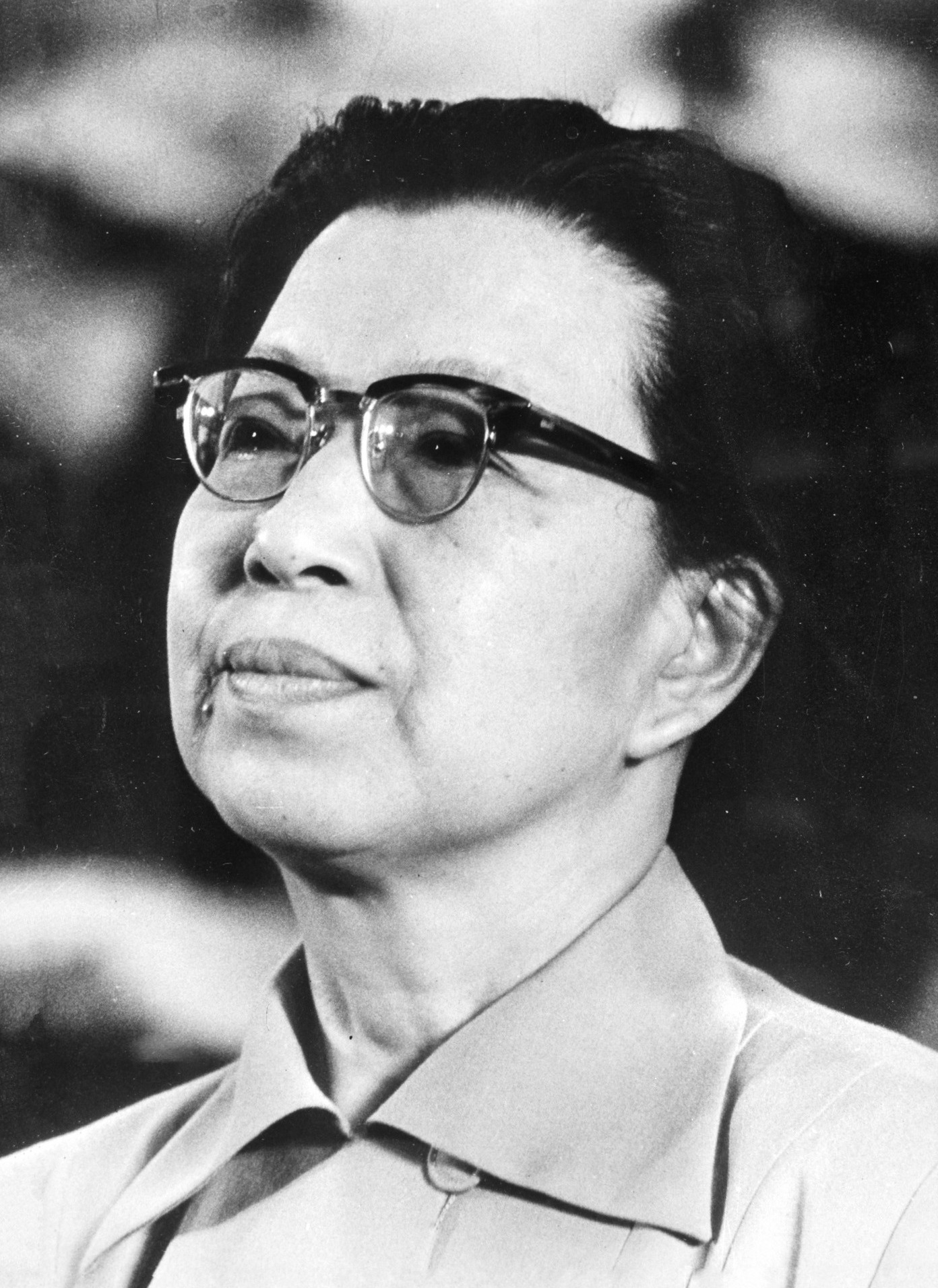
Jiang Qing

Jiang Qing

Chinese actressWikipedia

Search complete. 70 mentions across 13 episodes found for "Jiang Qing".

Oct 26, 2026

Rebecca KarlGUEST
73:06
And as the person who's going to help engineer Mao's rise again into the party in the 60s.
Rebecca KarlGUEST
73:17
And you have an accumulating sort of set of issues on the cultural front That indicate the arrival of Mao's wife, Jiang Qing, onto the cultural scene in a big way.
Rebecca KarlGUEST
73:40
She's always been there somewhere, but she now becomes a big spokesperson for a very large number of people.
Rebecca KarlGUEST
73:49
issues that emerge in the writing of historical plays, the acting of historical vignettes in Peking opera, the devising of dance and ballet and performative arts and so on.

22 MINS LATER

Richard HamesHOST
96:35
He gives sort of various different accounts at different times, but then mostly seems to have had a pretty bad time.
Richard HamesHOST
96:42
Let's talk about the figure we talked about before, because I think this is crucial to understanding the gender politics of contemporary China.
Richard HamesHOST
96:50
Talk to me about the blaming that goes on of the Gang of Four, and in particular, Jiang Qing, after the death of Mao.
Richard HamesHOST
96:59
So Mao dies in 1976.
Paul FryHOST
42:33
Who knows? We race off under the compulsion of the meaning of the red light, which is go.
Paul FryHOST
42:42
Now by the way, there's an anecdote, the truth of which I've never been able to ascertain, that during the Cultural Revolution in China, Madame Mao very much disapproved of the fact that red lights meant stop because red is of course the color of progress.
Paul FryHOST
43:01
It ought to mean go forward and everything behind it, but needless to say, her thoughts on the subject were never implemented.
Paul FryHOST
43:13
If one day red light means stop and the next day red light means go, there might be a few problems.
Leili SadaghianiHOST
27:39
He was 82 years old.
Leili SadaghianiHOST
27:40
He died still in power and within weeks of his death, the Gang of Four, which included his wife, Jiang Qing, and three other most radical architects of cultural revolution were arrested.
Leili SadaghianiHOST
27:52
Within a few years, the party issued an official assessment of his record that said roughly he was 70% right and 30% wrong.
Leili SadaghianiHOST
28:01
And that formulation is one that has struck me when I was creating this podcast as one of the most politically crafted sentences in history because it's designed to preserve enough of the revolutionary legacy to maintain party legitimacy, but then acknowledging enough of the disaster to give the reformers room to move.

Unknown podcast

22 Years:Nine Commenteries on the Communist Party 1

Oct 16 · 1 Mention

speaker_0NARRATOR
15:49
It was called Why Is This? Taking this as a turning point, the rectification movement suddenly transformed into an anti-rightist campaign.
speaker_0NARRATOR
15:59
When some criticized the persecution as a conspiracy or a plot in the dark, Mao claimed publicly, "This is not a plot in the dark, but a stratagem in the open." This is a part of the speech by Jiang Qing, the first vice director of the Central Leading Committee for the Great Cultural Revolution, recorded in the initial period of the Great Cultural Revolution.
speaker_0NARRATOR
16:27
Soon, the president of China, Liu Shaoqi, was taken as a rebel and a traitor from within and a scab.
speaker_0NARRATOR
16:36
That's what he was called and forever he was expelled from the party.

Unknown podcast

22 Years:Nine Commenteries on the Communist Party 1

Oct 16 · 1 Mention

speaker_0NARRATOR
15:49
It was called Why Is This? Taking this as a turning point, the rectification movement suddenly transformed into an anti-rightist campaign.
speaker_0NARRATOR
15:59
When some criticized the persecution as a conspiracy or a plot in the dark, Mao claimed publicly, "This is not a plot in the dark, but a stratagem in the open." This is a part of the speech by Jiang Qing, the first vice director of the Central Leading Committee for the Great Cultural Revolution, recorded in the initial period of the Great Cultural Revolution.
speaker_0NARRATOR
16:27
Soon, the president of China, Liu Shaoqi, was taken as a rebel and a traitor from within and a scab.
speaker_0NARRATOR
16:36
That's what he was called.

Unknown podcast

Mao Zedong: The Revolutionary Who Changed China Forever – A Bedtime History Documentary

Oct 13 · 4 Mentions

speaker_0NARRATOR
53:13
She'd never return as his wife.
speaker_0NARRATOR
53:18
Her replacement arrived from Shanghai, Jiang Qing, an actress with a dubious past and ambitious eyes.
speaker_0NARRATOR
53:28
The party leaders opposed the match, but Zedong didn't ask permission anymore.
speaker_0NARRATOR
53:36
They married in 1938, his fourth wife if you counted them all, which nobody did.

12 MINS LATER

speaker_0NARRATOR
65:55
Bourgeois elements had infiltrated the party.
speaker_0NARRATOR
66:00
They must be swept away.
speaker_0NARRATOR
66:04
But the real signal came when his wife, Jiang Qing, attacked a historical play about an honest official dismissed by a corrupt emperor.
speaker_0NARRATOR
66:16
Everyone understood.
Cathy WorthingtonHOST
0:04
[upbeat music] What if one woman's journey through oppression, survival, escape, and rebuilding her life could remind us that the human spirit is almost impossible to crush?
Merry ElkinsHOST
0:22
And what if the story began in Mao-era China, found its express- found its expression through dance, and eventually became a book and now a film?
Cathy WorthingtonHOST
0:33
Today we're going behind the story of Dancing Through the Shadow with the man who helped bring it to the page and the screen.
Merry ElkinsHOST
0:42
Ah, and because sometimes the most powerful stories aren't invented, they're the stories of people who somehow survived the unma- unimaginable.
Cathy WorthingtonHOST
1:04
Today we're talking about courage, resilience, filmmaking, and the extraordinary power of a true story.
Cathy WorthingtonHOST
1:11
Our guest is Leif Bristow, an Emmy-winning, Emmy-winning producer, director, screenwriter, and author.
Merry ElkinsHOST
1:20
Leif became involved with the remarkable life story of Tia Chung, whose experience during Mao-era China, her escape, her rebuilding her life through dance, which became the basis for Dancing Through the Shadow, a book that is now also being adapted to the screen.
Cathy WorthingtonHOST
1:38
Leif, welcome to Late Bloomers.
Alejandro DolinaHOST
13:38
No estaba el propio Mao, el jefe de Estado, Li Shaoqi, y el jefe del ejército, Lin Biao.
Alejandro DolinaHOST
13:47
Y Mao decidió abordar indirectamente esta, esta nueva idea, ¿no? Poniendo en el centro de la escena a su esposa, la actriz cinematográfica Jiang Qing.
Patricio BartonHOST
14:04
Mhm.
Alejandro DolinaHOST
14:04
Mao se había casado con ella en 1939.
Alejandro DolinaHOST
14:08
Vamos, ahora hablando del 65.
Alejandro DolinaHOST
14:12
Ella había actuado en Shanghái durante los años 30 utilizando el nombre profesional de Lan Ting.
Alejandro DolinaHOST
14:21
Durante los primeros veinte años de su matrimonio, Jiang Qing se mantuvo en un plano muy secundario, pero de pronto se convirtió en el centro de un grupo de intelectuales descontentos, escritores fracasados, actores de segundo orden y, en general, de un grupo que deseaba ejercer el dominio de las artes y radicalizarlas.
Alejandro DolinaHOST
14:46
Eh, siempre, tradicionalmente, los regímenes comunistas pasaron por algún momento así, ¿eh? Y le pareció que ciertas formas artísticas eran burguesas.

Unknown podcast

The Long Echo: The Missing Minutes

Oct 6 · 1 Mention

Alice PembertonHOST
7:28
Emma, Beijing.
Alice PembertonHOST
7:30
1976, a month after Mao died, Premier Hua Guofeng summoned the Gang of Four, Mao's widow Jiang Qing and three allies, to a Politburo meeting at Huairen Hall.
Alice PembertonHOST
7:44
The meeting was a pretext.
Alice PembertonHOST
7:46
Yao Wenyuan was lured with a draft of Mao's selected works.

Unknown podcast

Mao Zedong: From Humble Beginnings to Revolutionary Leader — The Rise of Modern China and Its Lasting Impact

Oct 4 · 10 Mentions

speaker_0NARRATOR
71:22
He Zizhen, who had suffered multiple wounds during the Long March and had lost the child she bore on the road, traveled to the Soviet Union for medical treatment in nineteen thirty-seven and effectively did not return.
speaker_0NARRATOR
71:36
In nineteen thirty-nine, Mao married Jiang Qing, a young actress from Shanghai who had come to Yan’an and worked her way into the political and personal circles around him.
speaker_0NARRATOR
71:46
The senior party leadership was not enthusiastic.
speaker_0NARRATOR
71:50
They allowed the marriage on the understanding that Jiang Qing would stay out of active politics.
speaker_0NARRATOR
71:55
It was a promise that held for roughly two decades before it stopped holding entirely, with consequences that would affect tens of millions of people.
speaker_0NARRATOR
72:04
Edgar Snow’s book about his Yan’an visit, Red Star Over China, published in nineteen thirty-seven, reached enormous audiences in both the West and among overseas Chinese, presenting the communists as disciplined, idealistic reformers untouched by the corruption that was visibly eating the nationalist government.

41 MINS LATER

speaker_0NARRATOR
113:37
He had, over the previous years, been cultivating relationships outside the regular party and government structure.
speaker_0NARRATOR
113:45
Lin Biao, now defense minister, had been systematically building Mao's personal cult within the People's Liberation Army, introducing intensive study of Mao's writings as a central feature of military training and producing the little red book, the quotations from Chairman Mao, as a daily reference for soldiers.

3 more episodes mention Jiang Qing.

Create an account to see the whole feed, search across every transcript, and follow the entities you care about.

We value your privacy

We use cookies to understand how you use our platform and to improve your experience. Click “Accept All” to consent, or “Decline non-essential” to opt out of non-essential cookies. Read our Privacy Policy.