Jet stream
25
MENTIONS
6
EPISODES
3
PODCASTS
Search complete. 25 mentions across 6 episodes found for "Jet stream".
Oct 17, 2026

Tail DraggerHOST
B-29 Superfortress crews flying combat missions over Japan from the Mariana Islands discovered that at altitude over the Pacific they could be running at full power and barely making headway westbound, while the same altitude eastbound practically pushed them home.
Tail DraggerHOST
The jet stream, those B-29 crews didn't know what to call it either, but they felt it in every fuel gauge.
Tail DraggerHOST
Wiley Post felt it first in a wooden airplane over the American West, wearing a rubber suit that made him look like something out of a Jules Verne novel.
Tail DraggerHOST
And the pressure suit work didn't stop being important when Post's flights ended.
Tail DraggerHOST
You can see the exhaust staining on the cowling.
Tail DraggerHOST
You can see the wear.
Tail DraggerHOST
She has been somewhere, several somewheres around the planet twice, into the jet stream.
Tail DraggerHOST
up to the altitude where human beings stop working without mechanical help, and she did all of it in plywood and spruce, in rubberized fabric and radial engine, flown by an oilfield roughneck who spent his accident insurance on flying lessons, and decided, apparently, that the entire planet was a reasonable cross-country destination.
Tail DraggerHOST
The aftershocks of that flight spread for years.
Tail DraggerHOST
Post's notes on high-altitude wind patterns became a foundational document for the emerging science of jet stream meteorology.
Tail DraggerHOST
The military paid close attention.
Tail DraggerHOST
The airlines paid close attention.
Tail DraggerHOST
He came home and wrote it down and said, there is something up there you need to know about.
Tail DraggerHOST
And then he went back up and built a suit so other men could follow him.
Tail DraggerHOST
We have been riding his jet stream ever since.
Tail DraggerHOST
Much of this history comes from Brian and Frances Sterling's biography of Post and from the Smithsonian's own records on the Winnie Mae.
Tail DraggerHOST
There was fast-moving air up high, very fast, moving consistently from west to east, something like a river in the sky, a ribbon of wind at altitudes above twenty thousand feet that blew at speeds no surface forecast had ever predicted.
Tail DraggerHOST
We know today that Post had found the polar jet stream.
Tail DraggerHOST
Meteorologists had been detecting it from weather balloon data and were beginning to understand its structure, but no pilot had ever flown through it intentionally.
Tail DraggerHOST
Post was the first aviator to recognize the jet stream as a navigational phenomenon, to understand that it could be deliberately used to add speed to an eastbound flight, and to start planning how to exploit it.
Tail DraggerHOST
The catch was altitude.
Tail DraggerHOST
To ride the jet stream consistently, you needed to fly above thirty thousand feet, possibly above forty thousand feet for the core of the flow.
Tail DraggerHOST
At thirty thousand feet in an unpressurized cockpit in the early nineteen thirties, you had perhaps thirty seconds of useful consciousness before hypoxia shut your brain down.
Tail DraggerHOST
Oxygen masks helped at lower altitudes, but above the mid-twenties they weren't enough.

Dan HolleyGUEST
You have high and low pressure around the world, different areas of them.
Dan HolleyGUEST
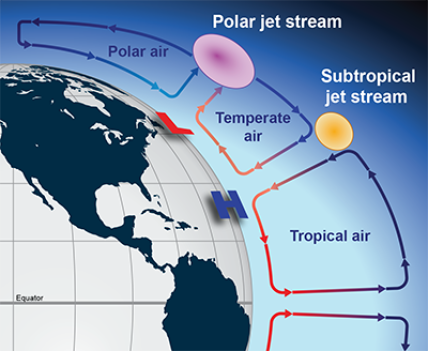
Low pressures are typically driven by the jet stream, which is obviously a fast flowing ribbon of air about six, seven miles above the ground, sits there all year, waxes and wanes in position across both hemispheres.
Dan HolleyGUEST
And certain parts of the jet stream are quite favourable for developing areas of low pressure.
Dan HolleyGUEST
If you look at a map of the jet stream, it's not one uniform strength all the way around.
Dan HolleyGUEST
You've got cores of stronger winds and then bits of weaker winds.
Dan HolleyGUEST
And those stronger winds are what we call jet streaks.
Dan HolleyGUEST
So as you leave a road on the left hand side, that's where we also get them too.
Dan HolleyGUEST
So they're the two key areas that we're watching for.
Tail DraggerHOST
Winds that were consistent, fast, predictable, and potentially fast enough to push an aircraft across continents at ground speeds impossible to achieve on engine power alone.
Tail DraggerHOST
What Wiley Post was describing was the jet stream and in 1934, no one had proved it existed.
Tail DraggerHOST
To reach those altitudes and gather useful data, he needed to solve two problems.
Tail DraggerHOST
The first was the engine.
Tail DraggerHOST
he logged ground speeds that the Vega's engine could not have produced on its own.
Tail DraggerHOST
The data he collected and submitted to the Smithsonian and to meteorological authorities became foundational evidence for what would later be formally named and mapped.
Tail DraggerHOST
The jet stream was real.
Tail DraggerHOST
A one-eyed oil field worker from Oklahoma had found it.

Dan DePodwinGUEST
The best way to put it is like the gesture obviously is the, is the, is the air, is the, um, the air, the strong winds that are about this, the level of airplanes fly in there.
Dan DePodwinGUEST
Uh, there's different, there's different jet streams across the parts, different parts of the world.
Dan DePodwinGUEST
There's the polar jet stream, which resides closer to the poles.
Dan DePodwinGUEST
There's the, um, like the subtropical jet stream, which is down in the Southern United States, for instance.
Dan DePodwinGUEST
And those jet streams like move North and South, depending on the time of the year.
Dan DePodwinGUEST
Um, and they strengthen and they weaken depending on what the weather pattern is across the world.
Dan DePodwinGUEST
Um, And there's different research that's been ongoing about, like, did the jet streams get stronger due to climate change? Did they become more wavy, sort of going more north and south, for instance? Some of that is still pretty new research, and there's not necessarily conclusions about some of that yet.
Dan DePodwinGUEST
But, I mean, from a... perspective of the weather i mean the jet streams are one of the most important parts of weather and how how our atmosphere works because they're these areas are very very strong wind at 30 to 40 000 feet up in the atmosphere and they help you know those winds transport moisture and air obviously um all across the world very quickly so um it's a very important part of how we forecast and uh We watch those closely.