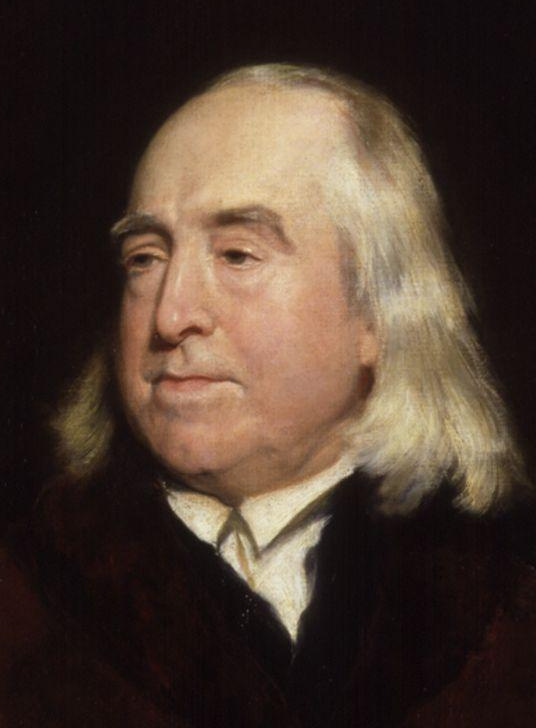
Jeremy Bentham
English philosopher and juristWikipedia
195
MENTIONS
107
EPISODES
94
PODCASTS
Search complete. 195 mentions across 107 episodes found for "Jeremy Bentham".
Nov 1, 2026

Ty LaskyNARRATOR
We think ill of people who are extravagant or reckless, even if they injure no one but themselves.
Ty LaskyNARRATOR
Bentham supposed that the whole of morality could be derived from enlightened self-interest, and that a person who always acted with a view to his own maximum satisfaction in the long run would always act rightly.
Ty LaskyNARRATOR
I cannot accept this view.
Ty LaskyNARRATOR
Tyrants have existed who derived exquisite pleasure from watching the infliction of torture.

Chris William MartinHOST
Just to kind of reiterate, I'm wearing this Fitbit thing, you know.
Trevor JamesHOST
So let's, may I jump in? So let's situate ourselves in the literature again on this, okay? I'm going to quickly cite Jeremy Bentham, okay?
Chris William MartinHOST
That old crusty white man.
Chris William MartinHOST
His mummified body can be found in the University College of London.
Chris William MartinHOST
Yeah, like a book to the library.
Trevor JamesHOST
Yeah.
Trevor JamesHOST
So Bentham had the prison panopticon, you know, where he assisted in, I don't know if he assisted in the actual architecture, you know, the design.
Trevor JamesHOST
of this idea but the the concept of the the panopticon in a prison um i believe came from bentham's thinking and work and that and that was this idea of a subject being observable at all times from a central location and not having knowledge of being observed okay So that's how the prison panopticon design came to be where you could have a guard in a tower centralized in the middle of the prison and the actual design of the prison is round, you know, like a sphere.

Michael SappirHOST
He says it's in fact a veritable Eden of human rights.
Michael SappirHOST
The things that reign exclusively are freedom, equality, property, and Bentham.
Michael SappirHOST
Freedom because only the free wills of the buyers and sellers of a commodity, for example, labor power, determine how these figures act.
Michael SappirHOST
Okay, contractual freedom, treat each other as equals as commodity owners.
Michael SappirHOST
Okay.
Michael SappirHOST
Everybody owns their own shit.
Michael SappirHOST
So freedom, equality, property, and Bentham, because everyone cares only about themselves.
Michael SappirHOST
Everybody acts just like the bourgeois economists would have it, out of self-interest and for personal gain.

Fred JollyGUEST
Well, yeah, in one sense.
Fred JollyGUEST
But we did discuss hedonism and pleasure, and an English guy by the name of Jeremy Bentham, who thought the highest good, the sumum bonum, was the greatest amount of pleasure for the greatest number of people.
Fred JollyGUEST
And that was pretty much what I was, that was my philosophy.
Fred JollyGUEST
So I'm in charge of what's right and what's wrong.

Jared PoirierHOST
Right.
Jared PoirierHOST
And that's where we can talk about Jeremy Bentham, which like later on got expanded by like John Stuart Mill and that kind of thing.
Jared PoirierHOST
But basically saying that you should judge.
Jared PoirierHOST
actions by their outcome.
14 MINS LATER
Jared PoirierHOST
Oh, yeah.
Jared PoirierHOST
Good ban, though.
Jared PoirierHOST
So just to be fair, I want to give Jeremy Bentham some quotes here, too.
Jared PoirierHOST
So, yeah, and I went ahead and found this lovely document here.

Jacob AbolafiaGUEST
That is saying that rehabilitation is possible, but not having a plausible account of how you rehabilitate it.
Jacob AbolafiaGUEST
And the problem with every single account of rehabilitation from Plato through Thomas More through Bentham to the present is nothing works.
Jacob AbolafiaGUEST
And the nothing works, that's a title of a famous book by James Q. Wilson, the person who came up with broken windows policing.
Jacob AbolafiaGUEST
is if nothing works, then okay, rehabilitation's out, deterrence may be still in, and leaves obviously retributive theories on the ground.

Jack HibbsHOST
I've personally never heard of him.
Jack HibbsHOST
But his name is Jeremy Bentham.
Jack HibbsHOST
And he left that school, that teaching hospital school there, multi-millions of dollars for their... expansion and for their future, only under these conditions, only if he could sit on the board of directors as long as the school, the teaching hospital school lasted.
Jack HibbsHOST
That was in his will.

TriciaGNARRATOR
England was in the throes of a convulsion not the less profound because it was silent.
TriciaGNARRATOR
Bentham had at last come into his own, and under the stress of his urgent protests, English institutions were being transformed into the organs of a middle-class state.
TriciaGNARRATOR
The relics of feudalism had at last submitted to the assaults of Ricardo and his school, and the newborn industrialism, even if to an observant eye it seemed but the grim doctrines of Calvin translated to an economic sphere, completely altered the atmosphere of social life.
TriciaGNARRATOR
The revolution, indeed, did not achieve its purpose without suffering.
TriciaGNARRATOR
As early as 1805, Charles Hall had uttered a remarkable protest against the implications of the new civilisation and that half-forgotten school of economists who form a link between the individualism of Bentham and the co-operation of Owen were riddling its protective armour in the name of social justice.
TriciaGNARRATOR
The masses had regarded the Reform Act of 1832 as the prelude to the greatest happiness of the greatest number, and their disappointment expressed itself in the revolutionary activity of the trade unions and the formation of the Chartist movement.
TriciaGNARRATOR
Thinkers like William Thompson and J. F. Bray, noble-minded agitators like Francis Place and William Lovett, are every whit as indicative of the new capitalism as the great merchants and the incredible machines of Lancashire and Yorkshire.
52 MINS LATER
TriciaGNARRATOR
Historically it is an attempt to explain the growth of movements and institutions entirely in economic terms.

speaker_2NARRATOR
It would, however, be easy to show that whatever steadiness or consistency these moral beliefs have attained has been mainly due to the tacit influence of a standard not recognized.
speaker_2NARRATOR
Although the non-existence of an acknowledged first principle has made ethics not so much a guide as a consecration of men's actual sentiments, still, as men's sentiments, both of favor and of aversion, are greatly influenced by what they suppose to be the effects of things upon their happiness, the principle of utility, or, as Bentham latterly called it, the greatest happiness principle, has had a large share in forming the moral doctrines even of those who most scornfully reject its authority.
speaker_2NARRATOR
Nor is there any school of thought which refuses to admit that the influence of actions on happiness is a most material and even predominant consideration in many of the details of morals, however unwilling to acknowledge it as the fundamental principle of morality and the source of moral obligation.
speaker_2NARRATOR
I might go much further, and say that, to all those a priori moralists who deem it necessary to argue at all, utilitarian arguments are indispensable.
45 MINS LATER
speaker_5NARRATOR
him.
speaker_5NARRATOR
Mr. Davies, by an oversight too common not to be quite venial, has in this case confounded the very different ideas of motive and intention.
speaker_5NARRATOR
There is no point which utilitarian thinkers, and Bentham, pre-eminently, have taken more pains to illustrate than this.
speaker_5NARRATOR
The morality of the action depends entirely upon the intention, that is, upon what the agent wills to do, but the motive, that is, the feeling which makes him will so to do, if it makes no difference in the act, makes none in the morality, though it makes a great difference in our moral estimation of the agent, especially if it indicates a good or a bad

Matthew YglesiasHOST
It makes it hard for me to know exactly how seriously to take her specific invocations of specific people.
Matthew YglesiasHOST
She has this long diatribe against utilitarianism and Bentham.
Matthew YglesiasHOST
She comes to the
Jerusalem DemsasHOST
EAs at the end.
97 more episodes mention Jeremy Bentham.
Create an account to see the whole feed, search across every transcript, and follow the entities you care about.