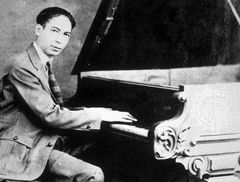
Jelly Roll Morton
American jazz pianist and bandleaderWikipedia
31
MENTIONS
16
EPISODES
13
PODCASTS
Search complete. 31 mentions across 16 episodes found for "Jelly Roll Morton".
Oct 1, 2026

Julian PlascenciaGUEST
And of course, uh, they didn't have like, uh, some, uh, DJs or, or some playlists to, to put on these, um, bars and cafes, uh, lined up all across Avenida Revolución.
Julian PlascenciaGUEST
But a lot of people talk about the music and the dancing, so it had to have been live music, and a lot of it was done by jazz musicians that, uh, came over, uh, from New Orleans, like Ro- uh, Jelly Roll Morton, and many, many others that used to cross the border to find some work and do some music.
Jade HindmanHOST
And among the musicians you have performing in both San Diego and Tijuana is pianist and composer, uh, Danilo Perez.
Jade HindmanHOST
Um, can you tell us about his music, Julián?

Jeff HaasHOST
1920s Chicago wasn't a bad place to grow up, though, if you were a kid hooked on jazz.
Jeff HaasHOST
Musicians had been working their way north from New Orleans since the turn of the century, and there Goodman got to hear the likes of Jelly Roll Morton, King Oliver, and Louis Armstrong.
Jeff HaasHOST
After cutting his teeth alongside cornet legend Bix Beiderbecke and fellow Chicago boy Ben Pollack, a 24-year-old Goodman eventually made his way to New York, where he'd heard NBC was looking for three bands for a new Saturday night radio broadcast called Let's Dance.
Jeff HaasHOST
One group was supposed to be sweet, another Latin, and a third hot, and Benny Goodman's sound apparently proved hot enough to claim the hot spot.

Nik CohnGUEST
Actually, I'd fallen in love with New Orleans at the age of 12.
Nik CohnGUEST
When I went from Derry to London for a few weeks and I went into Dobell's jazz shop and they had a few paperbacks and there was a paperback, Mr. Jelly Roll, Jelly Roll Morton's audio tapes that put the Library of Congress, his autobiography.
Nik CohnGUEST
I really fell in love with it.
Nik CohnGUEST
the picture of New Orleans that he created.
Nik CohnGUEST
In this looping, circular rhythm.
Nik CohnGUEST
There was a left hand, heavy left hand.
Nik CohnGUEST
And when we went to New Orleans in the flesh in 72, walked into the French Quarter with Chris Stamp and Pete Townsend, and it was exactly as I'd imagined it, exactly as Jelly Roll Morton had painted.
Nik CohnGUEST
It hadn't really changed at that stage.

Geoff TobinHOST
Well, for our next number, you've chosen Steve Pistorius, a pianist well known to you with Jig Heidegger on trumpet.
Geoff TobinHOST
And the number you've chosen, again, it's one of the latter Jelly Roll Morton numbers from 1929, Sweet Peter.
Geoff TobinHOST
And what would you say about this?
Barry WrattanGUEST
Well, Raymond came down to New Orleans in the mid-80s, and very quickly, he was quite a youngster then, he was at least only about 21, 22 or so, and he immediately immersed himself in the Jacques Gautier, Yerba Buena-style sound.

Big CHOST
And it does refer to a current day country artist, I would say now.
Big CHOST
You can jingle to the beat of Jelly Roll, which is the artist.
Big CHOST
Yes.
Big CHOST
With Tumba, Tumba, Tumba, Mardi Gras.
Big CHOST
to the Mardi Gras yeah yeah I
Jazzy JeffHOST
didn't hear that
Big CHOST
you can jingle to the beat of Jelly Roll Jelly Roll is
Jazzy JeffHOST
Jelly Roll Morton
Bent PerssonGUEST
He's also been doing the stride.
Bent PerssonGUEST
He has been doing his Jelly Roll Morton all the way.
Roger BeilbyHOST
He's one of the finest Jelly Roll Morton style piano players that I've ever heard.
Roger BeilbyHOST
And I think his ideas on ragtime are very, very good as well.
Roger BeilbyHOST
The Ophelia ragtime band, his first album, Snowball, I thought was excellent.
17 MINS LATER
Morton Gunnar LarssonGUEST
I'm very happy to finally be
John SmythHOST
here.
John SmythHOST
We have heard on this program many times your recordings and know that you are particularly interested in and a good performer of the music of Jelly Roll Morton.

speaker_1HOST
Amazing.
Charlie KeilGUEST
And that's Jelly Roll Morton.
Charlie KeilGUEST
That's New Orleans, the red light district.
Charlie KeilGUEST
So I think it's jazz all the way back.

Ed WardGUEST
... knew that she wasn't recording.
Nate WilcoxHOST
But he also got the jazz scene with Fletcher Henderson, King Oliver, Louis Armstrong, Jelly Roll Morton.
Ed WardGUEST
Well, that was because he was a young man.
Ed WardGUEST
These were people he was going to see, and, you know, once again, the, the, the reluctance of the record companies to, uh, record people like that, uh, just made his job all that easier.

Arroe CollinsHOST
In reality, are you not really, in this moment of now... bringing the real roots of jazz to life where it is about the emotion it is about the feeling and growing forward with it
Gary LucasGUEST
i think so i mean i try to invest as much energy and emotion in bringing out my inner most feelings when i play it's sort of expressionist playing it's been turned i guess uh and i you know i think that when if you listen to one of the first you know, normally considered jazz sides by Jelly Roll Morton or Louis Armstrong, Hot Five.
Gary LucasGUEST
They have a real gut bucket quality, very bluesy.
Gary LucasGUEST
And so it satisfies me to be, to feel part of that tradition, I guess.

John ClarkHOST
I assume that was Georgia Tom Dorsey, Thomas A. Dorsey.
John ClarkHOST
And, uh, Jelly's Blues, a tribute to Jelly Roll Morton.
John ClarkHOST
Actually, it probably...
John ClarkHOST
I don't know if, what came first, the tune and/or the association, uh, that gave Clarence "Jelly" Johnson his nickname, but who knows? Anyway, this is the only tune that, uh, is on this particular disc that I have of his work that was composed by Clarence Johnson.
19 MINS LATER
John ClarkHOST
He May Be Your Man, But He Comes to See Me Sometimes, done or composed by Lem Fowler, who will be coming up in the program soon.
John ClarkHOST
The Joe Oliver Blues by Smith and Dorsey, Thomas A. Dorsey, I'm sure.
John ClarkHOST
And then Jelly's Blues, whether named for himself or for Jelly Roll Morton, I do not know.
John ClarkHOST
But that was the first and the only composition I'm aware of by Clarence Jelly Johnson.
6 more episodes mention Jelly Roll Morton.
Create an account to see the whole feed, search across every transcript, and follow the entities you care about.