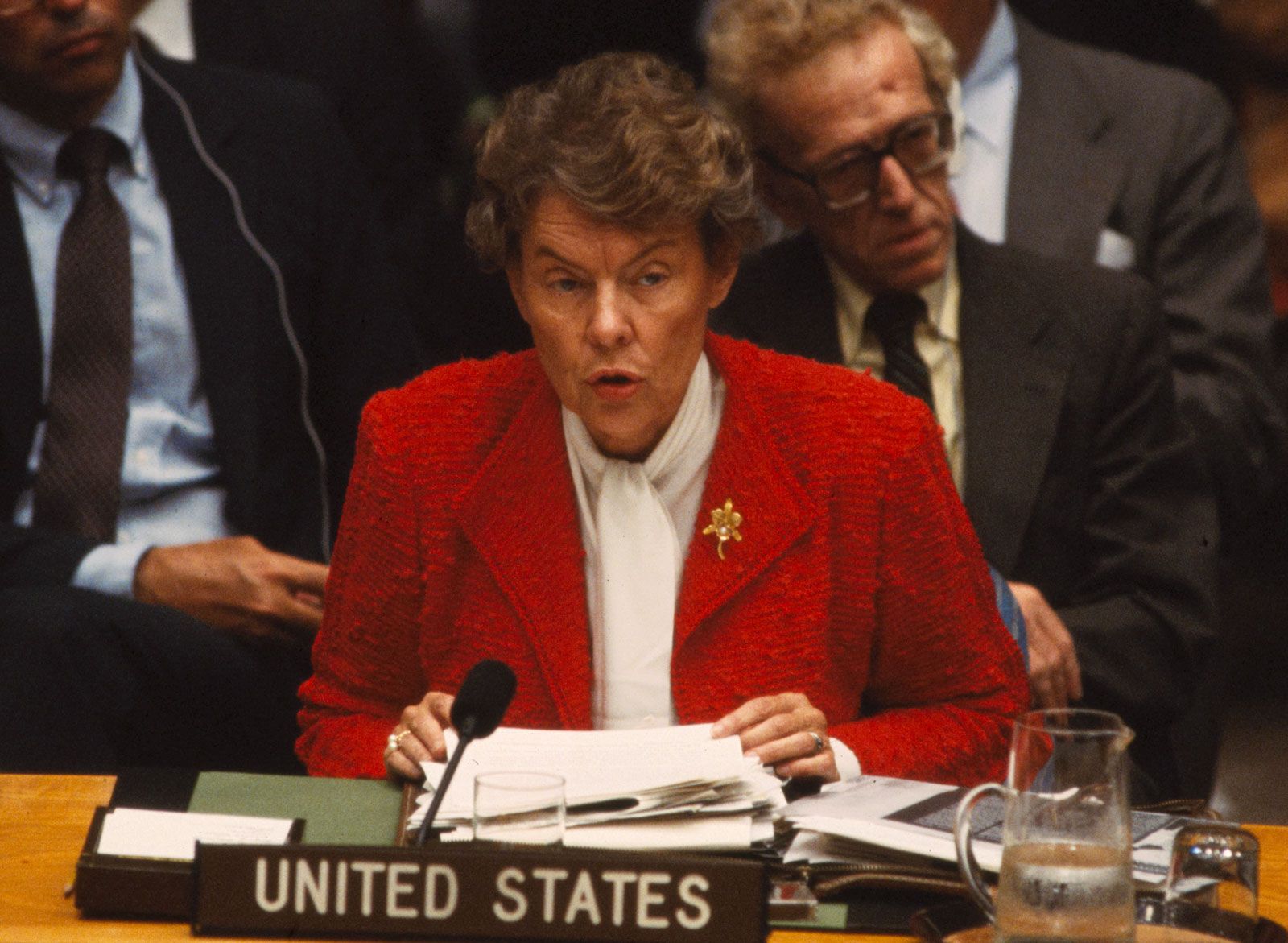
Jeane Kirkpatrick
Political scientist and former United States Ambassador to the United NationsWikipedia
66
MENTIONS
14
EPISODES
14
PODCASTS
Search complete. 66 mentions across 14 episodes found for "Jeane Kirkpatrick".
Oct 9, 2026

Andrew DickHOST
... she is a giant piece of shit.
Andrew DickHOST
That is all the notes I c- I cared to take on Jeane Kirkpatrick.
Tim FardoHOST
And boy, that foreign policy would carry on through many administrations beyond that, both Republican and Democrat, unfortunately.
Andrew DickHOST
Well, yep.

Steve ForbesGUEST
Well, I think that somebody like Jack Kemp had an understanding of it.
Steve ForbesGUEST
Somebody like Jeane Kirkpatrick has some understanding of it.
Steve ForbesGUEST
But I think you have to meld not just the traditional diplomatic military side, you also have to realize the extraordinary role that economics plays, not in terms of trade disputes, but in terms of creating an environment where other countries can get away from the clutches of our Treasury Department and the International Monetary Fund.
Steve ForbesGUEST
We are giving advice to these countries that qualifies as economic malpractice.

Einat WilfGUEST
Certainly.
Einat WilfGUEST
And someone once called me the Israeli Jane Kirkpatrick.
Einat WilfGUEST
I think she also said something similar about the Democratic Party.
Einat WilfGUEST
Yes, you are absolutely right that if you look at my positions today, if someone is old enough, they will tell me that they sound exactly like old labor, right? Ben-Gurion, Golda, if you listen to the words, the vision, the description of the kind of the foundational leaders of Israel and what was known as Mapai, as the old labor party, I I will sound very much in that vein.

Gwen WashingtonADVERTISER
Tap to listen now to Snap Judgment from KQED on Spotify.
JonHOST
An interesting commentary on these rationales came from a liberal Democrat turned conservative Republican named Jean Kirkpatrick, who served as Ronald Reagan's ambassador to the United Nations.
JonHOST
She wrote an article for Commentary magazine in November 1979 that criticized the Carter administration's efforts to promote human rights through trade and arms embargoes.
JonHOST
Whether she was right or wrong is immaterial, but she does make an interesting point about the difference between military dictatorships like the ones America supported in the Cold War and the communist regimes springing up with Soviet help.

Nick CaterGUEST
Which the left love this idea of global citizen, of course.
Nick CaterGUEST
Once you go down this whole idea of a global citizenry, who are we to decide who comes to this country? You have huge problems about accepting citizens Migrants, if you are one of those global citizen people, you think that everybody should be allowed to come.
Nick CaterGUEST
So I'm sure this is encouraging his worst instincts.
Nick CaterGUEST
Michael,
Michael KrogerGUEST
You've still got these Stalinist countries in places like Cuba.
Michael KrogerGUEST
So, yeah, the rules-based order depends on the leadership of these countries, which in those cases has been shocking.
Michael KrogerGUEST
I suppose one good thing is that if you look at Latin America, Latin America is moving to the right.
Michael KrogerGUEST
Trump-aligned candidates have been winning most of the elections in Europe.

Matt BevanHOST
The Reagan administration was split over the issue.
Matt BevanHOST
Reagan's UN ambassador supported the Argentines.
Matt BevanHOST
His defense secretary supported the British.
Matt BevanHOST
His secretary of state flew frantically between London and Buenos Aires to negotiate between each side.
Matt BevanHOST
She also asked Reagan how he would feel if this was happening in Alaska.
Matt BevanHOST
A few days later, there was a vote in the UN Security Council on whether there should be a ceasefire in the Falklands.
Matt BevanHOST
The UK was going to veto it, and they wanted the US ambassador, Jeane Kirkpatrick, to do the same.
Matt BevanHOST
She did at first, but then

Matthew ContinettiGUEST
The, the first wave in the '60s and '70s, those thinkers were primarily interested in the welfare state and in domestic policy.
Matthew ContinettiGUEST
The second wave in the 1980s, so late '70s, '80s, uh, they were, uh, thinkers like Jeane Kirkpatrick.
Matthew ContinettiGUEST
Uh, they were interested in foreign policy.
Matthew ContinettiGUEST
They had a very hawkish attitude toward, uh, fighting the Soviet Union.

Matthew ContinettiGUEST
The first wave in the 60s and 70s, those thinkers were primarily interested in the welfare state and in domestic policy.
Matthew ContinettiGUEST
The second wave In the 1980s, so late 70s, 80s, they were thinkers like Jean Kirkpatrick.
Matthew ContinettiGUEST
They were interested in foreign policy.
Matthew ContinettiGUEST
They had a very hawkish attitude toward fighting the Soviet Union.

Matthew ContinettiGUEST
The first wave in the 60s and 70s, those thinkers were primarily interested in the welfare state and in domestic policy.
Matthew ContinettiGUEST
The second wave In the 1980s, so late 70s, 80s, they were thinkers like Jean Kirkpatrick.
Matthew ContinettiGUEST
They were interested in foreign policy.
Matthew ContinettiGUEST
They had a very hawkish attitude toward fighting the Soviet Union.

Matthew ContinettiGUEST
The first wave in the 60s and 70s, those thinkers were primarily interested in the welfare state and in domestic policy.
Matthew ContinettiGUEST
The second wave In the 1980s, so late 70s, 80s, they were thinkers like Jean Kirkpatrick.
Matthew ContinettiGUEST
They were interested in foreign policy.
Matthew ContinettiGUEST
They had a very hawkish attitude toward fighting the Soviet Union.
4 more episodes mention Jeane Kirkpatrick.
Create an account to see the whole feed, search across every transcript, and follow the entities you care about.