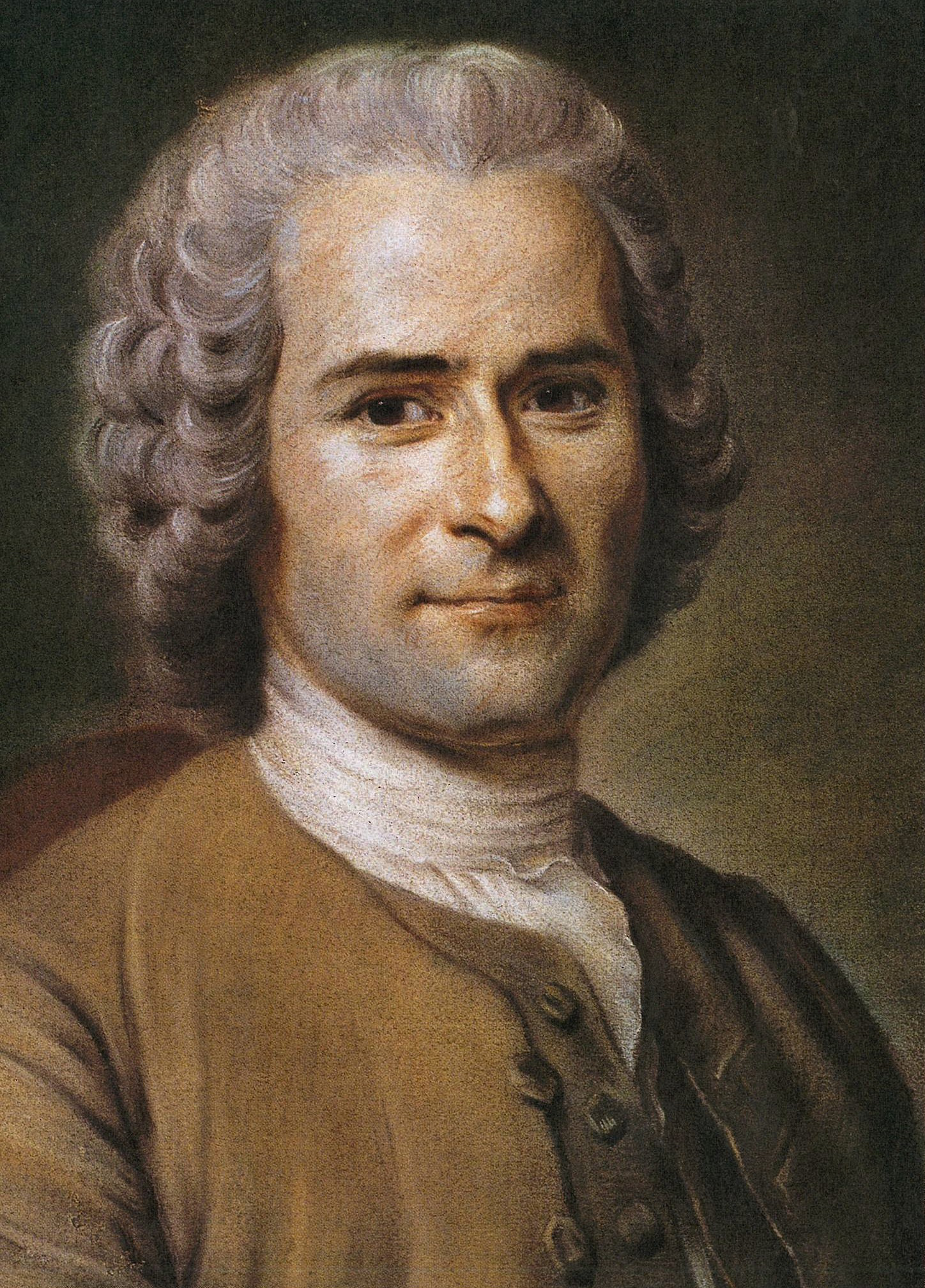
Jean-Jacques Rousseau
PhilosopherWikipedia
1.4k
MENTIONS
406
EPISODES
304
PODCASTS
Search complete. 1438 mentions across 406 episodes found for "Jean-Jacques Rousseau".
Sep 24, 2026

Ray ComfortHOST
Hmm.
Oscar NavarroHOST
Rousseau comes along in the 1700s, and he says, uh, essentially that man's state starts out innocent.
Oscar NavarroHOST
It's society, property, and comparison that corrupts him.
Oscar NavarroHOST
Marx then follows Rousseau, and he says that there's no such thing as human essence.
Oscar NavarroHOST
We are essentially an ensemble of social relations, meaning there's no nature to be fallen.
Oscar NavarroHOST
Then Freud talks about guilt as neurosis.

Bryn RobertsNARRATOR
Besides these descriptions, he gives us graphic pictures of the looseness of provincial life in the heart of Russia, which is sad and hopeless in the extreme.
Bryn RobertsNARRATOR
The story is written in the first person, and the hero makes his confessions with a cynical frankness which rivals that of Jean-Jacques Rousseau himself.
Bryn RobertsNARRATOR
He is supposed to be an examining magistrate, a functionary, who in Russia performs the combined duties of a coroner and a magistrate.
Bryn RobertsNARRATOR
He it is who is called upon to make the preliminary investigations of criminal cases, and who draws up the first reports.

speaker_3NARRATOR
Montesquieu, who revered Fénelon and characterized The Adventures of Telemachus as the divine work of this century, used it as a source of inspiration for his Persian Letters.
speaker_3NARRATOR
The persnickety Jean-Jacques Rousseau made it the only novel he would allow his ideal pupil Emile to read.
speaker_3NARRATOR
And more broadly across Europe, the book became a standard text in the formation of royal and aristocratic youth.
speaker_3NARRATOR
The young Frederick the Great thus encountered Telemachus as one of his earliest works of political education, while Catherine the Great personally annotated a copy for her grandson Alexander, inscribing maxims counseling humanity, accessibility, and compassion.
speaker_0NARRATOR
The good news is that, contrary to frequent depictions, neither is a simple prisoner's dilemma, in which each player's best strategy is to defect no matter what others do, and also that the only solution is necessarily some sort of global regulatory leviathan.
speaker_0NARRATOR
Instead, both collective action problems look more like what game theorists call a stag hunt, after a parable of Jean-Jacques Rousseau's.
speaker_0NARRATOR
party of hunters sets out after a stag.
speaker_0NARRATOR
It will take all of them to bring it down, and it will feed them all for days.

Bryn RobertsNARRATOR
Besides these descriptions, he gives us graphic pictures of the looseness of provincial life in the heart of Russia, which is sad and hopeless in the extreme.
Bryn RobertsNARRATOR
The story is written in the first person, and the hero makes his confessions with a cynical frankness which rivals that of Jean-Jacques Rousseau himself.
Bryn RobertsNARRATOR
He is supposed to be an examining magistrate, a functionary, who in Russia performs the combined duties of a coroner and a magistrate.
Bryn RobertsNARRATOR
He it is who is called upon to make the preliminary investigations of criminal cases, and who draws up the first reports.

Pamela NagamiNARRATOR
Well, Voltaire came and annihilated with laughter.
Pamela NagamiNARRATOR
He and Rousseau were the two voices of a vast process of economic and political transition from feudal aristocracy to the rule of the middle class.
Pamela NagamiNARRATOR
When a rising class is inconvenienced by existing law or custom, it appeals from custom to reason and from law to nature, just as conflicting desires in the individual sparkle into thought.
Pamela NagamiNARRATOR
So the wealthy bourgeoisie supported the rationalism of Voltaire and the naturalism of Rousseau.
Pamela NagamiNARRATOR
It was necessary to loosen old habits and customs, to renovate and invigorate feeling and thought, to open the mind to experiment and change before the great revolution could come.
Pamela NagamiNARRATOR
not that voltaire and rousseau were the causes of the revolution perhaps rather they were co-results with it of the forces that seethed and surged beneath the political and social surface of french life they were the accompanying light and brilliance of the volcanic heat and conflagration philosophy is to history as reason is to desire In either case, an unconscious process determines from below the conscious thought above.
Pamela NagamiNARRATOR
Yet we must not bend back too far in attempting to correct the philosopher's tendency to exaggerate the influence of philosophy.
Pamela NagamiNARRATOR
Louis XVI, seeing in his prison temple the works of Voltaire and Rousseau, said, Those two men have destroyed France, meaning his dynasty.

William JonesNARRATOR
If the true ideal is that of a stable condition free from conflict and disturbance, then there are a number of theories whose claims are superior to those of the popular doctrine of evolution.
William JonesNARRATOR
Logic points rather in the direction of Rousseau and Tolstoy, who would recur to some primitive simplicity, who would return from a complicated and troubled civilization to a state of nature.
William JonesNARRATOR
For certainly progress in civilization has not only meant increase in the scope and intricacy of problems to be dealt with, but it entails increasing instability.
William JonesNARRATOR
For in multiplying wants, instruments and possibilities, it increases the variety of forces which enter into relations with one another and which have to be intelligently directed.

David WalesNARRATOR
Nothing came of the scheme, however, presumably because of intrigues.
David WalesNARRATOR
The youth was partly consoled for this check by a noted physician, the celebrated Dr. Anton Mesmer, an early practitioner of mesmerism, at whose suburban home the one-act German Singspiel, Bastien und Bastienne, based on a parody of Jean-Jacques Rousseau's famous pastoral, La Davin du Velige, was performed.
David WalesNARRATOR
The little piece, for all its simplicity, lives on.
David WalesNARRATOR
Perhaps the most striking thing about the score is the fact that the prelude, or entrada, begins with the theme that was to be the main subject of Beethoven's Eroica.

Jon JakubowskiGUEST
A 16th century farmer would not ask, what is my purpose in life? He would find it through the institutions that surround him, his church, his community, his family.
Jon JakubowskiGUEST
Well, that flipped and after 400 years of philosophers such as Rousseau and Marx and all sorts of other more contemporary ideals, they've talked about now a poesia philosophy, which is inside out.
Jon JakubowskiGUEST
So I define myself, I define my reality.
Jon JakubowskiGUEST
The institutions exist so I can express myself.

MartinNARRATOR
I sat at the back of a little hall whilst he pleaded eloquently in French for the rights of man.
MartinNARRATOR
He was a Jean-Jacques Rousseau, a Mirabeau, a broad-viewed Bright, and the audience was mostly composed of cockney youths, who had come that they might boast that they had stood in the temple of anarchism." Pacard tapped the table impatiently.
MartinNARRATOR
"Why is it, George, that an element of bathos comes into all these things?" Manfred laughed.
MartinNARRATOR
"You remember Anderson, when we had gagged him and bound him to the chair, and had told him why he had to die? When there were only the pleading eyes of the condemned and the half-dark room with a flickering lamp, and you and Leon and poor Clarice, masked and silent, and I had just sentenced him to death.
396 more episodes mention Jean-Jacques Rousseau.
Create an account to see the whole feed, search across every transcript, and follow the entities you care about.