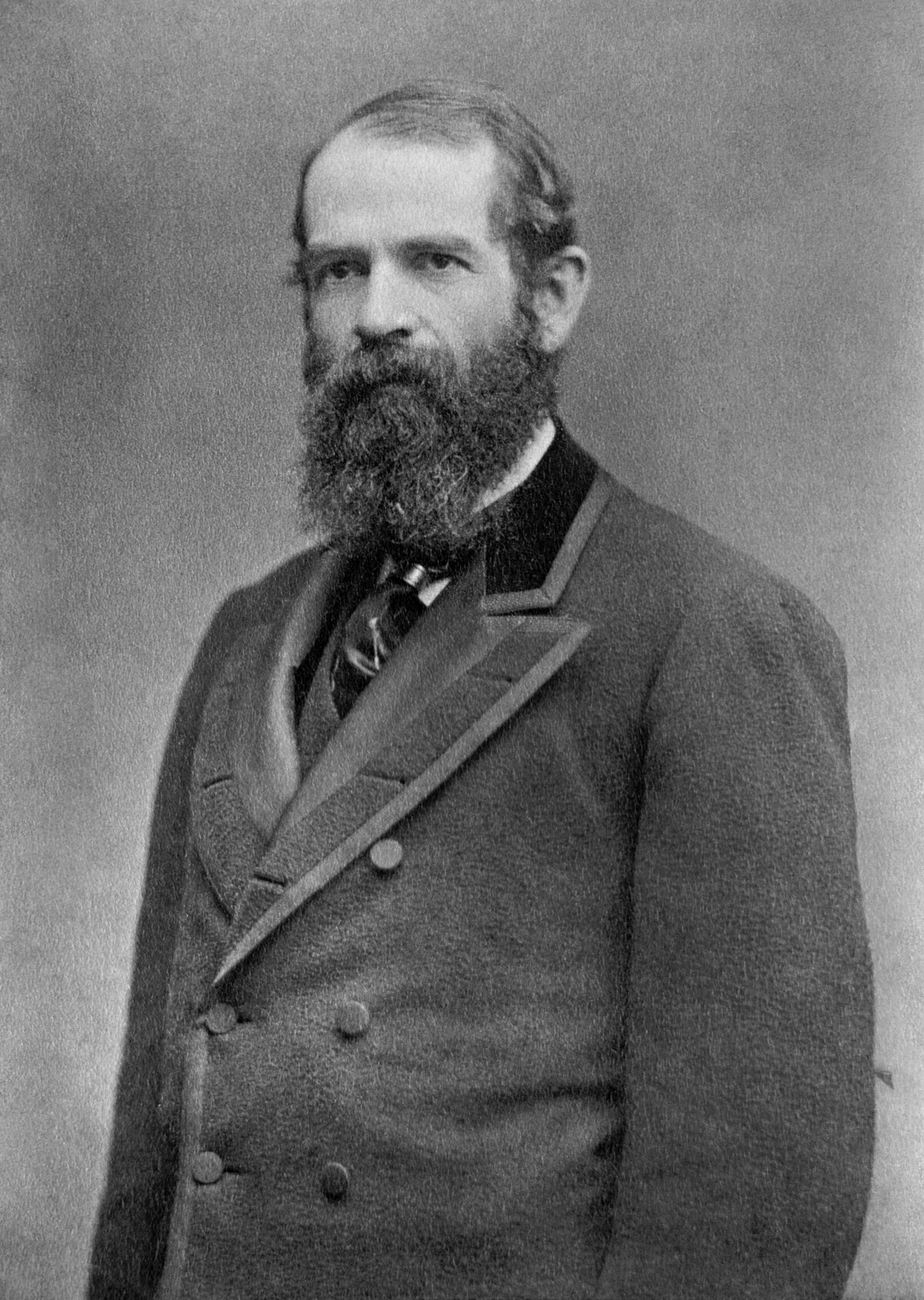
Jay Gould
American magnateWikipedia
77
MENTIONS
34
EPISODES
32
PODCASTS
Search complete. 77 mentions across 34 episodes found for "Jay Gould".
Oct 29, 2026

Elsie SelwynNARRATOR
This LibriVox recording is in the public domain.
Elsie SelwynNARRATOR
From Civil War to World War, Part 1. early history the very early history of the railroads of this country can be passed over very briefly because the more recent history is more important for our purpose the story of the railroads of this country is almost kaleidoscopic in retrospect and therefore highly interesting in the early days before the carriers were placed under the jurisdiction and control of the interstate commerce commission the situation gave a free rein to shrewd and clever operators to use the railroads for their own ends either for the purpose of manipulation to make profits in the stock market in the manner of jay cook and jay gould or to build up a tremendously powerful structure such as e h harryman built up with the union pacific as a nucleus we have said that the story of the roads is one of constantly changing situations roads like the new haven the stock of which for many years was considered one of the sound investments in the country in the space of a very few years under the control of mr mellon was brought to such a pitiable plight that the United States authorities were forced to intervene in an attempt to correct the situation, this road formerly prosperous is today going along at a starvation rate and it would seem as though the prospect of dividends for the stockholders is exceedingly remote the boston and main another of the new england roads paid dividends on its stock uninterruptedly for a period of practically seventy years until in nineteen fourteen the same influences which wrecked the new haven involved it also to such an extent that its dividends were passed the main central another prosperous new england road which had paid dividends practically as long as the boston in maine in the early part of nineteen twenty one also passed its dividend these instances show change from prosperity to starvation which is also duplicated in the histories of the alton and the rock island but of more general and wider interest is the change from weakness and even bankruptcy to great strength this latter is the history of such splendid properties as the northern pacific the atchison the union pacific and the southern pacific all of which have thrived and grown wealthy as the new country into which they have reached has developed Again, there are some properties which have not had to learn the folly of early overexpansion or early overcapitalization, but have had a steady, healthy growth with sane financing and sane operation from the very beginning.
Elsie SelwynNARRATOR
This group includes such great properties as the Pennsylvania, the New York Central lines, the Louisville and Nashville, and the illinois central again there is that group of roads which have started in weakness continued in weakness and now remain in weakness the erie the wabash the missouri pacific the frisco the seaboard and the mobile and ohio are types of this group roads as well as individuals do not stand still history shows that their fortunes are constantly either ascending or descending as the country has grown and population and industry have shifted the fortunes of the railroad companies have shifted in the early days one hundred miles of line was considered a maximum for efficient operation and this remained the standard up to about eighteen seventy about that time the illinois central with a mileage of perhaps seven hundred miles was considered and actually was one of the greatest railroad systems in the world we believe the figures show that until after the civil war with perhaps one or two exceptions there was no railroad in the country with a mileage of over one thousand miles It is interesting to note that the Chicago and Northwestern Road operated with only a little over 100 miles of road almost up to 1860.
Elsie SelwynNARRATOR
By 1866, this had grown to only about 500 miles.
25 MINS LATER
Elsie SelwynNARRATOR
The Baltimore and Ohio 2 was forced to suffer through the practice of its owners in falsifying income statements.
Elsie SelwynNARRATOR
While the real situation in connection with the Chicago and Alton during the time of the Harriman control was not given out to the public, and it would seem was not even known to the Rock Island at the time that the latter purchased control.
Elsie SelwynNARRATOR
It is said that deception had its part in almost every railroad that was ever owned or controlled by Jay Gould.
Elsie SelwynNARRATOR
The troubles of the Gould roads, of course, have been many.
William TomkoNARRATOR
Chapter nine, Men of Affairs, part two.
William TomkoNARRATOR
Let us turn for a moment to the career of another great fortune builder, the man who was perhaps the greatest freebooter the American financial world ever saw, who made his money by destroying rather than building up, and whose wealth finally killed him, Jay Gould.
William TomkoNARRATOR
Let us see if we can get some sort of idea of the personality of this extraordinary man.
William TomkoNARRATOR
Born in 1836, a farmer's boy with only such education as he could pick up, he managed to find time to study surveying, and for two or three years was engaged in making surveys of various New York counties.
11 MINS LATER
William TomkoNARRATOR
Of these men, we shall try to tell something briefly here.
William TomkoNARRATOR
We have already related how Cornelius Vanderbilt secured control of the New York Central and Hudson River roads, and added to these until he had secured an entrance into Chicago, and how his son, William Henry Vanderbilt, added to this system until it became, and still remains, one of the strongest in the country.
William TomkoNARRATOR
We have told, too, of Jay Gould's ideas of railroad management, which seem to have been to get the most out of it for Jay Gould.
William TomkoNARRATOR
But when Jay Gould died, he was caught, as it were, with thousands of miles of railroads on his hands.

speaker_1NARRATOR
The track reached Fort Worth in 1876 and stopped there for three years.
speaker_1NARRATOR
The man pushing the line west was Jay Gould, the New York financier whose syndicate had taken an interest in the railroad the autumn before.
speaker_1NARRATOR
He was racing Collis Huntington, whose Southern Pacific was building east from California along the route the Texas and Pacific had surveyed for itself.
speaker_1NARRATOR
Both men were building a route to the Pacific, and the ground along it counted as right-of-way.

Stefan LinkGUEST
And it took me a long time to understand this because, you know, we think about Henry Ford as almost, you know, the quintessential American capitalist.
Stefan LinkGUEST
And I think often he's kind of very in a kind of facile manner folded in with these Robert Barron types or, you know, compared to Carnegie or Jay Gould or J.P. Morgan.
Stefan LinkGUEST
And that really does him, well, injustice, I guess I was going to say, but it kind of misses the particular texture of what he was what he was trying to build.
Stefan LinkGUEST
You know, you say he was a capitalist.

Stephen EscaleraNARRATOR
In my morning paper, at least, there was no hint to the contrary.
Stephen EscaleraNARRATOR
and at six o'clock we opened our evening papers to discover him a prisoner and russia on the threshold of immediate democracy it was the kind of mental shock that is good for us the war was full of such shocks we learned from it in more dramatic fashion than ever before this very necessary truth that nothing is fixed nothing is sure nothing is changeless in this whole wide world A man told me the other day about a conversation he once held with Jay Gould.
Stephen EscaleraNARRATOR
Gould got up from his desk, walked over to the wall, and, pointing to a map of the United States, put his finger on the Missouri Pacific Railroad.
Stephen EscaleraNARRATOR
There, he said, is the finest railroad property in the United States.

Rick SmithHOST
It's always someone below them.
Rick SmithHOST
And this is the weird part, because again, this is, I go back to Jay Gould.
Rick SmithHOST
I could pay half the working class to murder the other half.
Rick SmithHOST
This is it in action.

Robert SmithHOST
At the same time that you're talking about here, we're also seeing a lot of regular people move into owning stocks and trading stocks.
Robert SmithHOST
And we've done shows before about the manipulation that started to happen, insider trading, pump and dumping stock was what we call it now, and Jay Gould and this whole thing.
Robert SmithHOST
Was there a movement to have protection for shareholders? Or did people think if you have the money to invest in shares, buyer beware?
Adrian WooldridgeGUEST
I think there's not much of a movement at first.

Riley KnightHOST
And today we've got a conspiracy undertaken by two such villains that caused a financial crisis in the United States in 1869.
Riley KnightHOST
It was this week in history, on the 24th of September 1869, that a huge market crash was caused by Jay Gould and James Fisk, who attempted to corner the gold market and thereby raise gold prices to make big bloody money for themselves.
Riley KnightHOST
Now, they did this through a range of different ways.
Riley KnightHOST
They did this through high-level government contacts, including access to President Ulysses S.
Riley KnightHOST
But did so at a predictable and pretty steady rate because, again, the Treasury was making these gold sales pretty predictably every week or so in regular batches, nothing that was going to cause too much economic turmoil.
Riley KnightHOST
However, the fact that the gold price was falling and would continue to for as long as the Federal Treasury continued to sell gold as it was, this put an idea into the heads of two men.
Riley KnightHOST
These blokes that I mentioned before, Jay Gould and James Fiske.
Riley KnightHOST
Gould and Fiske were both relatively wealthy.

Sam ParrHOST
It doesn't matter.
Sam ParrHOST
And there's this famous story about Jay Gould.
Sam ParrHOST
So Jay Gould was in the 1800s.
Sam ParrHOST
John Rockefeller said it's, he was the greatest business mind of all time, and there's a story where his wife had just died.
Sam ParrHOST
She had died, uh, two years ago.

speaker_0NARRATOR
Even when returns get smaller, they keep going.
speaker_0NARRATOR
Sean uses Jay Gould and Charlie Munger to show how some stay in the game almost until the end because making money is their first love.
speaker_0NARRATOR
But it's not just about greed or intensity, is it? Sean suggests this trait shows up early and usually comes with the ability to handle complexity without feeling overwhelmed.
speaker_0NARRATOR
They simplify hard situations by focusing on core logic, not noise.
24 more episodes mention Jay Gould.
Create an account to see the whole feed, search across every transcript, and follow the entities you care about.