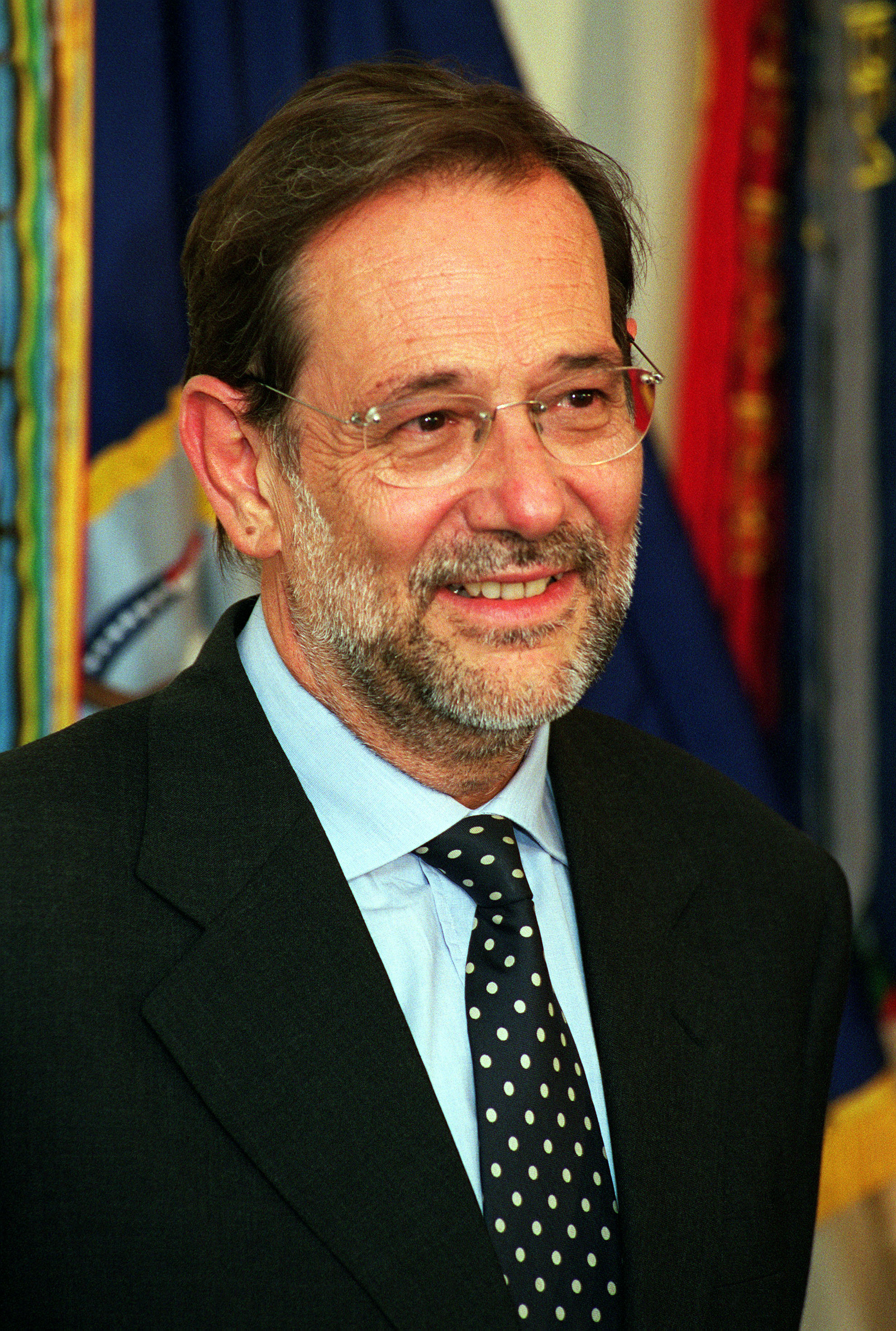
Javier Solana
Physicist and former Secretary General of NATOWikipedia
13
MENTIONS
3
EPISODES
3
PODCASTS
Search complete. 13 mentions across 3 episodes found for "Javier Solana".
Sep 18, 2026

Marwan MuasherGUEST
The Europeans also worked with us on the roadmap.
Marwan MuasherGUEST
Javier Solana was the external relations commissioner at the time.
Ksenia SvetlovaHOST
And
Marwan MuasherGUEST
we managed to come up with a plan that involved three stages.

George RobertsonGUEST
But she was highly charismatic.
George RobertsonGUEST
She had been the candidate before and made my predecessor's life pretty miserable.
George RobertsonGUEST
And they wanted somebody high profile to be the candidate.
George RobertsonGUEST
So I was persuaded to stand in the by-election, which is what I did.
24 MINS LATER
George RobertsonGUEST
So it began to look as if NATO was having some difficulties then during that conflict, albeit it was successful.
George RobertsonGUEST
and a lot of people wanted a reform to take place.
George RobertsonGUEST
My predecessor, Javier Solana, was leaving.
George RobertsonGUEST
He was the Secretary General, and he was going to go to the European Union to be the High Representative in foreign policy.

Ian BondHOST
So let's start with your early years as an EU official.
Ian BondHOST
After 18 years as a Spanish diplomat, in 2003, you started to work for Javier Solana, who was the first EU high representative for the common foreign and security policy.
Ian BondHOST
So what was Solana able to do as high rep that the EU had not been able to do before?
Pedro SerranoGUEST
Well, Solana provided permission continuity in representing externally the voice of the European Union, particularly as regards what we call common foreign and security policy, or the foreign affairs part of things.
Pedro SerranoGUEST
Because at the time, we still had rotating presidencies of the Council that were responsible for the representation of the European Union, which means that the person that chaired the Foreign Affairs Council and that visited different countries to represent the European Union during each period, was the minister of foreign affairs of the country that had the rotating presidency, and at higher level, heads of state or government of the country that was having the rotating presidency.
Pedro SerranoGUEST
But this meant that every six months there was someone new.
Pedro SerranoGUEST
You know, the famous Kissinger quote, whom to call.
Pedro SerranoGUEST
And if you're changing every six months, it's a bit more difficult to build a relationship that is necessary to pursue clarity of foreign policy line and the representation.