Javanese
Spoken languageWikipedia
60
MENTIONS
22
EPISODES
21
PODCASTS
Search complete. 60 mentions across 22 episodes found for "Javanese".
Sep 24, 2026

Alexandra LloydHOST
Sheila grew up in Blitar, East Java, where she spoke Javanese at home and Bahasa Indonesia at school.
Alexandra LloydHOST
She arrived in Memphis as a kid, navigated an American childhood without a roadmap.
SheylaGUEST
I was very self-conscious about speaking because I thought that I was going to have an accent.

Esther GeraldineGUEST
Yeah.
Esther GeraldineGUEST
Which is we're Padangnese and Javanese.
Esther GeraldineGUEST
And...
Esther GeraldineGUEST
Yeah.
Esther GeraldineGUEST
Yeah.
Zach SangHOST
Yes.
Shazfa AdesyaGUEST
We have, like, a Javanese dialect in it, so it's not the Bahasa Indonesia.
Shazfa AdesyaGUEST
It's, it's not-

Koroi HawkinsHOST
A scratchy recording from that Chicago World Fair of 1893, preserved on wax cylinders.
Koroi HawkinsHOST
Ethnic shows came to the fair from all over the world, including these Javanese musicians.
Koroi HawkinsHOST
The whole spectacle attracted 27 million visitors.
Koroi HawkinsHOST
There were dwarf elephants, Buffalo Bill was there, escapologist Harry Houdini, and a performing troupe from Samoa.

speaker_5NARRATOR
A trifling gift, generally a ring or a piece of cloth, is presented by the bridegroom to the bride as an earnest of their engagement, and this ceremony is called the binding.
speaker_5NARRATOR
Javanese marriages are of three kinds, the first being when the rank of the parties is equal or when that of the husband is superior to that of the bride.
speaker_5NARRATOR
The second when the rank of the wife is much superior to that of the bridegroom, and the third is a kind of imperfect marriage or concubinage, which legitimizes the offspring but does not give them all the rights of wedlock.
speaker_5NARRATOR
In the first two kinds of marriage, there is no difference in the ceremony itself, and in the last there is no ceremony at all, the marriage consisting in the parties living together.
Alexandra LloydHOST
Sheila grew up in Blitar, East Java, where she spoke Javanese at home and Bahasa Indonesia at school.
Alexandra LloydHOST
She arrived in Memphis as a kid, navigated an American childhood without a
SheylaGUEST
roadmap.
Alexandra LloydHOST
Not because she forgot them, because it felt safer not to.
Alexandra LloydHOST
This is From Where to Here, the podcast about language, culture, and the journeys that reshape who we are.
Alexandra LloydHOST
Sheila grew up in Blitar, East Java, where she spoke Javanese at home and Bahasa Indonesia at school.
Alexandra LloydHOST
She arrived in Memphis as a kid, navigated an American childhood without a roadmap, picked up English, French, and a bit of Japanese, and taught herself Korean through K-pop and sheer curiosity.
Alexandra LloydHOST
She thought she might become a linguist.

JimmyHOST
Mass hysteria took hold, and panicked villagers reported seeing ninjas everywhere.
JimmyHOST
In the minds of many Javanese, the ninjas had actually adopted the powers of the sorcerers they initially sought to hunt.
JimmyHOST
For instance, there's documented eyewitness accounts of black-clad figures leaping over rooftops, transforming into cats or other animals, and turning invisible.
JimmyHOST
The terror was palpable and often irrational.
JimmyHOST
Every person out wandering at night immediately became the target of suspicion.
JimmyHOST
And by suspicion, I mean that anyone caught out after dark took the very serious risk of being beaten to death by angry mobs.
JimmyHOST
The Javanese authorities detained hundreds of mentally ill people for their own safety, fearing they would be mistaken for ninjas by paranoid crowds.
JimmyHOST
By October and November, reports of gruesome vigilante executions flooded in.

EleanorHOST
So it's like you're going to have like your community of Venetians here.
EleanorHOST
You're going to have like your community of the Javanese here, you know, and things like this.
EleanorHOST
Right.
EleanorHOST
And they do flex things on an international trade level, which is what the treasure fleets are, which are probably the biggest historical flex of all time.

Nadira IlanaGUEST
Malay culture is so diverse.
Nadira IlanaGUEST
And I get really worried when I meet Malays in Peninsular Malaysia who cannot answer me when I ask them, you say that you're Malay, but what is your heritage? Are you Bugis or Javanese? Some people have no idea how to answer that question.
Nadira IlanaGUEST
Some Malays have no idea how to answer that question in Peninsular Malaysia.
Nadira IlanaGUEST
And that homogenization removes specificity, it removes nuance, it removes kind of just like your actual connection with culture because people don't even realize that they're conflating this political identity that has been handed to them as opposed to, you know, like, what are your grandparents' stories and how are you connected to ancestry?

JohnHOST
Right.
JohnHOST
Some of, you know, all of which sound very interesting, some of which are clearly more political than others, and not incoincidentally, those are the ones that are written in Javanese.
JohnHOST
And
BenHOST
they're the ones that Dry Stubble doesn't like also.

Vinay HarrichanGUEST
They speak, uh, Sranan Tongo or Sranan Togo, which is the Creole lingua franca, and then they have their indigenous language.
Vinay HarrichanGUEST
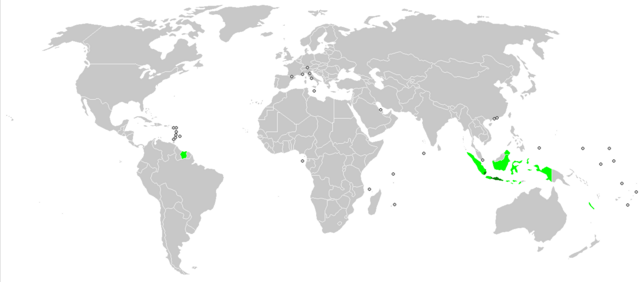
So the Indians speak Hindustani, the people who came from Indonesia speak Javanese, um, indigenous people speak their indigenous tongues.
Vinay HarrichanGUEST
And so the average person there is trilingual because the Dutch were very accepting of a multilingual society, and they were not as strict about conversion and cultural assimilation as the British were.
Vinay HarrichanGUEST
So when you have this sort of forced monolingual society, which is what was happening in Trinidad, where English had to be the medium of government because government was based on the British system, English had to be the medium of education because the education was based in the British system as well, you had this kind of Creole that was created that incorporated not just Hindustani words, but French words, Spanish words, Arabic, words from the Chinese community.
12 more episodes mention Javanese.
Create an account to see the whole feed, search across every transcript, and follow the entities you care about.