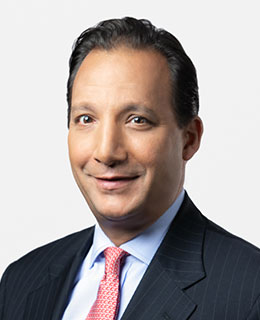
Jason Desena Trennert
14
APPEARANCES
8
PODCASTS
Sep 22, 2026


Jason TrennertGUEST
And I think that's because there's, I think, a general consensus that these companies are going to continue to spend.
Jason TrennertGUEST
They're going to spend every dollar they have, whether it's from cash flow or whether it's from secondaries or bond offerings.

Jason TrennertGUEST
But I think u- unless you're gonna put boots on the ground, it's very, very difficult to use some sort of, as they say, kinetic, um, you know, uh, ver- kinetic, um, approach and have it be successful.
Jason TrennertGUEST
So this may i- indeed help in that regard to get what we want in the United States, which is, uh, a, a non-nuclear Iran.
5:50
So what does this mean if it becomes this long, dragged out trade war as some are saying it might?


Jason TrennertGUEST
You have the war and the oil prices, then you have this debate over hyperscalers and whether they're spending too much or too little on, on CapEx.
Jason TrennertGUEST
Um, and so those are the th- And the Fed, of course, which is the other big...
Jason TrennertGUEST
So i- it, in some ways, it looks like it's hard for the market to make forward progress.
Jason TrennertGUEST
By the same token, the, what's driven the market so far this year, just in the last, Chris and I were talking about this on the way over here, the last 72 hours, people are saying it's, uh, a boulevard of green lights for, for the hyperscalers now because it doesn't look like demand for AI is, is slowing anytime soon.
33 MINS LATER

Jason TrennertGUEST
Well, per- you know, the person in charge gets, uh, gets the blame, and the fact also is that the Fed's balance sheet has gone, uh, went to $9.5 trillion [laughs] during COVID.
Jason TrennertGUEST
Now it's $6.5 trillion, but I think one of the things Warsh is focusing on, um, is that the Fed should not be an active player in the game.
Jason TrennertGUEST
And I think since QE started in 2008, 2009, an enormous amount of negative consequences have accrued to that, not the least of which is it's massively regressive.
Jason TrennertGUEST
It, it's great for rich people that have private equity portfolios and, and venture capital.

Kelly EvansHOST
target.Jason, what's your point of view on the, the hike versus cut versus hold?

Jason TrennertGUEST
I think one of the issues for inflation as well is that there, uh, is really no end, uh, in terms of capital spending on artificial intelligence, and so that's creating some inflation in the system.
Jason TrennertGUEST
The question really is will the benefits of all the spending, the productivity that we're, um, supposed to get out of it, happens before the inflation really shows up? And that I don't know.
Jason TrennertGUEST
Uh, but it is a little bit of a foot race, uh, between, uh, between productivity and inflation right now.
Jason TrennertGUEST
It's hard to see the timing being perfect on that because the inflationary pressures are already here.
Jason TrennertGUEST
Inflation, uh, as it's stated from the government, uh, is really just the change, uh, in inflation from month to month, you know, .2, .3, that type of thing.
12 MINS LATER

Paul SweeneyHOST
How do you put that in context of kind of just the conversation you're having with
Jason TrennertGUEST
Three big things we're talking about with clients, obviously the war, private credit, and the sustainability of the infrastructure spend on artificial intelligence.
Jason TrennertGUEST
And the way we're looking at it is, as we discussed, we think private credit's going to stick around for a while.
Jason TrennertGUEST
The longer it lasts, you know, people forget we've had a 50% increase in the price of oil and three, it's only two weeks.
8 MINS LATER
Paul SweeneyHOST
What are you telling your clients here? Is it the diversification story? Is it the courage to be in the market? Is it all of above?


Jason TrennertGUEST
I think the problem with the private assets, of course, is the opacity, which, which also tends to be the attraction for a lot of pensions, endowments, and foundations, uh, because it seems less volatile, although it's, it's not.
Jason TrennertGUEST
Um, but based on experience, I would say that, um, there's probably gonna be more problems a-and that's only because Wall Street is great at, um, finding ways, very creative ways to extend credit to marginal, [chuckles] marginal players.
Jason TrennertGUEST
I'm for free trade, but again, if you're fixing your currency, it's not free trade.
39 MINS LATER

Jason TrennertGUEST
I'm a big fan of the president, but, uh, some of the actions versus Jay Powell are not, not market-friendly, uh, we'll put it that way.
10:00
Why is the bond market so vitally important for President Trump, and why is Warsh, although President Trump and Warsh have differences of view on monetary policy, why is Warsh probably, for capital markets, the smartest pick at this time?
Jason TrennertGUEST
I'm a big fan of the president, but some of the actions versus J-PAL are not market friendly.

Steve BannonHOST
Why is the bond market so vitally important for President Trump? And why is Warsh, although President Trump and Warsh have differences of view on monetary policy, why is Warsh probably for capital markets the smartest pick at this time? Yeah,
Jason TrennertGUEST
But I do think there are times when gold comes in handy, and I think this is one of those times, because I, I- there- the US has absolutely, in my opinion, there's no chance of the US losing its, its, uh, reserve currency status.
Jason TrennertGUEST
I do think, though, because of a variety of reasons, one is just, uh, the accumulation of debt in the United States and other, other fiat currencies, um, that people wanna hedge against paper, against debt, uh, with a hard asset, uh, like, like gold.
5:28
W- why are central banks buying gold now at record rates when they're in charge of the fiat currency, sir?

Jason TrennertGUEST
Yeah, no, trust me, I've built my entire career out of paper, out of financial assets, as opposed to hard assets.
Jason TrennertGUEST
But I do think there are times when gold comes in handy and I think this is one of those times because the US has absolutely, in my opinion, there's no chance of the US losing its reserve currency status.
Jason TrennertGUEST
I do think though, because of a variety of reasons, one is just the accumulation of debt in the United States and other fiat currencies that people want to hedge against paper, against debt.
Steve BannonHOST
Why are central banks buying gold now at record rates when they're in charge of the fiat currency, sir?
18:49
What, what's your sense of the financial markets' response to the big beautiful bill, and where Jason Trennert thinks we are in the summer of, uh, '25?
Jason TrennertGUEST
Well, in terms of the one big beautiful bill, I mean, I, it's, it's probably a little larger than I would like, uh, but I know that's kind of the way the sausage is made.
Jason TrennertGUEST
But there are provisions in the bill, (clears throat) particularly full expensing of research and development, uh, of capital, expenditures, uh, of factory building, that I think are extremely exciting and will lead to, uh, productivity, which is, in my opinion, the only way the US is going...
Jason TrennertGUEST
It's not go- not going to be a- be able to raise taxes enough, as, as Margaret Thatcher said, you know, "Sooner or later, you run out of other people's money." We- we're right at that, uh, right at that precipice here in New York.
Jason TrennertGUEST
So th- so in my opinion, the US has to grow itself out, and it, and my opinion, that one big beautiful bill, uh, gives, uh, a lot of incentives for businesses not to do financial engineering, but to actually invest in capital and, and in their own, uh, their own businesses.
20:50
... and plus the job he's doing and President Trump continuing to hammer him every day?

Kelly EvansHOST
of course but a 20 down move as you said whether it's the power names you know somebody that you don't get opportunities like that a lot the flip side is those who say that this is the dot-com moment where we thought we needed this massive build out for communications back in the 90s then all of a sudden kind of the the multiples start to slow and they shift and then you think well all of a sudden you know these stock valuations aren't justified so is that the risk for anyone who's thinking about getting in now that it turns out there was, you know, X trillion of market cap for a company, okay, that's still going to do fine, but it's just not going to be as big as we thought it was.
Jason TrennertGUEST
I mean, you know, these folks are, you know, no one's perfect, but there are a lot of smart people here.
Jason TrennertGUEST
Meta made an announcement last week that they're going to be spending $60 to $65 billion on artificial intelligence.
Jason TrennertGUEST
And so this idea that a new AI model that costs a fraction of the price that's coming out of a Chinese hedge fund is going to completely disrupt the AI economy universe right now seems, again, I'm somewhat skeptical of that, but knowing that as we started the show, the thing about technology investing is that you're always subject to the fact that there's always a new widget, there's always new innovation that can wear away competitive advantages quickly.
Jason TrennertGUEST
But I'm not sure this is the one, but again, I'm going to be keeping an open mind.
Kelly EvansHOST
What are you telling clients to expect in terms of tariffs on Mexico and Canada? And why has the president been kind of quiet on China?