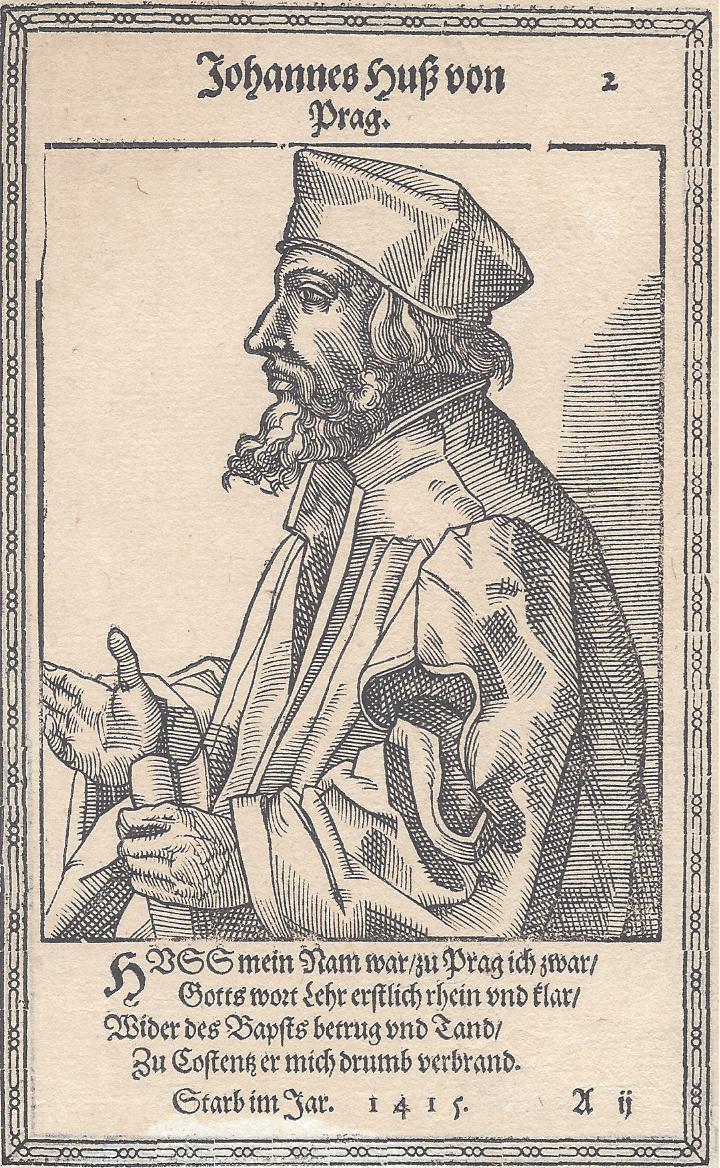
Jan Hus
PhilosopherWikipedia
160
MENTIONS
75
EPISODES
63
PODCASTS
Search complete. 160 mentions across 75 episodes found for "Jan Hus".
Sep 12, 2026

Pamela NagamiNARRATOR
At that session two of the rival popes, John XXIII and Gregory XII, were persuaded to resign, and he had afterwards obtained from the third, Benedict XIII, an engagement to acknowledge the authority of the Council.
Pamela NagamiNARRATOR
Before leaving Constance, too, he had, though most unwillingly, yielding to the solicitations of the divines, consented to the execution of John Huss, the Bohemian heretic to whom he had given a safe conduct.
Pamela NagamiNARRATOR
Extinguishing heresy was supposed to be a great means of promoting harmony among Christians, and he was taught by his spiritual instructors that he had no right to keep faith with the Church's enemies.
Pamela NagamiNARRATOR
But now he was on a mission to prevent war and bloodshed between two nations, for he wished to be the negotiator of peace between France and England, and Charles VI, whom he had visited on his way, had desired him to use his best efforts toward that end.
39 MINS LATER
Pamela NagamiNARRATOR
By this time Pope John repented of the advice that he had given, as the death of Ladislas left him free to go back to Rome, but the matter was now settled.
Pamela NagamiNARRATOR
Besides the rival claims of three different popes, the council had to take into consideration the subject of heresy, for the doctrines of Wycliffe had spread beyond England and were very popular in Bohemia.
Pamela NagamiNARRATOR
John Huss, the confessor of Sophia, Queen of Bohemia, was deeply imbued with them and had translated several of Wycliffe's works into the Bohemian language.
Pamela NagamiNARRATOR
So great was the influence he had obtained that he was made rector of the University of Prague, and though excommunicated by the Archbishop of Prague, he gathered by his preaching a considerable party till disturbances took part in public between his followers and the supporters of papal authority.

Cynthia PacesGUEST
So yeah, I think in my first book, I look at what the Czechs were trying to discover about their past to really almost create a national identity.
Cynthia PacesGUEST
So they look at Jan Hus and they s- they sort of say, "What can we take from this medieval figure?" Or they kind of invent a version of St.
Cynthia PacesGUEST
Wenceslas and say, um, "Okay, how do we make him a symbol of who we are?" So you do, you see tremendous creativity.
Cynthia PacesGUEST
You have, you know, the painters who, who decorate the interior of the National Museum with these epic murals.
Cynthia PacesGUEST
And so to be Czech often meant to not be German and therefore sometimes to not be Jewish, although there were some Jews who gravitated toward the Czech community.
Cynthia PacesGUEST
But yeah, I, I kind of fell in love with those stories too in my... especially writing my first book.
Cynthia PacesGUEST
And I remember the first day that I was at the city archive when I was a graduate student, I was looking at the records of the committee that built the Jan Hus Memorial, and there was a sign-in sheet of who was there at that first meeting.
Cynthia PacesGUEST
And you could see people were using different pens, just like you might pass around a sheet at a meeting.

Cynthia PacesGUEST
So yeah, I think, and my first book, I look at what the Czechs were trying to discover about their past to really almost create a national identity.
Cynthia PacesGUEST
So they look at Jan Hus and And they sort of say, what can we take from this medieval figure? Or they kind of invent a version of St.
Cynthia PacesGUEST
Wenceslas and say, okay, how do we make him a symbol of who we are? So you do, you see tremendous creativity.
Cynthia PacesGUEST
You have, you know, the painters who decorate buildings.
Cynthia PacesGUEST
And so to be Czech often meant to not be German and therefore sometimes to not be Jewish, although there were some Jews who gravitated toward the Czech community.
Cynthia PacesGUEST
But yeah, I kind of fell in love with those stories too, especially writing my first book.
Cynthia PacesGUEST
And I remember the first day that I was at the City Archive when I was a graduate student, I was looking at the records of the committee that built the Jan Hus Memorial, and there was a sign-in sheet of who was there at that first meeting.
Cynthia PacesGUEST
And you could see people were using different pens, just like you might pass around a sheet at a meeting.

Jacob PraschHOST
There's always been.
Jacob PraschHOST
Even in the Dark Ages, the followers of John Wycliffe, the Lollards, or a hundred years before Luther was the Bohemian Brethren under Jan Hus.
Jacob PraschHOST
Other times it was the Waldensians, the Valdési.
Jacob PraschHOST
This is in the Dark Ages now.

Martyn IlesHOST
Here's the interesting thing.
Martyn IlesHOST
What about when I went on the Reformation tour in Europe? And Jan Hus, who for the sake of preaching the gospel in Prague, was taken out and burnt at the stake and died for it.
Martyn IlesHOST
What about the martyrs throughout the history of the church who have died for what? For the evidence of things not seen.
Martyn IlesHOST
For the substance of things hoped for.

Brad OnishiHOST
It was also a time of deep Christian-on-Christian violence.
Brad OnishiHOST
By the time you get to John Wycliffe, Jan Hus, and the Proto-Reformation, you have Christians hanging other Christians at the stake for their beliefs.
Brad OnishiHOST
John Wycliffe was killed because he translated the Bible from Latin into the vernacular.
Brad OnishiHOST
And then we get to the Reformation and the European wars of religion.

Pamela NagamiNARRATOR
The marriage of Anne of Bohemia to the English king Richard II brought the two courts into communication.
Pamela NagamiNARRATOR
Jerome of Prague carried Wycliffe's writings from Oxford to his own country, where they had a profound influence on John Huss, who became the leader of a national religious movement.
Pamela NagamiNARRATOR
Huss was betrayed by the emperor and put to death at Constance in 1415.
Pamela NagamiNARRATOR
This martyrdom led to a long war in Bohemia from 1415 to 36, when racial and political dissensions were mixed with those of religion.
Pamela NagamiNARRATOR
The movement, ceasing to be a united national one, was crushed, but the Hussite doctrines were still held by the people, and many of the reformers' pamphlets were circulated in Germany.
Pamela NagamiNARRATOR
Luther, however, does not seem to have been influenced by them, for it was only after the disputation at Leipzig in 1518 that he carefully studied the teachings of the Bohemian and then declared that he had hitherto been a Hussite without knowing it and that Paul and Augustine were Hussites too.
Pamela NagamiNARRATOR
Other movements less like the Lutheran had a far greater influence upon the 16th century Reformation by preparing the minds of the people for its reception.
Pamela NagamiNARRATOR
In the later Middle Ages, many German translations of the Scriptures were circulated and read in spite of the prohibition of the popes, and the natural result of this study was that laymen began to think for themselves.

Kyle WorleyHOST
When we think about the formal start of the Reformation, we often tie it to Martin Luther with the 95 Theses.
Kyle WorleyHOST
But there were precursors to this, John Wycliffe, Jan Hus.
Kyle WorleyHOST
There were others that were kind of sounding the alarm bells, and I would say there were a number of fronts for which they were sounding these bells.
Kyle WorleyHOST
One was on having access to the scriptures, and that that was really crucial and significant, that people could study the Bible and look at the Bible for themselves.

LukeHOST
The two sides squared off around the question of vernacular Bibles, with one saying that the medieval church was fine with their use, citing a number of early medieval manuscripts translated into vernacular languages such as Old Church Slavonic, Old English, Old High German, and so on.
LukeHOST
Yet their opponent retorted that the church clearly prescribed vernacular Bibles, given the Council of Constance in 1415 specifically pointed to vernacular Bibles as heretical behavior, posthumously charging John Wycliffe with heresy and burning and banning his writings before ordering the execution of Jan Hus under the same pretenses.
LukeHOST
How could two people be right about the same question? Was the medieval church accepting of vernacular Bibles or not? How could it be that we have two equally satisfying answers, each with their own evidence to back it up? Well, not to put too fine a point on it, but the term medieval, historical periodization generally, and hindsight all combine to flatten both time and our perspective.
LukeHOST
The European Middle Ages cover over 1,000 years and the breadth of an entire continent.
17 MINS LATER
LukeHOST
they were also saying, you guys are not doing this right.
LukeHOST
You guys are not doing this thing.
LukeHOST
And all of those critiques, all of the critiques that they made would eventually be rolled up into Jan Hus.
LukeHOST
And then Martin Luther.

speaker_0HOST
In short, in all the long time from the past down to the present, there could not have been Christians on earth if infant baptism were not valid.
speaker_0HOST
Since God has confirmed infant baptism by giving his Holy Spirit, as is perfectly recognized in such church fathers as St. Bernard, Garrison, John Huss, and others who were baptized in infancy.
speaker_0HOST
And since the Holy Christian Church will continue to the end of the world, our opponents must acknowledge that infant baptism is pleasing to God.
speaker_0HOST
For he can never go against himself, foster lies and evil, or give his grace and spirit for such purposes.
65 more episodes mention Jan Hus.
Create an account to see the whole feed, search across every transcript, and follow the entities you care about.