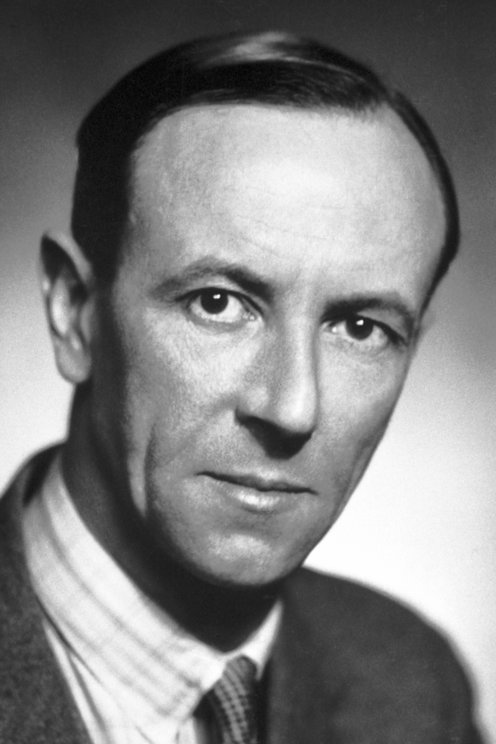
James Chadwick
British physicistWikipedia
9
MENTIONS
7
EPISODES
7
PODCASTS
Search complete. 9 mentions across 7 episodes found for "James Chadwick".
Oct 30, 2026

Scott ManleyHOST
And gamma rays shouldn't do that because gamma rays don't have the sort of energy to do that.
Scott ManleyHOST
It would take James Chadwick in Cambridge in 1932.
Scott ManleyHOST
And he repeated the experiment with the polonium and the beryllium and the paraffin.
Scott ManleyHOST
And he realized that the energies of the protons that are coming out of this were consistent with being knocked out by a particle which has kinematically roughly the same mass as the proton.

speaker_5NARRATOR
The products might have had quite different rates of radioactive disintegration, but they appeared to consist of chemically identical atoms of the same chemical element and hence to belong at the same place on the periodic table of elements.
speaker_5NARRATOR
soddy suggested that such atoms be called isotopes from a greek word meaning same place at the same meeting francis w aston an assistant of thomson described what happened when charged atoms or ions of neon gas were accelerated in a discharge tube similar to the cathode ray tube in which thomson had discovered the electron the rapidly moving neon ions were deflected by a magnet since light objects are more easily deflected than heavy objects the amount of deflection indicated the weight by making a comparison with a familiar gas like oxygen thomson and aston were actually able to measure the atomic weight of neon to their surprise they found two kinds of neon about nine-tenths of the neon atoms had an atomic weight of twenty and the remainder an atomic weight of twenty-two what thomson and aston had done was to show that the stable element neon is a mixture of two isotopes a device that can do what their apparatus did is called a mass spectrometer since their time instruments of this type have shown that more than three-fourths of the stable chemical elements are mixtures of two or more stable isotopes in fact there are about three hundred such isotopes in all the number of known unstable radioactive isotopes radioisotopes natural or man-made is greater than one thousand and is still growing End of Section 4
Wayne CookNARRATOR
Section 5 of Our Atomic World The Story of Atomic Energy This is a LibriVox recording.
Wayne CookNARRATOR
All LibriVox recordings are in the public domain.
5 MINS LATER
Wayne CookNARRATOR
This was the first instance of deliberate transmutation of one stable chemical element into another.
Wayne CookNARRATOR
Since that time, practically every known element has been transmuted by bombardment.
Wayne CookNARRATOR
the dream of the alchemists has been partially fulfilled in that mercury has been changed into gold we say partially fulfilled because the process is much too expensive to be economically profitable some particles have no electric charge during the early nineteen twenties a number of investigators including harkins in the united states orm masson in australia and rutherford and his assistant james chadwick in england seriously considered the possibility that a neutral particle might exist in nature possibly formed by the very close association of a proton and an electron However, strenuous efforts to produce such particles by combining protons and electrons were unsuccessful.
Wayne CookNARRATOR
During these years, the new technique of bombarding all kinds of matter with alpha particles to see what would happen was mightily exploited, and it gradually became clear that in a few instances, a peculiar and highly penetrating kind of radiation was produced.

RyanHOST
From it, Rutherford concluded that an atom is made of a tiny, hard, positively charged nucleus that is surrounded by orbiting electrons.
RyanHOST
And finally, in 1932, James Chadwick discovered the neutron.
RyanHOST
That experiment was super complicated, so I'm not going to try to explain it here.
RyanHOST
The important thing for our purposes is it established that the nucleus is made of protons, which are positively charged, and neutrons, which do not have a charge.

Matt Money SmithHOST
Scientists had identified the proton and electron by the early 1900s, but the elusive neutron to complete the trifecta took much longer to find.
Matt Money SmithHOST
And the person who finally caught it was a quiet, stubborn Englishman named James Chadwick.
Matt Money SmithHOST
Born in Bullington, Small town in Cheshire, England.
Matt Money SmithHOST
Family did not have much money, but like so many we celebrate in this space, his big brain got him out of the neighborhood.
Matt Money SmithHOST
Yes, it was.
Matt Money SmithHOST
Radioactive.
Petros PapadakisHOST
James Chadwick.
Petros PapadakisHOST
All right.

Richard ToyeHOST
And you can see – Perhaps Churchill, to some extent, sort of used his charm in order to persuade Roosevelt to do things which Roosevelt's advisors might not like him to have agreed to, right? And also, really, the question is what the status of it was.
Richard ToyeHOST
Did other people in the U.S. government really know about it? And there's also the question of was Roosevelt doing this in order to keep Churchill happy without really intending to implement it fully? But it does have some effect because there is some restoration of scientific collaboration, which means that brilliant British scientists like James Chadwick and Otto Frisch are sent to Los Alamos, one of the key sites of the Manhattan Project.
Richard ToyeHOST
And so it's not that the Quebec Agreement is totally redundant, but I would say the British invests and Churchill invests much more significance in it than the Americans ever do.
Warren DockterHOST
Right, yeah, because I think already from the American perspective, Britain's a junior partner in this.

Dave FarinaHOST
Ernest Rutherford found protons in 1911.
Dave FarinaHOST
James Chadwick found neutrons in 1932.
Dave FarinaHOST
Then Carl Anderson found the first antimatter particle, the positron, in the same year.
Dave FarinaHOST
Within the next two decades, muons and pions were found, and particle accelerators started coming online around the world.