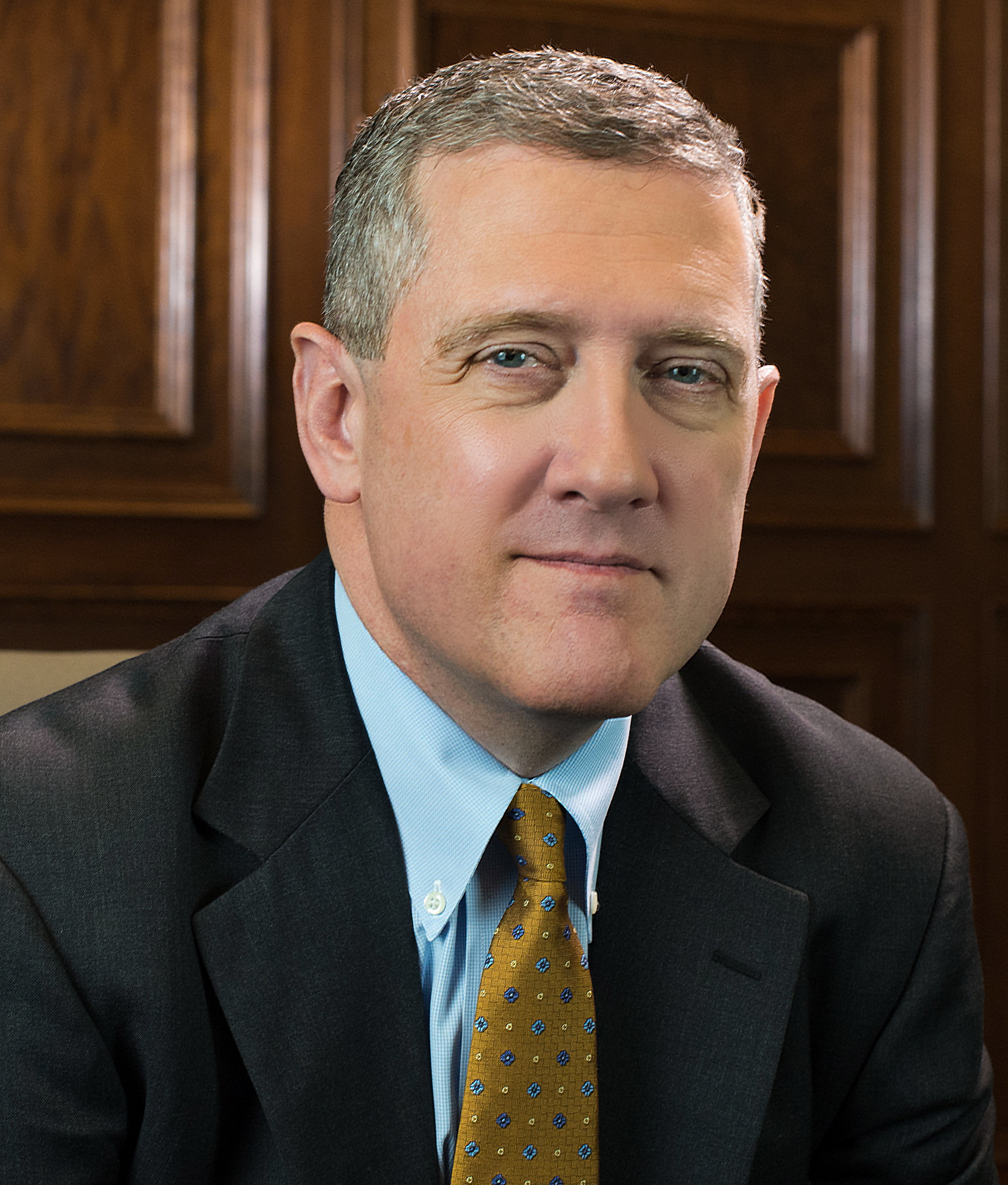
James B. Bullard
Dean of the Krannert School of Management
34
APPEARANCES
10
PODCASTS
Oct 30, 2026


James BullardGUEST
And again, I think you just don't want these long, dry spells in case something does happen during that period.
James BullardGUEST
And again, you can manage that, but you've got to come in with some special meeting.

Kelly EvansHOST
Do you think that's a fair statement? And how do you think that also may impact or not impact kind of markets reaction to monetary policy? He has

James BullardGUEST
heard yesterday? I think it was a good decision by the committee, and I think this decision was essentially made in the September meeting.
James BullardGUEST
I think that when we heard from New York Fed President John Williams, he laid out his own view, but a view that I think is popular on the committee, which is that He didn't think he had to go that often.
James BullardGUEST
He thought they could wait and see, wait until December, and then for 2027, they'll have another SEP coming up in December, and at that point, they'll be able to decide what to do.
James BullardGUEST
I think for this meeting, for the press conference, I think Chair Warsh could have just said, look, we just moved at the last meeting, and there was a lot of market movement around that meeting, and there was.
Jonathan FerroHOST
What do you think the end game looks like in the next 12 months? Because I can't take much more of it.
James BullardGUEST
Uh, I think that the September meeting is the meeting that has the most forward guidance, uh, because they give a dot plot that only goes to the end of the year, so you're basically saying what you're gonna do over the next two meetings.
James BullardGUEST
And the dot plot came out with, "Okay, we'll raise in September, and we'll do one more by the end of the year." So the speakers have come out, uh, in particular Chris Waller and John Williams, and they said, uh, that's a, you know, that's what they see happening.
James BullardGUEST
I think that's where the center of the committee is, and I think they wanna wait and see for 2027, and so they've got a flat, uh, outlook for 2027.
Jeremy SzafronHOST
Which raises the obvious question, if not rates, then what is it pricing? I asked Bullard whether gold ever came up in 15 years of these international meetings.

Jim BullardGUEST
Uh, but I do think the activity in the gold market, uh, certainly according to people I've talked to overseas, you know, it is a bigger issue overseas because you could say the foreign central bank might wanna hold the gold instead of, uh, instead of US Treasuries.
Jim BullardGUEST
Uh, there certainly have been banks that have been diversifying away from Treasuries.
Jim BullardGUEST
And, um, uh, so I think there it's, uh, more of a factor, and I know markets have been betting one way or another against, against that, uh, in recent times.
Jim BullardGUEST
And, and, uh, you know, gold still is an indicator of, uh, maybe lack of faith, uh, in the Fed.
Jim BullardGUEST
So normally, uh, you'll get, uh, gold running up if, if that credibility's being eroded.
9 MINS LATER
Jeremy SzafronHOST
And one more, on the Treasury's decision to step into the long end of its own bond market.

Jim BullardGUEST
So I think, you know, some of the hawks like Beth Hammack have made the case even this morning that the data is already there.
Jim BullardGUEST
The committee is already saying that at the end of this year, the best they're going to be able to do on core PC inflation is something very close to 3%.
Jim BullardGUEST
and that's going to be very similar to where it's been in 2023 in December, in 2024 in December, in 2025 in December.
Jim BullardGUEST
So it really made no progress across those years, and you have to get more restrictive if you're going to do that.
Jim BullardGUEST
I've also made the argument that this is a good time to fight inflation, and I saw a little bit of that in speech here where he summarized the real side of the economy as being uh relatively good uh you know pretty strong growth certainly the ai boom going on you've got the um labor market uh seemingly uh you know very close to full employment certainly the unemployment rate uh very low by historical standards in the us and so then he turns to inflation and clearly that's not going so well so i think uh the case for getting more restrictive is is there and uh it probably doesn't depend so much on you know uh hair splitting about the about the data and anyway the committee could could start um in september or sometime in the second half of this year and then they could see how the data come in and see if they wanted to make more moves uh going forward so so all of this is uh is i think good news for markets they were looking for a more explicit message from the chair and they got it
8 MINS LATER
Jeremy SzafronHOST
So, I mean, is that ordinary debt management or is it interest rate policy run out of the wrong building?
Jonathan FerroHOST
Would you assume that's the direction of travel now into the next quarterly refunding later on this year?
James BullardGUEST
Uh, yeah, you could see that, and, and, uh, markets would have to react to that, and, and, uh, of course supplies is, uh, is critically important for the traders.
James BullardGUEST
But I don't think for the macro, uh, economy, you know, that doesn't change the fundamentals.
James BullardGUEST
The committee's still expecting over 3% at the end of this year, even with good inflation reports between now and then.
James BullardGUEST
Uh, you've got, uh, you know, longer term yields, 30 years, uh, up over 5%, 10 year, you know, heading toward 5%.
Jonathan FerroHOST
Would you assume that's the direction of travel now into the next quarterly refunding later on this year?
Jim BullardGUEST
And, and, uh, of course supplies is, uh, is critically important for the traders.
Jim BullardGUEST
But I don't think for the macro, uh, economy, you know, that doesn't change the fundamentals.
Jim BullardGUEST
The committee's still expecting over 3% at the end of this year, even with good inflation reports between now and then.
James BullardGUEST
Uh, it's probably not, uh, unanticipated given, uh, that, uh, Chair Warsh is new, uh, in the role.
James BullardGUEST
But I thought, uh, you know, the sell-off, uh, the higher yields in the, um, uh, 30 year are, are, you know, kind of nerve-wracking for a central banker.
James BullardGUEST
I think he needed to do more to, uh, create optionality in September, uh, and he didn't do very much of that.
Jonathan FerroHOST
Jim, do you think that performance makes it more likely they'll hike in September?


James BullardGUEST
I'm l- looking forward to trying out this material with the, uh, group here, and I'm looking forward to the question and answer period and see what you guys think.
James BullardGUEST
Um, my answers on the poll would be, uh, from this talk, are gonna be, yes, the Fed's behind the curve, although you have to reinterpret it a little bit.
James BullardGUEST
So, um, [clears throat] this is called Is the Fed Behind the Curve? Two Interpretations.
20 MINS LATER


Daleep SinghHOST
Is Chair Warsh doing the right thing? And what does it cost the Fed to give up guidance in terms of front-end volatility, the transmission of policy to the economy, and global spillovers? What are the trade-offs?
James BullardGUEST
He says you telegraphed so much that the committee felt trapped at times that they had to deliver, even in cases where the data had not really come in the way that it was projected to come in.
James BullardGUEST
At that meeting, the committee raised the policy rate and then projected further rate increases during twenty seventeen.
6 MINS LATER
Daleep SinghHOST
One is, do you expect that Warsh's inflation framework task force might end up with the type of regime-dependent approach that you described and advocated for? And second, maybe this is a harder one, if your regime-dependent framework were in place today with core PC at three point four percent, what regime are we in?


Frank HollandHOST
You don't seem to think it has a big impact, but I do have to ask, the fact that there's potential, uh, for some other legal action to happen, is that an overhang over the Fed?
Jim BullardGUEST
Um, but it is very important for Fed independence, and I think the majority was exactly right, that if you allow partisans on either side of the aisle to just say, uh, somebody did something wrong, you know, a long time ago, and then not have any, uh, due process around that, that that's just firing at will.
Jim BullardGUEST
And if you're gonna have firing at will, then put that into the legislation and just say you can fire at will.
Frank HollandHOST
The fact that, uh, Justice Roberts was actually part of the majority, is that a good sign just for Fed independence if it ever comes back up to the Supreme Court in the near future? The fact that he was on the side of the majority, it was a close vote, as you mentioned, but the chief justice on the side of the majority.
James BullardGUEST
I think that is, you know, the, the kinds of actions that were taken there in the several week period in March and April of 2020, uh, required, uh, you know, really great dexterity on his part, uh, working with the US Treasury.
James BullardGUEST
I don't think he really gets enough, uh, credit for everything that he did there.
James BullardGUEST
Um, he's gonna unfortunately also, uh, be known as the, the Fed chair that's associated with the, uh, inflation episode that's unprecedented in the last 30 years or so.

Scott WapnerHOST
In total, though, do, do you think he did, uh, an A job, a, a B job, g- given everything that we know?
speaker_0ADVERTISER
He talked about regime change, but can you translate to, in details what else we could see out of a Kevin Warsh Federal Reserve?
Jim BullardGUEST
Um, I think on the communication, he equivocated a little bit on press conferences, so, uh, we'll see.
Jonathan FerroHOST
Jim, if they put more emphasis on short-term rates, what does it tell you about their ability to really influence the US economy more broadly?

Jonathan FerroHOST
Now, Jim, I just wondered this time around how critical this moment actually is with a fragile labor market and pressure once again on inflation coming from energy.
Jim BullardGUEST
I mean, of course, this is going to bring up, you know, hearkening back to the 70s, but the U.S. is a leading oil producer today.
Jim BullardGUEST
I think the recession threat from this shock is probably smaller than it would have otherwise been because you've got the supply side kind of offsetting demand destruction that could occur.
Lisa AbramowiczHOST
Jim, what gives you confidence that there's enough momentum in the underlying economy to make this not an issue of demand destruction, not an issue of the consumer increasingly crimped?
James BullardGUEST
Uh, we were talking about this when I was on the show last time, you know, in, in more in the value space.
James BullardGUEST
Uh, and certain, like, defense companies are defensive right now because they're hard asset companies that also are seeing good, strong top line growth for, uh, obvious reasons.
James BullardGUEST
Pharma companies, strong dividends, broad, you know, broadly diversified and well defended, um, you know, product moats, if you will.
James BullardGUEST
So it's, it's these companies that are very broadly diversified, not as reliant on, you know, um, where the market is valued, have a good dividend yield.
Jonathan FerroHOST
Now, Jim, I just wonder this time around how critical this moment actually is with a fragile labor market and pressure once again on inflation coming from energy.
Jim BullardGUEST
Yeah, I mean, I've backed off the term independence because I think it gives the impression that the Fed is off on its own island, doesn't have to be responsible to anybody.
Jim BullardGUEST
But on the other hand, you don't want it to be too close to the political process because countries that have allowed that have gotten poor outcomes, both with respect to employment and with respect to inflation.
Jim BullardGUEST
So I think you want to be close enough to be responsible and accountable, but far enough from day-to-day politics so that you can make good decisions on monetary policy.

Leslie PickerHOST
Do you think Kevin Warsh, if approved, would kind of change his thinking as it pertains to improving Fed accountability, Fed credibility in any way? Does it change the way maybe he communicates with the market or the way that he communicates with the committee?

Annmarie HordernHOST
So is the committee almost looking through inflation? Uh, have they been given the green light by the Fed chair to look through if there's going to be any hot print, prints upcoming when it comes to inflation?
Jim BullardGUEST
Yeah, I, I do think that the chair at Jackson Hole, uh, very much signed on to the idea that, uh, any inflationary effects coming through the tariff channel would be, uh, smaller than, uh, previously anticipated.
Jim BullardGUEST
even though you say, uh, like, uh, President Barkin said, "Well, it's not getting any better," uh, for those that thought there was an important tariff component to inflation, uh, that part should go away since that's a one-time effect.
Jim BullardGUEST
And so that's giving the committee confidence that they can go ahead and get to, uh, closer to neutral.
Lisa AbramowiczHOST
I just wonder if the Fed should think of a new paradigm, a new benchmark to try to u- understand exactly what the optimal employment level is and how they should weigh these two risks.
Jonathan FerroHOST
I think you can share with us the kind of questions I imagine that he's asking you when I asked them to you, which essentially is how do you view things right now? How do you think about the labor market?
Jim BullardGUEST
Uh, this is, uh, looks like a sequence of three moves in a row through the end of the year.
Jim BullardGUEST
Of course, you wanna be data-dependent and, uh, Chair stressed that in the press conference.
Jim BullardGUEST
But I think the committee was, uh, worried about the nonfarm payrolls, uh, report that, that, uh, you know, revised the previous, uh, months down considerably.
8 MINS LATER
Lisa AbramowiczHOST
Are you gonna get rid of it? Would you get rid of it? I mean, what use does it have?


David HarperHOST
And a little earlier on, I asked him what impact this current case is having on markets.
Jim BullardGUEST
People have been commenting that the market impact hasn't been as much as they would have thought.
Jim BullardGUEST
Markets feel that as this current case winds through the courts in the U.S., that ultimately the Supreme Court will back the intention, I think, of the Congress, which was to make it very hard to change personnel at the central bank based on political whim.
Jim BullardGUEST
feature of the federal reserve act we'll see how it all comes out but i think markets are betting that the supreme court will will sort of back the independence to the extent it's in the federal reserve act
David HarperHOST
Do you think we're in a situation where whoever does take that job can be fully independent of the political system, given the situation we're in at the moment?
Jim BullardGUEST
Even though we've been using the term even right here of central bank independence, I try to steer away from that a little bit and say that the central bank is arm's length from politics, day-to-day politics.
Annmarie HordernHOST
James, Jim, how much are you seeing what we heard from Fed Chair Jay Powell and seeing anything different that you would really say if you were at that podium?
James BullardGUEST
He didn't say too much about beyond that, what you want to do with the October meeting or the December meeting.

Michael McKeeCORRESPONDENT
Going into a speech like this, would he have polled everybody? Does he think he has the votes for that? Because we've been speaking with Fed officials here in Jackson Hole, and there are still some who are saying, well, we're not sure that we need to do that yet.

Lisa AbramowiczHOST
James, Jim, how much are you seeing what we heard from Fed Chair Jay Powell and seeing anything different that you would really say if you were at that podium?
Jim BullardGUEST
He didn't say too much about beyond that, what you want to do with the October meeting or the December meeting.
Michael McKeeCORRESPONDENT
Going into a speech like this, would he have polled everybody? Does he think he has the votes for that? Because we've been speaking with Fed officials here in Jackson Hole, and there are still some who are saying, well, we're not sure that we need to do that yet.

Lisa AbramowiczHOST
James, Jim, how much are you seeing what we heard from Fed Chair Jay Powell and seeing anything different that you would really say if you were at that podium?
Jim BullardGUEST
He didn't say too much about beyond that, what you want to do with the October meeting or the December meeting.
Mike McKeeCORRESPONDENT
Going into a speech like this, would he have polled everybody? Does he think he has the votes for that? Because we've been speaking with Fed officials here in Jackson Hole, and there are still some who are saying, well, we're not sure that we need to do that yet.
Lisa AbramowiczHOST
Uh, James, Jim, how much are you seeing what we heard from Fed Chair Jay Powell a- and seeing anything different that you would really sake, uh, say if you were at that podium?
Jim BullardGUEST
Uh, he used the, the, uh, speech to, uh, solidify expectations for 25 basis points in September.
Jim BullardGUEST
Um, he leaned into the most recent labor market report, which was, uh, very soft.
Jim BullardGUEST
Um, he didn't say too much about beyond that, um, uh, what you wanna do with the October meeting or the December meeting.
Michael McKeeHOST
Going into a speech like this, would he have polled everybody? Does he think he has the votes for that? Because we've been speaking with Fed officials here in Jackson Hole, and there are still some who are saying, "Well, we're not sure that we need to do that yet."
Jonathan FerroHOST
How much will we see? And once they've seen it, to what degree will it hang around? To what degree will it actually be transitory, or will it be sticky? Jim, is two CPI reports enough to draw any conclusions on that?
Jim BullardGUEST
Uh, they're gonna wanna see that data, uh, uh, going into September, and that'll be the, uh, that'll carry the day here today, I think.
Jim BullardGUEST
You've also got jobs reports, uh, in there, so, uh, they'll wanna see that, uh, before they make a decision, and that'll, that'll be the basic idea.
Jim BullardGUEST
But, I think the, the notion is that they've already put the, um, recalibration policy on pause.... for the first six months of 2025, waiting to see what the tar- policy would be and whether it would feed through to inflation.
Jim BullardGUEST
They didn't really get anything out of that, uh, and that's why, uh, the policy rate's sitting a little bit high compared to, uh, inflation readings and unemployment readings right now.
Lisa AbramowiczHOST
And James, do you think that, uh, Jim, do you think that it's fair to think that next year you're going to see some pretty significant rate cuts? And not just because of the new Fed chair, but because you think it could be appropriate based on potentially ongoing disinflation?
Mike SantoliHOST
Is that something that makes sense, or is that just another way of saying they'd like to kind of keep the Fed's feet to the fire?
Jim BullardGUEST
But a lot of that was actually the Congress and the White House at that time authorizing a lot of expenditure in that March bill there in 2021.
Jim BullardGUEST
And that turned out to ignite a lot of inflation in the US economy in conjunction with the low rates that the Fed had at the time.
Jim BullardGUEST
So, but I do think the Fed recovered with its 2022 policy, which I advocated for a very sharp increase in the policy rate, brought down the inflation rate without a recession.
Jim BullardGUEST
So that's a huge success story for the Fed that we were able to get rid of that level of inflation, 80s level of inflation without a Volcker type recession.
Mike SantoliHOST
How much farther do you think they have to fall before they get to something reasonable in terms of neutral? Because, look, if we have a nominal GDP right now of 5-ish percent, what are we to expect? from short-term rates?
Scroll for more appearances