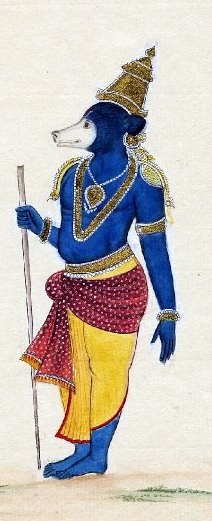
Jambavan
8
MENTIONS
3
EPISODES
3
PODCASTS
Search complete. 8 mentions across 3 episodes found for "Jambavan".
Oct 8, 2026

PremHOST
We all know that, you know, there is this scene which is taking place.
PremHOST
The Vanaras and, uh, Jambavan and all of them are gathered on the s- shore of the other side of, uh, the ocean.
PremHOST
And they're wondering who is, who is capable of jumping across and going to, mm, uh, Lanka and looking for Mother Sita.
PremHOST
And everybody is telling yojanas, or the distance they can jump.
PremHOST
He does not say how much he can, uh, uh, jump.
PremHOST
The reason is, I think he has this curse because of which he's not aware of his own strength.
PremHOST
He's not aware how much he's capable of doing himself, right? So he's quiet and finally, I think Jambavan or somebody, uh, looks at Hanuman and says that, "You can do it.
PremHOST
I know that you don't realize that you can do it, but you really can do it." And that's how Hanuman is chosen, and he's sent across this ocean as emissary of Lord Rama to go and ma- meet Mother Sita.

Marney BlairHOST
Everywhere.
Arjun DheerGUEST
Everywhere they've existed in Hinduism, there's a king of bears called Jambavan who interacted with the Hindu kings and fought one of them.
Arjun DheerGUEST
And I mean, these stories are thousands of years old.
Arjun DheerGUEST
And in every culture where there's bears, they're so present in the mythology, right? In all the stories.

speaker_1HOST
The Russian word for bear, medved, means honey eater or one who knows where the honey is, which is itself a euphemism that parallels the naming conventions found in Scandinavian and Germanic cultures.
speaker_1HOST
In Hindu mythology, the god Jambavan takes the form of a bear.
speaker_1HOST
And in several Native American traditions, bear clan membership carries specific ceremonial responsibilities and social standing.
speaker_1HOST
The prevalence of bears in human mythology across such diverse and geographically separated cultures suggests something fundamental about the way humans perceive these animals: a combination of fear, admiration, and recognition that the bear, of all wild animals, seems in some ways most like us—omnivorous, curious, protective of its young, capable of standing upright, and inclined to use its intelligence to solve problems rather than relying solely on speed or stealth.
4 HRS 58 MINS LATER
speaker_1HOST
The Elgin Marbles, sculptures from the Parthenon in Athens dating to the 5th century BCE, include a famous frieze depicting a procession of riders and horses.
speaker_1HOST
The horses are carved with extraordinary naturalism.
speaker_1HOST
In Norse mythology, Sleipnir was the eight-legged horse of the god Odin.
speaker_1HOST
Sleipnir could travel between the worlds of the living and the dead and was said to be the fastest and most powerful horse in existence.