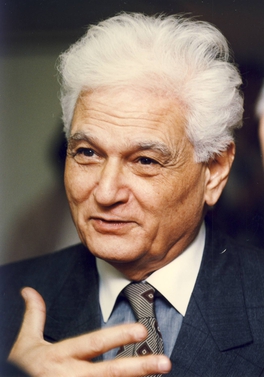
Jacques Derrida
French philosopherWikipedia
211
MENTIONS
108
EPISODES
91
PODCASTS
Search complete. 211 mentions across 108 episodes found for "Jacques Derrida".
Sep 13, 2026

Tiger LiuGUEST
Yeah.
Tiger LiuGUEST
One thing when I was reading the text, one thing I was immediately thinking about is the-- I mean, if we were to kind of contextualize the theoretical references here, such as Derrida's Specter of Marx or Mark Fisher's Lost Futures diagnoses, those kind of texts came out of this background of like the kind of deep political dis-disenfranchisement in the West, right? So Derrida was very much writing this kind of post-post sixty-eight mood of searching, searching for a kind of revolutionary subjectivity and the lack of any revolutionary horizon, and the same as Mark Fisher is coming out of a real frustration with any kind of meaningful notion of left politics since the entire Europe, really.
Tiger LiuGUEST
But obviously, UK is more of a cogent example in that regard, the degeneration of party form.
Tiger LiuGUEST
So that kind of cultural pessimism very much come out of that type of general feeling of defeat.

Chuck KlostermanGUEST
It appears that this book is just the book people buy when they get to a certain age.
Chuck KlostermanGUEST
Like, it's the first, it's the first cultural criticism they read, and then it either becomes like, then they stop, or maybe they move on to Derrida or something more serious, but this is like the in- it- that's the, this is the bridge it seems to be-
Brad ListiHOST
Yeah
Chuck KlostermanGUEST
... for, like, writing about popular culture in a way, in whatever way that they see it as, yeah.

Dipesh ChakrabartyGUEST
I think a German person should have a deep sense of being German.
Dipesh ChakrabartyGUEST
But you realize it's a point that Derrida once made.
Dipesh ChakrabartyGUEST
The more a language becomes monolingual, it becomes internally plural.
Dipesh ChakrabartyGUEST
Because your capacity to do everything, to work in every aspect of life means you borrow from other languages.

Ciara BreathnachGUEST
I really do think that we need a conversation that includes the public as to what can be included.
Ciara BreathnachGUEST
Because the idea of the total archive, Jacques Derrida's notion, discussed in Archive Fever, It's a pipe dream.
Ciara BreathnachGUEST
We have to be ruthless here.
Ciara BreathnachGUEST
We can't keep everything.

Ciara BreathnachGUEST
I really do think that we need a conversation that includes the public as to what can be included.
Ciara BreathnachGUEST
Because the idea of the total archive, Jacques Derrida's notion, discussed in Archive Fever, It's a pipe dream.
Ciara BreathnachGUEST
We have to be ruthless here.
Ciara BreathnachGUEST
We can't keep everything.

Ryan EngleyGUEST
sidetracked on this, but so anyway, my first thing when I decided I wanted to be a professional in this, I thought I had all these gaps, and I was trying to fill them.
Ryan EngleyGUEST
I was rushing to try to fill them, and then somewhere in my master's program, I realized that's not really possible and you you can't i don't think you can learn anything effectively from a position of deficit where you just think ah there's no way i can possibly know enough to understand even the 10 pages i just read or the 100 pages i just read and so what that pushed me to try to do is is to try to find ideas that cut across a lot of what i was reading and so one of my Early, I don't know, one of my early insights, I suppose, or things that I was looking for in a lot of different texts was what did people do with the idea of like a palimpsest? or like the trace and I'm not maybe I was inspired by by Freud a note upon the mystic writing pad which was something that like really really made sense to me that short essay like like really made a great sense to me about how Freud understood the psyche and there was already this You know, this connection with that essay to things that Derrida was interested in, and he was very hard for me, but I felt like I understood Mystic Writing Pad, and that helped me understand a little bit of what, like, Derrida was getting at, and I felt like, okay, here's, like, a little bit of a link, so what can I do with this? And this led me to think about this idea of, you know, of palimpsest, and this was...
Ryan EngleyGUEST
Something I explored, I think, actually, in my first journal publication, which is on the work of Brett Eason Ellis.
Ryan EngleyGUEST
It's published in the International Journal of Zizek Studies, and it's on a theoretical idea of palimpsest, which is something I was really interested in.

Ambrose LittleADVERTISER
So
Irenaeus DunlevyGUEST
he mentions Derrida and Foucault by name.
Irenaeus DunlevyGUEST
And he's saying, hey, they are offering us a new idea, a new cosmology of underlying structures that are just parts in reference to one another.
Irenaeus DunlevyGUEST
That there's no metaphysical baseline that we espouse here at the Thomistic Institutes.

Francis FukuyamaGUEST
[laughs]
Martin WolfHOST
... by Barthes and Derrida, which seems to have had a rather powerful negative effect.
Francis FukuyamaGUEST
[laughs]
Martin WolfHOST
Would you tell a little bit about what you took from that?
Francis FukuyamaGUEST
Well, so my first teachers had been followers of, uh, the German-American Jewish philosopher Leo Strauss.
Francis FukuyamaGUEST
Uh, but- Postmodernism hit Cornell like a freight train in the early 1970s.
Francis FukuyamaGUEST
Uh, we had a number of professors that had been students of Jacques Lacan or Derrida.
Francis FukuyamaGUEST
Michel Foucault himself came to, uh, Cornell.

Brian ZahndGUEST
And it predated the, for lack of a better word, the rise of what we now call deconstruction, which I do not like the term.
Brian ZahndGUEST
It's a term from philosophy, from Jacques Derrida, that has to do with deconstructing texts.
Brian ZahndGUEST
Okay.
Brian ZahndGUEST
I don't like it for a lot of reasons, but it's what people use, so that's the vocabulary I'm forced to use.

Brian ZahndGUEST
And it predated the, for lack of a better word, the rise of what we now call deconstruction, which I do not like the term.
Brian ZahndGUEST
It's a term from philosophy, from Jacques Derrida, that has to do with deconstructing texts.
Brian ZahndGUEST
Okay.
Brian ZahndGUEST
I don't like it for a lot of reasons, but it's what people use, so that's the vocabulary I'm forced to use.
98 more episodes mention Jacques Derrida.
Create an account to see the whole feed, search across every transcript, and follow the entities you care about.