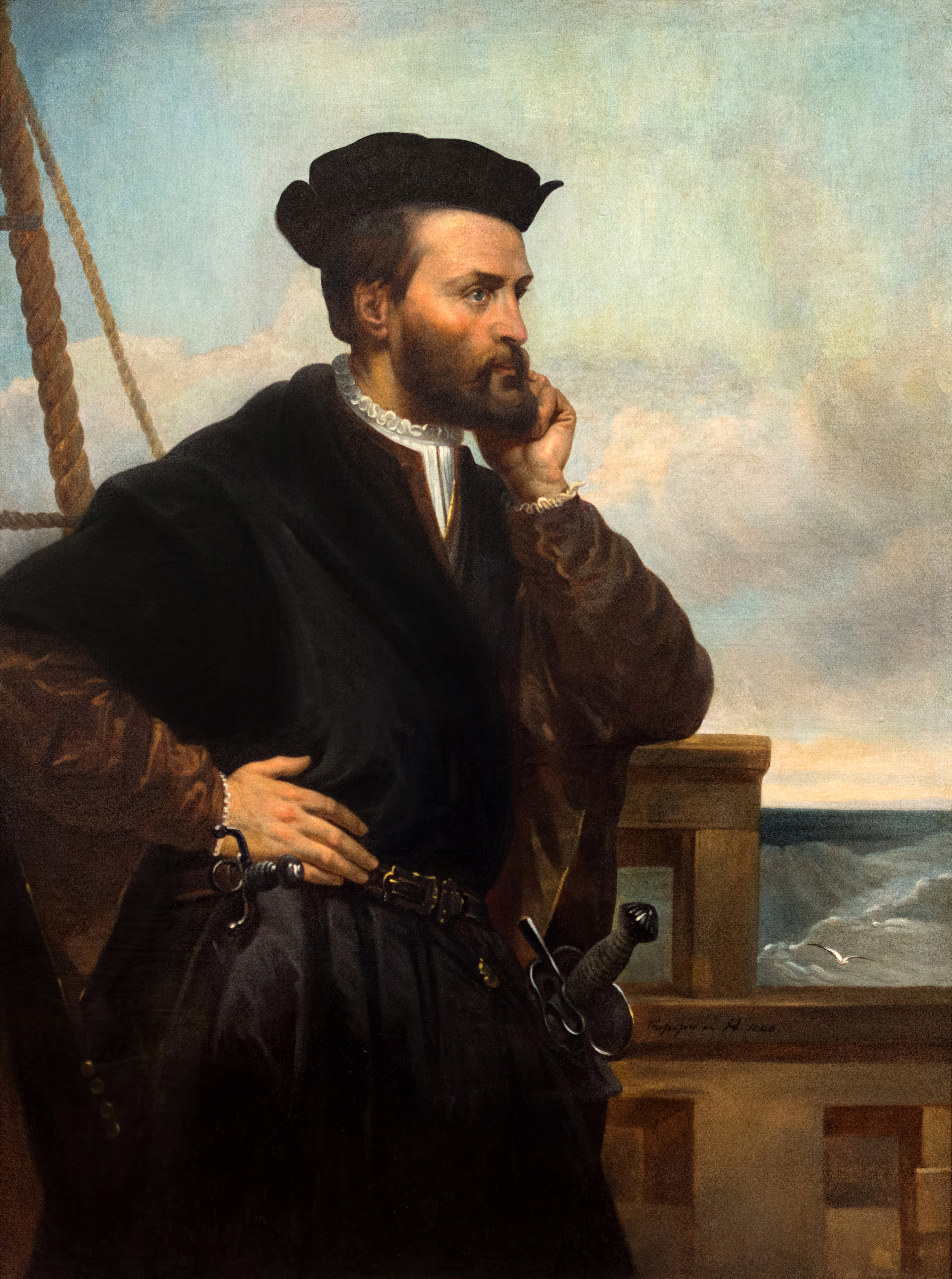
Jacques Cartier

Jacques Cartier

French explorerWikipedia

Search complete. 49 mentions across 23 episodes found for "Jacques Cartier".

Sep 30, 2026

Unknown podcast

Ontario Readers Third Book-Various

Sep 30 · 3 Mentions

speaker_18UNKNOWN
379:29
The Ontario Reader's Third Book, by the Ontario Ministry of Education.
speaker_18UNKNOWN
379:34
Jacques Cartier In the seaport of St. Malo, 'twas a smiling morn in May, when the Commodore Jacques Cartier to the westward sailed away.
speaker_18UNKNOWN
379:45
In the crowded old cathedral all the town were on their knees for the safe return of kinsmen from the undiscovered seas.
speaker_18UNKNOWN
379:52
And every autumn blast that swept o'er pinnacle and pier filled manly hearts with sorrow and gentle hearts with fear.
speaker_18UNKNOWN
380:01
A year passed o'er St. Malo.
speaker_18UNKNOWN
380:03
Again came round the day when the Commodore Jacques Cartier to the westward sailed away.
speaker_18UNKNOWN
380:08
But no tidings from the absent had come the way they went, and tearful were the vigils that many a maiden spent.
speaker_18UNKNOWN
380:15
And manly hearts were filled with gloom and gentle hearts with fear, when no tidings came from Cartier at the closing of the year.

Unknown podcast

Makers of Canada Champlain-Narcisse-Eutropee Dionne

Sep 29 · 8 Mentions

Cathy BarrattNARRATOR
19:37
feast given by the indians in commemoration of their victory the celebration consisted of dances songs speeches and games tessoat the sagamot of the ottawas was the chief captain and took a prominent part in the demonstration after a long description of these public festivities champlain gives ample details of the manners and customs of the indians especially of their superstitions the indians believed that a god existed who was the creator of all things but they had a curious manner of explaining the creation of man when man had made everything they said he took a quantity of arrows and fixed them in the earth whence came men and women who have increased ever since the the sagamot said they believed in the existence of a god a son a mother and a son that is a celestial son that god was the greatest of the four that the son and the sun were both good that the mother was a lesser person and so was the father who was less bad the indians were convinced that their deity had held communication with their ancestors one day five indians ran towards the setting sun where they met god who asked them where are you going we are going to seek our life they replied then god said you will find it here but they did not hear the divine word and went away then god took a stone and touched two of them and they were immediately turned into stones addressing the three other indians god asked the same question where are you going and he was given the same answer do not go further said the divine voice you will find your life here seeing nothing however they continued their journey then god took two sticks and touched two of them and they were at once turned into sticks the fifth indian however paused and god gave him some meat which he ate and he afterwards returned to his countrymen these indian tribes had their jugglers whom they called pilatois from the basque or hautmoins which means a magician these jugglers exercised great sway over the indians who would not hesitate to kill a frenchman if the jugglers decided that it was necessary in spite of their superstitions champlain believed that it would be an easy task to convert the indians to christianity especially if the french resided near them this desirable end was not to be attained without great difficulty as champlain soon realized for the missionaries toiled for many years before their efforts were crowned with success champlain now proceeded to explore the river saguenay for a distance of twelve to fifteen leagues and he thus describes the scenery all the land i have seen is composed of rocks covered with fir-woods cypress birch very unpleasing land where i could not find a league of plain land on each side he also learned from the indians of the existence of lake st john and of a salt sea flowing towards the north it was evidently hudson bay to which these northern tribes directed champlain's attention and if they had not seen it themselves they had probably heard of its existence from the indians dwelling around the southern or south-western shores of the bay who came annually to numisca lake to trade their furs this lake was half-way between hudson bay and the river st
Cathy BarrattNARRATOR
22:45
lawrence the callistinans and other indians of the north had regular communication with their congeners scattered along the shores of the st maurice and the several rivers which flow into lake st john when the french arrived in canada with chauvin in the year sixteen hundred they began to monopolize the fur trade of all the indian nations but some years later the english established themselves on the shores of hudson bay and prosecuted the trade for their own benefit champlain could not evidently have been in possession of any exact information as to the existence of this large bay as he was searching for a northern passage to cathay the great desideratum of all the navigators and explorers of the time after having promised to aid the various tribes gathered at tadousac in their wars champlain and pont grav proceeded to sault st louis this expedition lasted fifteen days during which they saw hare island so named by jacques cartier and the island of orleans the ship anchored at quebec where champlain stopped to make a short description of the country watered by the st lawrence and they then proceeded to sault st louis here champlain gathered much valuable information relating to lakes ontario and erie the detroit river niagara falls and the rapids of the st lawrence returning to tadousac he determined to explore gaspisia and proceeded to visit percy and malbay where he met indians at every turn he was also informed by prvert from st malo who was exploring the country of the existence of a copper mine
Cathy BarrattNARRATOR
24:11
champlain carefully noted all the information he had received and after his return to tadousac he sailed again for
Cathy BarrattNARRATOR
24:18
france on august sixteenth sixteen o three and reached havre de grce after a passage of twenty-one days on his arrival in france he heard that aymard de chaste had died a few weeks previously on august thirteenth this was a great loss to canada and especially to champlain for he was convinced that the noble and enterprising de chaste was seriously disposed to colonize new france in this enterprise he says i cannot find a single fault because it has been well inaugurated with the death of de chaste the project of colonizing would undoubtedly have fallen through had not champlain been present to promote another movement in this direction champlain had an interview with the king and presented him with a map of the country which he had visited and placed in his hands a relation of his voyage henry the fourth was so favorably impressed that he promised to assist champlain in his patriotic designs chapter one chapter two of the makers of canada this librivox recording is in the public domain the makers of canada champlain chapter two acadia st croix island port royal soon after the period mentioned at the close of the previous chapter pierre du gois sieur de mont governor of pont a native of the ancient province of saint-ange who had served under henry the fourth obtained a commission as lieutenant-general au pays de cadis du quarantième degré au quarante sixième degré on the condition that his energy should be especially directed to the propagation of the catholic faith de Monts was a Huguenot.

8 MINS LATER

Cathy BarrattNARRATOR
33:31
This disease proved one of the obstacles to rapid colonization in New France.
Cathy BarrattNARRATOR
33:36
It was epidemic, contagious and often fatal.
Cathy BarrattNARRATOR
33:39
It is a somewhat remarkable fact that the epidemic was prevalent amongst the french only when they were established on the soil being rarely discovered on shipboard jacques cartier had experienced the horrors of this disease in the winter of fifteen thirty five thirty six when out of his one hundred and ten men twenty-five died and only three or four remained altogether free from attack during the year fifteen forty two forty three robert saw fifty persons dying of the disease at charlebourg royal at sainte-croix the proportion of deaths was still greater thirty-five out of seventy-nine there was a physician attached to de monts party but he did not understand the disease and therefore could not satisfactorily prescribe for it de monts also consulted many physicians in paris but he did not receive answers that were of much service to him At the commencement of the 17th century, scientific men distinguished scurvy on land from scurvy on sea.
Cathy BarrattNARRATOR
34:32
They laboured under the false impression that the one differed from the other.
speaker_0NARRATOR
186:47
If there was a New England and a New Holland over the seas, there was also a New France.
speaker_0NARRATOR
186:54
Some sixty years before this time, when the spirit of discovery was abroad and all eyes were turned towards the golden east, a French sailor called Jacques Cartier left his native shores to try and find a new passage to India by way of America.
speaker_0NARRATOR
187:11
His home was at Saint-Malo, a seaport in Brittany, the nursery of hardy mariners such as himself.
speaker_0NARRATOR
187:18
In the town hall, there today hangs his portrait, the keen eyes ever searching something beyond the seas that dashed against the shores of his native town.
speaker_0NARRATOR
187:29
He left France in the summer of 1534 with three small ships and sailed across the Atlantic Ocean to the storm-beaten shores of Labrador, already discovered by Cabot.
speaker_0NARRATOR
187:41
Passing through the narrow straits between that coast and Newfoundland, he came to a great expanse of water, which he named the Bay of Saint Lawrence, a name he gave later to the great river which flows into this mighty bay.
speaker_0NARRATOR
187:55
Undaunted by the dangers of the unknown, Jacques Cartier, with two young natives, made his way up the River Saint Lawrence till he came to some great cliffs standing high above the surging current below.
speaker_0NARRATOR
188:08
Little did he think, as he looked at those silent heights, that here should be the site of the busy city of Quebec in Canada, now full of heroic memories.

Unknown podcast

Harper's Young People, Vol. 01, Issue 36, July 6, 1880-Various

Sep 27 · 1 Mention

Larry WilsonNARRATOR
48:02
Number 2, Champlain and the Iroquois.
Larry WilsonNARRATOR
48:06
it was a long while ago in fifteen thirty five that jacques cartier of france discovered the st lawrence river he sailed up the mighty stream to the indian village of hotelaga a cluster of wigwams at the foot of a hill which he named mount royal but which time has changed to montreal seventy-four years rolled away before any other white man visited the spot in sixteen nine samuel champlain an officer in the french navy sailed up the great river he was a brave adventurer who was ever taking long looks ahead and dreaming of what might be in the future how the unexplored wilderness of america might become a new france he had built houses at quebec and was on his way to discover what might be beyond he treated the indians kindly gave them presents and made them his friends there were many tribes but all the indians east of the mississippi and between lake superior and the ohio were divided into two great families the algonquins and the iroquois the indians along the st lawrence the ottawa and lake huron were algonquins The Iroquois lived in New York.
Larry WilsonNARRATOR
49:19
They were the Mohawks, Onondagas, Oneidas, Senecas, and Cayugas.
Larry WilsonNARRATOR
49:25
They called themselves the Five Nations.
speaker_1HOST
4:08
They were comprised of fire eaters, jugglers, and stilt walkers, which gave them their local name, Les Echasseurs de Baie-Saint-Paul.
speaker_1HOST
4:23
One of the stilt walkers, Guy Laliberté, saw that there was potential in the group, and so he proposed that they do a province-wide tour for the 450th anniversary of the discovery of Canada by Jacques Cartier, and that would be in 1984.
speaker_1HOST
4:46
The anniversary, not the discovery.
speaker_1HOST
4:49
That was in 1534.
Mark VinetteHOST
7:25
First contact brought about culture shock and a clash of civilizations throughout the age of exploration on the North American continent.
Mark VinetteHOST
7:33
In New France, my corner of the world, the French established an extensive colony in the New World from 1534 to 1763, exactly 100 years after Jacques Cartier first sailed up the mighty St. Lawrence River to Quebec City, formerly known as the aboriginal village of Stadacona.
Mark VinetteHOST
7:54
Most Algonquin Huron settlements lived by hunting and fishing, and Catholic Jesuit priests from France lived amongst them.
Mark VinetteHOST
8:03
The nations of the Iroquois Confederacy considered the Jesuits legitimate targets of their raids and warfare.

Unknown podcast

Harper's Young People, Vol. 01, Issue 36, July 6, 1880-Various

Sep 26 · 1 Mention

Larry WilsonNARRATOR
53:03
Champlain and the Iroquois.
Larry WilsonNARRATOR
53:06
It was a long while ago in 1535 that Jacques Cartier of France discovered the St. Lawrence River.
Larry WilsonNARRATOR
53:13
He sailed up the mighty stream to the Indian village of Hotelaga, a cluster of wigwams at the foot of a hill which he named Mount Royal, but which time has changed to Montreal.
Larry WilsonNARRATOR
53:25
Seventy-four years rolled away before any other white man visited the spot.
Benjamin BosterHOST
5:51
In the early stages of European colonization in northeastern North America, local indigenous peoples showed the arriving colonists how to tap the trunks of certain types of maples during the spring thaw to harvest the sap.
Benjamin BosterHOST
6:10
André Thevet, the royal cosmographer of France, wrote about Jacques Cartier drinking maple sap during his Canadian voyages.
Benjamin BosterHOST
6:22
By 1680, European settlers and fur traders were involved in harvesting maple products.
Benjamin BosterHOST
6:31
However, rather than making incisions in the bark, the Europeans used the method of drilling tap holes in the trunks with augers.

Unknown podcast

Chronicles of Canada Volume 09 - The Acadian Exiles A Chronicle of the Land of Evangeline-Arthur G. Doughty

Sep 25 · 1 Mention

speaker_5NARRATOR
3:21
When the French came, and for long after, this country was the hunting ground of tribes of the Algonquin race, Micmacs, Malecites, and Abnakis or Abenakis.
speaker_5NARRATOR
3:31
By right of the discoveries of Jean Verrazzano, 1524, and Jacques Cartier, 1534 through '42, the French Crown laid claim to all America north of the sphere of Spanish influence.
speaker_5NARRATOR
3:43
Colonial enterprise, however, did not thrive during the religious wars which rent Europe in the 16th century, and it was not until after the Edict of Nantes in 1598 that France could follow up the discoveries of her seamen by an effort to colonize either Acadia or Canada.
speaker_5NARRATOR
3:59
Abortive attempts had indeed been made by the Marquis de La Roche, but these had resulted only in the marooning of 50 unfortunate convicts on Sable Island.
Connor McKennaHOST
11:36
Did you hear this story about the parking in Outremont? I heard about that,
Sean StarrHOST
11:40
and I saw that our exit for here, so if you're coming to the Jacques Cartier Papineau close at 6.30 this morning, I saw kind of the railings with the sponsor logos and everything.
Sean StarrHOST
11:49
I mean, it wasn't even an inconvenience yesterday when they had it shut down and the police were like at the lights.
Sean StarrHOST
11:54
Yeah.

13 more episodes mention Jacques Cartier.

Create an account to see the whole feed, search across every transcript, and follow the entities you care about.

We value your privacy

We use cookies to understand how you use our platform and to improve your experience. Click “Accept All” to consent, or “Decline non-essential” to opt out of non-essential cookies. Read our Privacy Policy.