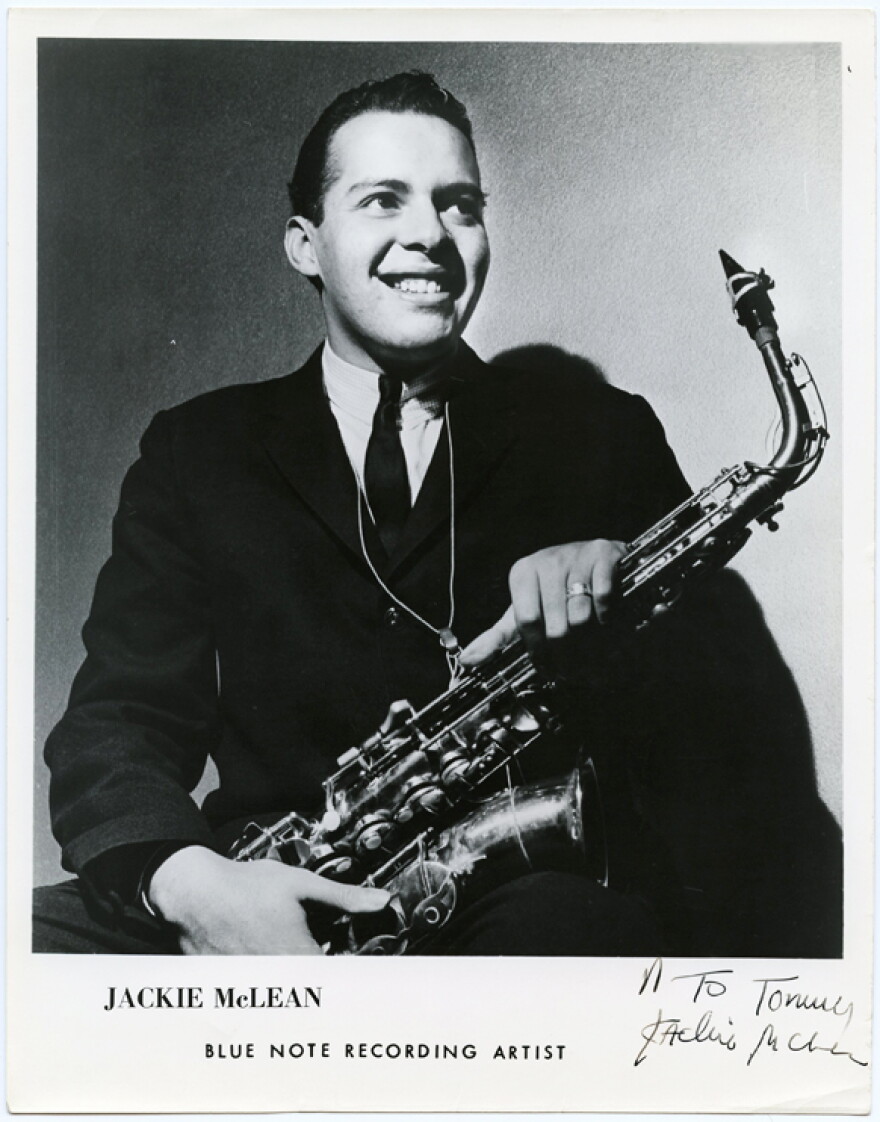
Jackie McLean
American saxophonist and composerWikipedia
20
MENTIONS
13
EPISODES
13
PODCASTS
Search complete. 20 mentions across 13 episodes found for "Jackie McLean".
Oct 30, 2026

Mike CaseyGUEST
And on alto is a whole nother group.
Mike CaseyGUEST
Bird, Charlie Parker, you know, Jackie McLean, Sonny Stitt.
Mike CaseyGUEST
I'm grateful to be, you know, a very small part of this huge, amazing legacy of the instrument of jazz saxophone.
Mike CaseyGUEST
It's just like, it's really a lot.
8 MINS LATER
Mike CaseyGUEST
And I thought, you know what? It's good to have this documented so that there's no mystery.
Mike CaseyGUEST
No one's ever wondering, can he play bebop? Did he study bebop? And he's like, yes.
Mike CaseyGUEST
I learned every Charlie Parker melody by ear from someone who learned it from Jackie McLean, who learned it from Charlie Parker himself.
Mike CaseyGUEST
Yes.

Mark HavensGUEST
It was a distinctly urban aesthetic that established the iconography of post-war jazz.
Mark HavensGUEST
to the casual listener prestige is remembered for hastily assembled sessions with little rehearsal time and quick head arrangements the recordings demonstrate something more nuanced however it should come as no surprise that the depth and versatility of the prestige visual language was equalled by the music in fact the stylistic range was far more expansive than most independent labels of the era for every jammin in hi-fi with gene ammons there was a luminous jango by the modern jazz quartet jackie mclean's visceral emotionally complex outburst Curtis Fuller's careening Vance No. 5, or something truly outré like Ghost Story by Teo Massero and the Prestige Jazz Quartet.
Mark HavensGUEST
What's more, Sonny Rollins' entire output in 1955 and 1956 and the marathon sessions documenting Miles Davis' working band, the first great quintet, are prestige recordings that in many ways define jazz in the popular imagination.
Mark HavensGUEST
As David Rosenthal observed, for many listeners, hard bop and jazz are still virtually synonymous.
27 MINS LATER
Chris EntwhistleGUEST
You know, when we talk about this and when we've worked on it, there have been so many at different points or so many different covers.
Chris EntwhistleGUEST
And it's obviously hard to pinpoint a certain thing.
Chris EntwhistleGUEST
But for me, one of the things that one of the covers that has always struck me was Tom Hannon's cover for Jackie McLean's Four, Five and Six.
Chris EntwhistleGUEST
partly because it provides such a stark contrast to what he was doing at exactly the same time at Blue Note.

speaker_1UNKNOWN
Thank you.
ChrisHOST
In 1964, Rivers was on the road with T-Bone Walker when he received a telegram from Tony Williams, who had moved to New York to work with Jackie McLean and later joined Miles Davis, telling him that Miles wanted him to join the quintet.
ChrisHOST
Sam stayed for six months touring the U.S. and Japan, where a live album was taped but not issued in the U.S. for about a decade.
ChrisHOST
at this point rivers's music begins to be documented a tad dameron septet date with sam was started for blue note but never satisfactorily completed three dameron originals and rivers's own the elder speaks were recorded larry young's into something tony williams lifetime and spring bobby hutcherson's dialogue followed by several andrew hill sessions Again, for Blue Nut.

Kevin LawrenceHOST
Anyway, that's music from one of his more popular albums.
Kevin LawrenceHOST
Cornbread, Sior is the name of the cut, Lee Morgan Trumpet, Jackie McLean, Alto Sax, Hank Mobley, Tenor Sax, Herbie Hancock, Tinkling the Keys on piano, Larry Ridley bass, Billy Higgins on drums.
Kevin LawrenceHOST
And before that, you heard music from The Sidewinder.
Kevin LawrenceHOST
Boy, What a Night is the name of the song from that album.

Corcoran HoltGUEST
That's something that I teach as well.
Corcoran HoltGUEST
In my, in my teaching, you know, we, if we're checking out Jackie McLean, let's, let's, what, what's the story? What's his story? What's happening? What's happening? Why, why did Jackie McLean do this? Why is, how does this, you know, what, where did this song come from? We're checking out the Kenny Garrett tune, like, and then I played it with him so many times and I know how it makes me feel.
Corcoran HoltGUEST
know i'll bring it into them and i want to see you know how does this make y'all feel you know check oh check out check out what this is really about you know and and so it's just it's about opening up opening up your mind and that's and i feel like i under i was telling my wife the other night And she got it.
Corcoran HoltGUEST
And I told Kenny this as well.

DVJHOST
So, we got a little jazz music going here.
DVJHOST
This is Art Blakely, Miles Davis, Lee Morgan, Sonny Clark, Horace Silver, Sonny Rollins, Jackie McLean, Jackie McLean, my bad, and the great John Coltrane.
DVJHOST
This one's called Kinda Chillin' Volume 4, The Fourth Mode.
DVJHOST
Let this roll out for a minute while I go pour me a coffee.

Michael KarnGUEST
and switch to bass.
Michael KarnGUEST
And Jackie McLean talks about that in the liner notes to One Step Beyond, which Eddie Khan is on.
Michael KarnGUEST
He says, I met him on the West Coast as a tenor player and then he came East as a bass player and I couldn't believe it.
Michael KarnGUEST
So there are a few people who did it, but it's pretty rare.

Leo SidranHOST
In a way, you were lucky not to have interacted with Charlie Parker because I think Red and Frank were young and impressionable and they heard Charlie playing the way he played and they saw him acting the way he acted and they made a connection that was not necessarily true, that they were related to each other.
Monty AlexanderGUEST
Jackie McLean.
Monty AlexanderGUEST
Yes.
Monty AlexanderGUEST
Those guys were all, you know, fascinated with Charlie Parker and what he was doing.

speaker_6ADVERTISER
Thank you.
Bobby BroomHOST
Alto saxophonist Jackie McLean with Das Dat from 1965's It's Time album, and that features Charles Tolliver's trumpet, Herbie Hancock at the piano, Cecil McBee bass, Roy Haynes drums.
Bobby BroomHOST
Welcome back to Jazz Spectrum, Bobby Broom.
Bobby BroomHOST
Up next, pianist Horace Parlin, Borderline.

JamesHOST
um that run the place they've got whole staff shokai on their website but yeah really really disappointing especially because what you said our good friend professor bennett said about it being one of the best spots and now looking at the website i i hate it even more because it's a cat place and i hate cats so yeah yeah i mean
PhilipHOST
i think for me i mean again just from a visual perspective i mean it's it's on a corner unit it's got a sort of nine square mural on the side, which has Jackie McLean and has some records and then has like MJQ.
PhilipHOST
And part of the building is kind of, or Jazz Flash, you know, it's got this lovely wooden door and the building and the wall is all covered with ivy.
PhilipHOST
So like, it looks amazing, but it sort of caught me by surprise because I was just outside taking a few photographs of the exterior.
3 more episodes mention Jackie McLean.
Create an account to see the whole feed, search across every transcript, and follow the entities you care about.