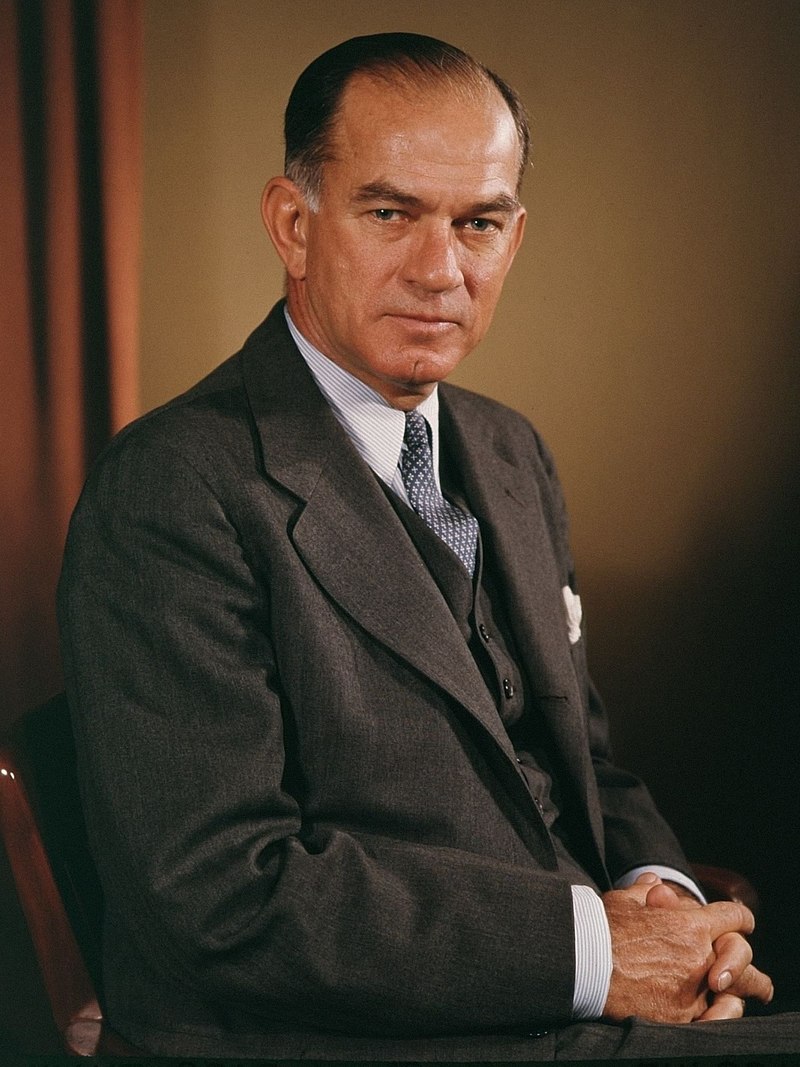
J. William Fulbright
Former United States SenatorWikipedia
11
MENTIONS
9
EPISODES
9
PODCASTS
Search complete. 11 mentions across 9 episodes found for "J. William Fulbright".
Oct 23, 2026

Patrick CourrielcheHOST
And it wasn't just Richard Nixon questioning LBJ's ground troop strategy.
speaker_6NARRATOR
Arkansas Democrat J. William Fulbright coined the phrase credibility gap, saying he couldn't get a straight answer from the administration about the war.
speaker_6NARRATOR
The most outspoken critic of the war was again Senator Wayne Morse.
speaker_6NARRATOR
The Oregon Democrat's raspy voice echoed through the empty Senate chamber.

IndieHOST
The US is subservient to Israel.
IndieHOST
All right? Senator William Fulbright was the longest-serving chairman of the Senate Foreign Relations Committee, and in 1962 and '3, he led a hearing on foreign principles operating inside the US.
IndieHOST
Because of Senator Fulbright, the American public got their only inside look at how powerful Zionist organizations like the Jewish Agency for Israel, United Jewish Appeal, and the American Zionist Council were operating.
IndieHOST
The American Zionist Council, by the way, now is APAC or ZOA.

IndieHOST
All right.
IndieHOST
Senator William Fulbright was the longest-serving chairman of the Senate Foreign Relations Committee, and in nineteen sixty-two and three, he led a hearing on foreign principles operating inside the US.
IndieHOST
Because of Senator Fulbright, the American public got their only inside look at how powerful Zionist organizations like the Jewish Agency for Israel, United Jewish Appeal, and the American Zionist Council were operating.
IndieHOST
The American Zionist Council, by the way, now is AIPAC.

Bob CrawfordHOST
Okay.
Bob CrawfordHOST
J. William Fulbright of Arkansas.
Ben SawyerHOST
A Democrat.
Bob CrawfordHOST
A member of Truman's own party argues that President Truman is a spent force.

Cassidy LongGUEST
Um, for example, right now we have a lot of students with an Ozarks history class, um, that is doing, that are doing research, um, for that topic.
Cassidy LongGUEST
We have people that do a lot of political research, um, with, um, Senator Fulbright's papers and, um, um, Mark Pryor's, or, um, David Pryor's papers.
Cassidy LongGUEST
And, um, we have, like I said, if you can think of a topic, we probably have things that can satisfy your curiosity.
Cassidy LongGUEST
[laughs]
Kyle KellamsHOST
Indeed.
Kyle KellamsHOST
If your curiosity bends toward a familiar Arkansas figure or subject, say architects E. Fay Jones or Edward Durell Stone, or composers like Florence Price or William Grant Still, or politicians like J. William Fulbright or Asa Hutchinson, this place has you covered.
Kyle KellamsHOST
But the far more obscure can be explored here as well.
Kyle KellamsHOST
There is a box with the label Feral Hogs, for example.

Joe PlenzlerHOST
How does this isolationist stance impact our future security and military posture?
Steve MiskaGUEST
Yeah, it's, you know, I think that it all goes, one of the foundational books I read early on when I started realizing I probably need to know something about foreign policy if I'm going to be in the military, was J. William Fulbright wrote a book called The Arrogance of Power.
Steve MiskaGUEST
And it was a compilation of a series of speeches that he had given at colleges around the country and stuff.
Steve MiskaGUEST
And this was before we really got deep into Vietnam.

David KountzGUEST
Uh, I tell in the middle of the book a, a really interesting, um, story where he met the president of the University of Arkansas.
David KountzGUEST
Now, that was, uh, William Fulbright, who became Senator Fulbright after his tenure as president of the University of Arkansas.
David KountzGUEST
And my dad befriended him and said, "I'd like to go to your medical school," which again, w- was almost a fanciful idea.
David KountzGUEST
Segregation was still in place.

Curt RomHOST
I want to have the students go through the same revelation that I did, that the world is simultaneously big and simultaneously coincidentally small.
Curt RomHOST
And it really follows our faculty member, past president, and Senator William Fulbright.
Curt RomHOST
And William Fulbright essentially said, it's through the exchange of education and international experiences that we humanize the world.
Curt RomHOST
And that's paraphrased, but his intent was if we understand each other better, we'll lead to better cooperation, collaboration, and less conflict in the future.
Curt RomHOST
So I have a lot of motivations for doing it.

David S. KountzGUEST
One of the first chapters I wrote was kind of what's turned out to be in the middle of the book.
David S. KountzGUEST
And that's about... how he sought mentorship and how he, and to me, this was a very good lesson learned even for me that as he was going through his education and hitting various walls here and walls there, I think there could be a tendency to be internal and be very bitter And yet he reached out to Senator William Fulbright.
David S. KountzGUEST
That's a name that some people recognize with Fulbright scholarships.
David S. KountzGUEST
Senator Fulbright from Arkansas had been the president of the University of Arkansas.