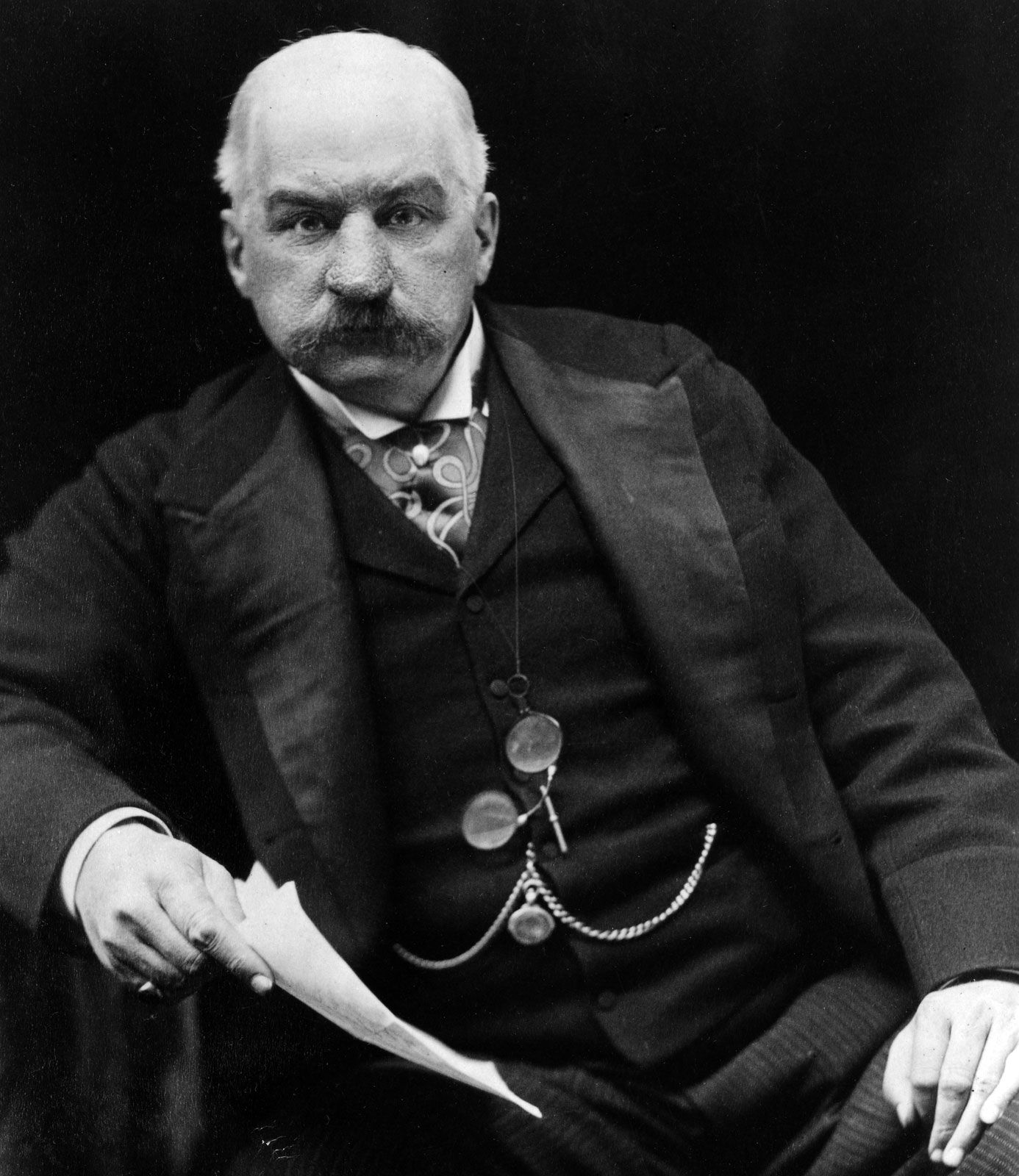
J. P. Morgan
American financier and investment bankerWikipedia
66
MENTIONS
34
EPISODES
34
PODCASTS
Search complete. 66 mentions across 34 episodes found for "J. P. Morgan".
Oct 27, 2026

Patrick BoyleHOST
We'll be focusing mostly on LBOs today as that's what most people mean when they talk about private equity, and there's a long history of transactions like this as people have been borrowing money to buy out businesses as long as businesses have existed.
Patrick BoyleHOST
J. Pierpont Morgan's acquisition of Carnegie Steel in 1901 for $480 million is considered the first true major buyout, and the first leveraged buyout was the purchase of Pan Atlantic Steamship Company and Waterman Steamship by McLean Industries in 1955. where the buyer borrowed $42 million for the transaction and were able to pay off $20 million of that debt as soon as the transaction closed using the cash and assets of the acquired companies.
Patrick BoyleHOST
Up until the 1980s, the LBO remained an obscure financing technique as since the Great Depression, companies had kept their debt loads low.
Patrick BoyleHOST
Robin Wigglesworth described in the FT how KKR's 1978 purchase of Houdet Industries using only $1 million in equity for the $380 million purchase was private equity's genesis moment.

Robert ReichSOUNDBITE_SPEAKER
I
Darren O'NeillHOST
mean, he's the equivalent of the, you know, the J.P. Morgans, the Rockefellers.
Darren O'NeillHOST
You know, the people that built the country.
Darren O'NeillHOST
Yes, they're all evil.

John PotashGUEST
But the U.S. didn't have any royalty.
John PotashGUEST
So when new industrialists rose up, like Rockefellers, Carnegies, J.P. Morgans, Harrimans and all that, was no one you know against them no royalty against them so they just when workers tried to rise up and get free health care national health care and for your media they were just squashed and so uh that's why the us is so behind you know in those kinds of you know areas the European countries.
John PotashGUEST
In the US, you had all these Rockefellers, Harrimans.
John PotashGUEST
JP Morgan's Julius Pierpont is John Pierpont Morgan's name.

Tim DillonHOST
I mean, they have their own armies, drone armies, high-end robotics, satellite systems, Starlink, and... geopolitically all of the, you know, this is the most powerful group of people that has ever lived.
Tim DillonHOST
I mean, even more powerful than like, The robber barons, the JP Morgans, these people have access to technology that is way far beyond anything that private citizens have ever had access to.
Tim DillonHOST
And they have more data and information on people, including their own leaders, than anyone has ever had.
Tim DillonHOST
And it has made them godlike and omniscient.

Robin WigglesworthGUEST
It's Jay Cooke, the dominant financier of the era.
Robin WigglesworthGUEST
He was John Pierpont Morgan before John Pierpont Morgan was anybody.
Robin WigglesworthGUEST
So it's such a psychological shock that this shock that first maybe starts in Europe and ricochets over to the US, then ricochets back to Europe and it starts feeding on itself and just becomes an epic financial crisis, one of the biggest we've seen in the world, and it leads to this very long, nasty recession.
Robin WigglesworthGUEST
Which became known as

Robin WigglesworthGUEST
You don't really know much about him these days because he's kind of in popular consciousness.
Robin WigglesworthGUEST
John Pierpont Morgan became the big American... that exemplified American banking.
Robin WigglesworthGUEST
But really, Jay Cooke was the daddy.
Robin WigglesworthGUEST
He was the guy that single-handedly helped finance the North's victory in the Civil War.

Mark SmithNARRATOR
Banking.
Mark SmithNARRATOR
Leading bankers include J. Pierpont Morgan, Welsh, Nathan Strauss, Felix Warburg, Jacob Schiff, Otto Kahn, and James Spire, German Jews.
Mark SmithNARRATOR
Charles G. Dawes, English.
Mark SmithNARRATOR
Amadeo Giannini, Italian, and Jesse Jones, Welsh.

DJ PetrovskiHOST
Gates to represent the U.S. to China.
DJ PetrovskiHOST
David Rockefeller gave his OK to the selection of Gates, and Gates was transferred directly from working on the board of J.P. Morgan and Company to Peking.
DJ PetrovskiHOST
The Illuminati's banks have been lining up over the years, making loans to Red China.
DJ PetrovskiHOST
One of the articles that I read to understand where Clinton was going with Red China was in the Yanfev issue of the China Business, which had on its cover a picture of Clinton and Li Peng with the question, a new era.

Chris RenwickHOST
You remember the era of the robber barons? Yeah, that's the Rockefeller, Andrew Carnegie, Cornelius Vanderbilt, J.P.
Chris RenwickHOST
Morgan era.
Chris RenwickHOST
This is the late 1800s.
Chris RenwickHOST
And you look at how much power they yielded.
Chris RenwickHOST
Andrew Carnegie built Carnegie Steel.
Chris RenwickHOST
Vanderbilt dominated U.S. shipping.
Chris RenwickHOST
J.P. Morgan, the financier who bought out Carnegie Steel, performed U.S. Steel, even bailed out the government in the early 1900s.
Chris RenwickHOST
They wielded so much power, so much influence.

Tunde OgunlanaHOST
And so if you think about it, that period of the late 1800s, early 1900s was the first time humanity had seen this.
Tunde OgunlanaHOST
Like this ability for, in one generation, people like John D. Rockefeller or John Pierpont Morgan or Cornelius Vanderbilt to basically rival governments in their wealth and maybe even exceed them.
Tunde OgunlanaHOST
And I think what's fascinating seeing this documentary in 2026 is that We now have historical context, unlike they did back then.
Tunde OgunlanaHOST
We now can see, okay, well, we know why they created, you know, he did the trust busting, Teddy Roosevelt, why he broke up monopolies, why all this stuff, and why, again, it maybe bookended in the 30s with FDR and the New Deal.
8 MINS LATER
Tunde OgunlanaHOST
And that's what I mean by us reading that article about power recently.
Tunde OgunlanaHOST
Because now that we know from scientific research and fMRI scans on the brain and all that, that power actually changes the cognitive nature of a human brain.
Tunde OgunlanaHOST
that people lose empathy and all that, that that's the idea of creating a system, like you said, that kind of refreshes this tree every so often, because had we not done that, you're right, John Pierpont Morgan and Rockefeller's families might still be running the United States today.
Tunde OgunlanaHOST
And so do we want that or
24 more episodes mention J. P. Morgan.
Create an account to see the whole feed, search across every transcript, and follow the entities you care about.