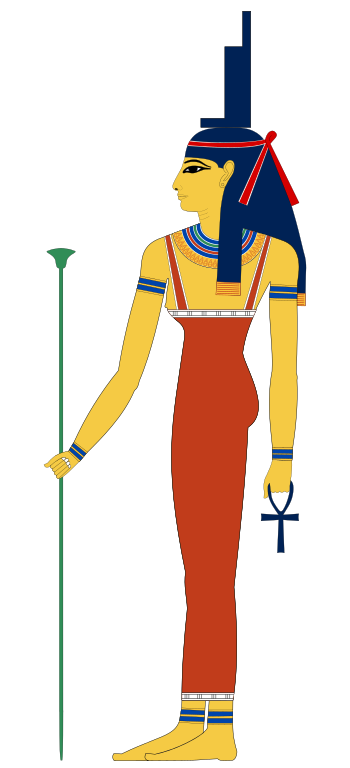
Isis
GoddessWikipedia
529
MENTIONS
25
EPISODES
23
PODCASTS
Search complete. 529 mentions across 25 episodes found for "Isis".
Sep 16, 2026

Tanandra KallenbergerHOST
Because while we talked about Amunet, a priestess, to the goddess Hathor, who was heavily tattooed.
Tanandra KallenbergerHOST
We're going to be talking about priests, processions, and more to another goddess, Isis, the goddess of 10,000 names.
Tanandra KallenbergerHOST
She had her own mystery cult that spanned throughout the Mediterranean world.
Tanandra KallenbergerHOST
Her initiates, her followers, her devotees, and more turned to her for a higher purpose in their lives.
Tanandra KallenbergerHOST
And through archaeological evidence and even writings from the author of The Golden Ass, we can begin to piece these secret initiations and rituals back together.
Tanandra KallenbergerHOST
From Egypt's myths to a temple in Pompeii, we're covering it all.
Tanandra KallenbergerHOST
And yes, I will be doing my makeup and getting ready with you all today just to keep my hands busy as I talk ruins, artifacts, and more to make your day suck less with Isis, the goddess of 10,000 names.
Tanandra KallenbergerHOST
First and foremost, we have to talk about what makes a mystery cult a mystery cult.

speaker_5NARRATOR
In later times the image of Horus subduing the powers of evil seems to have been the protective figure of the house.
speaker_5NARRATOR
when we reach roman times we have a fuller view of the popular worship in the terra-cotta figures at anasia for instance we find the following proportions five of serapis five isis twenty-four horus four bess one goddess of palm-trees it was especially the worship of horus that was developed in this line the kind of shrines used in the houses are also shown by the terracottas these were wooden framed cupboards with doors below over them a recess between two pillars to hold the image and a lamp burning before it and the whole crowned with a cornice of smaller little lamp-holders were also made to hang up and very possibly to place with a lamp on a grave at present mud-hatches are made to place lamps in on holy sites in egypt the terracottas have also preserved the forms of the wayside shrines these were certainly influenced in their architecture by greek models but the idea is probably much older the shrines were sometimes a little chamber with a domed top like a modern welly or saint's tomb or sometimes a roof on four pillars with a dwarf wall or lattice-work around three sides such were the places for wayside devotions and passing prayers as among the egyptians of the present day CHAPTER XIV.
speaker_5NARRATOR
Egyptian Ethics fortunately we have preserved to us a considerable body of the maxims of conduct from the pyramid times and these show very practically what were the ideals and the motives of the early people this is only a small side of the present subject but it will be fully stated in religion and conscience in ancient egypt the repudiation of sins before the judgment of osiris is the earliest code of morals and it is striking that in this there are no family duties such an exclusion points to the family being unimportant in the early times the matriarchy perhaps then excluding the responsibility of the man in the earliest form the prominence of duties is in the order of those to equals to inferiors to gods and to the man's own character in later times the duties to inferiors have almost vanished and the inner duties to character are greatly extended being felt to lie at the root of all else the ideal character was drawn in the maxims as being strong steadfast commanding direct self-respecting avoiding inferior companionship active and above all truthful and straightforward discretion quietness and reserve were enforced and a dignified endurance without pride was to be attained in material things energy and self-reliance were held up and a judicious respect for and imitation of successful men covetousness was specially reprobated and luxury and self-indulgence were looked on as a course which ends in bitterness the aspect of marriage depended essentially on property where a woman had property of her own she was mistress of the house and her husband was but a kind of permanent boarder though in early times and among the priestesses later the choice by a woman was scarcely regarded as permanent where however the household depended on the work of the men he naturally took the leading part but the code of abstract morality and the dictates of common prudence between men and women were of as high a standard as in any ancient or modern peoples no reasonable legislator would wish to add more although six thousand years and christianity have intervened since the egyptian framed his life the family sense of duty in training and advancing a man's sons was strongly urged in the general interchange of social life perhaps the main feature was that of consideration for others a higher standard of good feeling and kindliness existed than any that we know of among ancient peoples or among most modern nations the council hall of the local ruler was the main theatre for ability and the injunctions to be fearless and at the same time gentle and cautious would improve the character of any modern assembly the greater number of precepts however relate to the judicious conduct towards inferiors justice and good discipline were the necessary bases but they were to be always tempered by respect for the feelings and comfort of the servants the religious aspect of ethics was almost confined to the respect for the property and offerings to the gods but the more spiritual side was touched in the precept that which is detestable in the sanctuary of god are noisy feasts if thou implore him with a loving heart of which all the words are mysterious he will do thy matters he hears thy words he accepts thine offerings the permanence of the egyptian character will strike any who knows the modern native the essential mode of justification in the judgment was by the declaration of the deceased that he had not done various crimes and to this day the egyptian will rely on justifying himself by sheer assertion that he has not done wrong in face of absolute proofs to the contrary the main fault of character that was condemned was covetousness and it is the feeling which wrecks the possibility of egyptian independence at present the intrusion of scheming underlings between the master and his men is noted as a failing and exactly this trouble continually occurs now when every servant tries to turn his position to an advantage over those who do business with his master the dominance of the scribe in managing affairs and making profits was familiar in ancient as in modern times and recent events in egypt have reminded us of the old fickleness shown in the saying thy entering into a village begins with acclamations at thy going out thou art saved by thy hand chapter Chapter 15 The Influence of Egypt Chapter 15 The Influence of Egypt how far egypt in its earlier days had influenced the faiths of other countries we cannot trace owing to our ignorance of the early civilisations of the world but in the later times the extension of the popular religion of egypt can only be paralleled by the spread of christianity or islam isis was worshipped in greece in the fourth century b c and in italy in the second century soon after she won her way into official recognition by sulla and immediately after the death of julius a temple to isis was actually erected by the government once firmly established in rome the spread of imperial power carried her worship over the world emperors became her priests and the humble centurion in remote camps honoured her in the waltz of france germany yorkshire or the sahara Not only Isis, but also Osiris claimed the world's worship.
speaker_5NARRATOR
In the new form of the Osir-Hapi of Memphis, or Serapis, the Ptolemies identified him with Zeus, both in appearance and by attributes, and by the time of Nero, Isis and Osiris were said to be the deities of all the world.
speaker_5NARRATOR
An interesting outline of this subject will be found in Professor Dill's Roman Society from Nero to Aurelius.
speaker_5NARRATOR
besides these parent gods their son horus also conquered the world with them isis and horus the queen of heaven and the holy child became the popular deities of the later age of egypt and their figures far outnumbered those of all other gods horus in every form of infancy was the loved bambino of the egyptian women again horus appears carried on the arm of his mother in a form which is indistinguishable from that adopted by christianity soon after we see then throughout the roman world the popular worship of the queen of heaven mater dolorosa mother of god patroness of sailors and her infant son horus the child the benefactor of men who took captive all the powers of evil and this worship spread and increased in egypt and elsewhere until the growing power of christianity compelled a change the old worship continued for the syrian maid became transformed into an entirely different figure queen of heaven mother of god patroness of sailors occupying the position and attributes already belonging to the world-wide goddess and the divine teacher the man of sorrows became transformed into the entirely different figure of the potent child isis and horus still ruled the affections and worship of europe with a change of names egypt also exercised an immense influence upon the church in the trinitarian controversy that was a purely egyptian dispute between two presbyters brought up in the atmosphere of intricacies about the ka the ku the kat the ba the sahu the kaibat and the various other entities which constituted man to carry forward similar refinements concerning the divine nature was as congenial to such minds as it was incomprehensible to the western and the dispute finally rested on the question of whether before time was the same as from eternity such was the struggle which arius and athanasius thrust upon the church a dispute which would never have been heard of in such a shape but for their egyptian origin in another direction egypt was also dominant from some source perhaps the buddhist mission of asoka the ascetic life of recluses was established in the ptolemaic times and monks of serapium illustrated an ideal to men which had been as yet unknown in the west this system of monasticism continued until pahomios a monk of serapis in upper egypt became the first christian monk in the reign of constantine quickly imitated in syria asia minor gaul and other provinces as well as in italy itself the system passed into a fundamental position in mediaeval christianity and the reverence of mankind has been for fifteen hundred years bestowed on an egyptian institution we thus see how the religious ideas of six thousand years or more have still survived and continued their power over civilized men, renamed but scarcely changed, and it is shown how new religious ideas can but transform, but not eradicate, the ancestral beliefs of past ages.

speaker_1ADVERTISER
That's why you rack.
Andrew M. HenryHOST
This is a temple to the goddess Isis, one of the most famous Egyptian goddesses, wife of the god-king Osiris, mother to the falcon god Horus.
Andrew M. HenryHOST
So where in Egypt would you find this temple to this Egyptian goddess? Well, not in Egypt.
Andrew M. HenryHOST
This is the temple of Isis in Pompeii, the Roman city famously destroyed by the volcano Vesuvius in 79 CE.
Andrew M. HenryHOST
But hold on, what is an Egyptian goddess doing in a Roman city on the Italian peninsula? The answer is a fascinating example of religious exchange and evolution.
Andrew M. HenryHOST
Isis captured the attention of the Greeks and the Romans, and worship of this goddess expanded outside of Egypt, evolving into what historians call a Greco-Roman mystery religion.
Andrew M. HenryHOST
Today's video is a collaboration with my friend and colleague, Dr. Angela Puca.
Andrew M. HenryHOST
She's an expert in the study of magic, esotericism, and contemporary paganism.

speaker_0NARRATOR
He is enthroned inside a shrine.
speaker_0NARRATOR
Isis and Nephthys stand beside him.
speaker_0NARRATOR
The man who has died hopes to be accepted before the god who rules the dead.
speaker_0NARRATOR
But Osiris did not begin this story as the calm figure at the end of another person's death.
speaker_0NARRATOR
Egyptian tradition remembered him as a divine ruler, attacked by his own brother Seth.
speaker_0NARRATOR
His body was endangered, his kingship was broken.
speaker_0NARRATOR
Isis and Nephthys mourned and protected him.
speaker_0NARRATOR
Horus acted for his father.

speaker_10ADVERTISER
See Lowe's.com for more details.
Joann FletcherNARRATOR
The most famous of these was the great goddess Isis and Osiris, brother-sister gods who were also husband and wife.
Joann FletcherNARRATOR
Now, according to the ancient Egyptians, unlike most ancient cultures, it was Isis who was the active, dominant partner, whereas Osiris was a rather passive fellow.
Joann FletcherNARRATOR
In fact, he was killed off early on in the story.
Joann FletcherNARRATOR
Oh, poor Osiris.
Joann FletcherNARRATOR
The only power in the universe strong enough to bring him back to life and resurrect him was his great sister, Isis, who brought to bear all her great magic to resurrect him from the dead.
Joann FletcherNARRATOR
And from this pair, so began all humankind.
Joann FletcherNARRATOR
Such stories of Isis, this powerful, mythical woman, are in many ways key to understanding how women had such prominence in Egyptian life.

Heather M. ByeNARRATOR
The celestial Nile had its periodic rise and fall, on which those of the earthly Nile depended.
Heather M. ByeNARRATOR
Every year, towards the middle of June, Isis, mourning for Osiris, let fall into it one of the tears which she shed over her brother, and thereupon the river swelled and descended upon earth.
Heather M. ByeNARRATOR
Isis has had no devotees for centuries, and her very name is unknown to the descendants of her worshippers, but the tradition of her fertilizing tears has survived her memory.
Heather M. ByeNARRATOR
Even to this day, everyone in Egypt, Muslim or Christian, knows that a divine drop falls from heaven during the night between the 17th and 18th of June, and forthwith brings about the rise of the Nile.
Heather M. ByeNARRATOR
Swollen by the rains which fall in February over the region of the Great Lakes, the White Nile rushes northward, sweeping before it the stagnant sheets of water left by the inundation of the previous year.
1 HR 47 MINS LATER
Heather M. ByeNARRATOR
Khumu at the place of its entering into Egypt and again at the town of Haurit, near the point where a great arm branches off from the eastern stream to flow towards the Libyan hills and form the Bar Yusef.
Heather M. ByeNARRATOR
Harshafitu at the gorges of the Fayyum, where the Bar Yusef leaves the valley, and finally Osiris at Mendes and at Busiris, towards the mouth of the middle branch, which was held to be the true Nile by the people of the land.
Heather M. ByeNARRATOR
Isis of Buto denoted the black vegetable mould of the valley, the distinctive soil of Egypt annually covered and fertilized by the inundation.

Sarah TerryNARRATOR
On the sides of the cliffs showed here and there small openings surrounded with blocks of stone thrown in disorder.
Sarah TerryNARRATOR
Square holes flanked by pillars covered with hieroglyphs, the lintels of which bore mysterious cartouches on which could yet be made out in a great yellow disk the sacred scarabaeus, the ram-headed sun, and the goddesses Isis and Nephthys standing or kneeling.
Sarah TerryNARRATOR
These were the tombs of the ancient kings of Thebes.
Sarah TerryNARRATOR
Argyropolis did not stop there, but led the travelers up a sort of steep slope at which first glance seemed nothing but a break on the side of the mountain, choked in many places by fallen masses of rock, until they reached a narrow platform, a sort of cornice projecting over the vertical cliff on which the rocks, apparently thrown together by chance, nevertheless exhibited on close examination some symmetrical arrangement.
Sarah TerryNARRATOR
The entrance of the tomb, which had evidently escaped the investigations of the treasure seekers, appeared in all its integrity.
Sarah TerryNARRATOR
It was a sort of portico squarely cut in the living rock.
Sarah TerryNARRATOR
On the two sidewalls, a couple of pairs of pillars exhibited capitals formed of bulls' heads, the horns of which were twisted like the crescent of Isis.
Sarah TerryNARRATOR
Below the low door, with its jambs flanked by long panels covered with hieroglyphs, there was a broad emblematic square.

speaker_0NARRATOR
When Osiris lays down in it, Set seals the chest and throws it in the Nile.
speaker_0NARRATOR
Isis searches.
speaker_0NARRATOR
She finds the chest in Byblos, on the coast of what is now Lebanon, where the Nile carried it.
speaker_0NARRATOR
It came to rest against a tree, a tamarisk tree that grew around it, incorporating the chest into the trunk.
speaker_0NARRATOR
The king of Byblos had the tree cut down and used it as a pillar in his palace.
speaker_0NARRATOR
Isis arrived, recognized what the pillar contained, and retrieved the body of her husband.
speaker_0NARRATOR
She brought it back with her to Egypt.
speaker_0NARRATOR
Set found it.

Sarah TerryVOICE_ACTOR
On the sides of the cliffs showed here and there small openings surrounded with blocks of stone thrown in disorder.
Sarah TerryVOICE_ACTOR
Square holes flanked by pillars covered with hieroglyphs, the lintels of which bore mysterious cartouches on which could yet be made out in a great yellow disk the sacred scarabaeus, the ram-headed sun, and the goddesses Isis and Nephthys standing or kneeling.
Sarah TerryVOICE_ACTOR
These were the tombs of the ancient kings of Thebes.
Sarah TerryVOICE_ACTOR
Argyropolis did not stop there, but led the travelers up a sort of steep slope at which first glance seemed nothing but a break on the side of the mountain, choked in many places by fallen masses of rock, until they reached a narrow platform, a sort of cornice projecting over the vertical cliff on which the rocks, apparently thrown together by chance, nevertheless exhibited on close examination some symmetrical arrangement.
Sarah TerryVOICE_ACTOR
The entrance of the tomb, which had evidently escaped the investigations of the treasure-seekers, appeared in all its integrity.
Sarah TerryVOICE_ACTOR
It was a sort of portico squarely cut in the living rock.
Sarah TerryVOICE_ACTOR
On the two side walls a couple of pairs of pillars exhibited capitals formed of bull's heads, the horns of which were twisted like the crescent of Isis.
Sarah TerryVOICE_ACTOR
Below the low door, with its jambs flanked by long panels covered with hieroglyphs, there was a broad emblematic square.

R.C.HOST
It abounds with hermetic symbols and zodiacal signs.
R.C.HOST
And there we see Hermes Trismegistus, young and beardless, in the company of Isis and Moses.
R.C.HOST
Around 1500, he was painted on a wall of the church Sint Walburgis in Zutphen, in the Low Countries, in the company of Maria, the newly born Jesus, angels, and civils.
R.C.HOST
On a pilaster of a Sistine room in the Bibliotheca Vaticana, a painting, 1587, shows him with attributes of Mercurius.
10 MINS LATER
R.C.HOST
Go to Dr. Terry Burns' YouTube channel to watch that exquisite 50-hour course.
R.C.HOST
Yeah, so her self-interest in magic was presented therein as the sovereign who would restore the Golden Age and undo the ravages wrought by the fall of man.
R.C.HOST
Elizabeth's Protestantism was thus seen metaphorically as a return to the old Egyptian religion as opposed to Catholic imperialism, understood as a perversion to the true religion of Isis and Hermes Trismegistus.
R.C.HOST
Likewise, and much later, in his Pensaruso, 1645, in which Hermes is the central character, John Milton would link poetry, Hermetism, and Protestant reforms.
15 more episodes mention Isis.
Create an account to see the whole feed, search across every transcript, and follow the entities you care about.