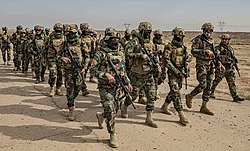
Iraqi Armed Forces
MilitaryWikipedia
17
MENTIONS
13
EPISODES
10
PODCASTS
Search complete. 17 mentions across 13 episodes found for "Iraqi Armed Forces".
Oct 8, 2026

Matthew CzekajHOST
Yeah, you, you've already mentioned the, uh, attack that we saw on, uh, an out- a federal police outpost near Kirkuk that happened earlier this week.
Matthew CzekajHOST
Um, but in fact, just one day after the U.S. military's withdrawal, the Iraqi government actually, uh, warned that there was a potential threat of ISIS terrorism coming across the border from Syria, but they did promise that the Iraqi Armed Forces could handle it.
Matthew CzekajHOST
Uh, do you think, uh, the Iraqi state is in fact up to the task? Uh, how do you evaluate the level of, uh, capabilities and the capacity of today's Iraqi army and its internal security services?
Robert S. FordGUEST
Well, of course, uh, we all remember what happened in twenty fourteen when the Iraqi security forces essentially melted in front of, uh, resurgent ISIS, uh, captured Mosul with just a couple hundred people.

Inna RudovGUEST
So on the one hand, there is the Popular Mobilization Forces, which by law is part and parcel of the Iraqi security architecture.
Inna RudovGUEST
By law, they're recognized as an official pillar of the Iraqi Armed Forces, and the paradox stems from the fact that the law that, um, institutionalized their mandate within the Iraqi security sector, in a way described them as part of the armed forces, but also as an independent entity, and this law never really delineated what this independence entails in a way.
Inna RudovGUEST
Um, the problem also stems from the fact that the PMF is not a unitary actor.
Inna RudovGUEST
Also, it's very difficult when you're being asked to comment on what does the PMF want now? What is the PMF planning to do? In a way, we can't talk about the PMF as a singular actor, but rather as another institution within the context of an already highly fragmented Iraqi state that's being contested from within and from the outside.
11 MINS LATER
Inna RudovGUEST
... for their loyalty towards the state.
Inna RudovGUEST
And one of the arguments that really struck me in, in a lot of the interview situations, because of course, as a critical scholar, you push against any piece of, uh, narrative or propagandist, uh, slogans, you know, uh, self portrayals that you're being confronted with.
Inna RudovGUEST
So even in some cases, I would ask, how is it possible that this and this faction may decide to go against the prime minister, may decide to have a clash with the Iraqi Armed Forces, may decide to particularly contradict this or that directive of the elected government? And in that sense, a lot of them would argue that in a way they have to perceive, uh, to preserve an armed presence outside of the formal chain of command to defend the sovereignty of Iraq.
Marc LynchHOST
Yeah, it's interesting.

Louay FaourPANELIST
I mean, US Central Command, um, said today that it's completed the orderly departure of US forces and equipment from Erbil Airbase, marking the end of the Operation Inherit Resolve mission.
Louay FaourPANELIST
The Centcom commander, uh, Brad Cooper, said, "Job," quote, "job well done to the tens of thousands of American service members, diplomats, and civilian personnel who answered the call in Iraq." He says, "ISIS no longer poses a systematic threat to Iraq's national security and Iraqi Security Forces, including the Peshmerga-
Hugo GoodridgeHOST
Mm
Louay FaourPANELIST
... and other Iraqi Kurdistan regional security forces now possess the capacity, leadership, and operational independence to unilaterally manage threats to their homeland." As you can imagine, there has been political celebration in Iraq.
Louay FaourPANELIST
... which is still facing lots of, um, challenges, uh, with regards to militias.
Louay FaourPANELIST
Um, which brings me to my point.
Louay FaourPANELIST
The bigger unresolved security question in Iraq, which now remains, is whether the Iraqi Army and Iraqi Security Forces can actually replace American troops in terms of having full authority over the country.
Hugo GoodridgeHOST
Mm.

Gideon ResnickHOST
Some experts now worry that Iraq's own security forces won't be able to prevent a wave of instability or the growth of Iranian influence.
Gideon ResnickHOST
Retired Army Lieutenant General H.R. McMaster commanded US forces in Iraq and later served as Trump's National Security Advisor.
Gideon ResnickHOST
He told NPR's Morning Edition this is not the right time to leave.
speaker_6SOUNDBITE_SPEAKER
This is going to embolden, I think, the Iranis to a certain extent.
speaker_6SOUNDBITE_SPEAKER
Uh, and it's not clear that there has been the enduring defeat of ISIS.
Gideon ResnickHOST
Iraqi intelligence officials told Reuters that ISIS still has an active sleeper cell network in the country, and the last time the US withdrew, back in 2011, the Iraqi Army quickly proved no match for ISIS.
Gideon ResnickHOST
The group captured the second-largest city and ultimately seized control of roughly a third of Iraq and Syria.
Gideon ResnickHOST
By that point, Iran had deep influence in the country, and McMaster tells NPR they're still making an impact today.

Nick GaleHOST
Yeah.
Nick GaleHOST
General, so in that regard though, how prepared are the Iraqi Armed Forces to thwart anything like what we saw shortly after we pulled the troops the first time, where ISIS came in and tried to take things over?
Richard NewtonGUEST
Exactly, Nick.
Richard NewtonGUEST
I think, uh, they are, uh, going to be challenged.
Richard NewtonGUEST
Uh, they will still need to have, uh, their efforts to organize and train, equip their, the Iraqi Armed Forces, to include not only their ground forces, but their fledgling air force and so forth.
Richard NewtonGUEST
Um, it will be a challenge.
Richard NewtonGUEST
I think the broader question is, uh, not only from the military, Iraqi military standpoint, but their political infrastructure as well.

Sabah al-NumanSOUNDBITE_SPEAKER
We are very proud to reach this day.
Jane ArrafCORRESPONDENT
That's Iraqi Armed Forces spokesman Sabah al-Numan.
Jane ArrafCORRESPONDENT
At its height during an eight-year-long occupation, the US had 170,000 military personnel in Iraq.
Jane ArrafCORRESPONDENT
Jane Arraf, NPR News, Baghdad.
Sabah al-NumanSOUNDBITE_SPEAKER
We are very proud to reach this day.
Jane ArrafCORRESPONDENT
That's Iraqi Armed Forces spokesman Sabah al-Numan.
Jane ArrafCORRESPONDENT
At its height during an eight-year-long occupation, the U.S. had one hundred and seventy thousand military personnel in Iraq.
Jane ArrafCORRESPONDENT
Jane Arraf, NPR News, Baghdad.
Sabah al NumanSOUNDBITE_SPEAKER
We are very proud to reach this day.
Jane ArrafCORRESPONDENT
That's Iraqi Armed Forces spokesman Sabah al Numan.
Jane ArrafCORRESPONDENT
At its height during an eight-year-long occupation, the US had one hundred and seventy thousand military personnel in Iraq.
Jane ArrafCORRESPONDENT
Jane Arraf, NPR News, Baghdad.
Sabah al-NumanSOUNDBITE_SPEAKER
We are very proud to reach this day.
Jane ArrafCORRESPONDENT
That's Iraqi Armed Forces spokesman Sabah al-Numan.
Jane ArrafCORRESPONDENT
At its height during an eight-year-long occupation, the U.S. had 170,000 military personnel in Iraq.
Jane ArrafCORRESPONDENT
Jaina Raf, NPR News,

Sabah al-NumanSOUNDBITE_SPEAKER
We are very proud to reach this day.
Jane ArafCORRESPONDENT
That's Iraqi Armed Forces spokesman Sabah al-Numan.
Jane ArafCORRESPONDENT
At its height during an eight-year-long occupation, the U.S. had 170,000 military personnel in Iraq.
Jane ArafCORRESPONDENT
Jane Araf, NPR News, Baghdad.
3 more episodes mention Iraqi Armed Forces.
Create an account to see the whole feed, search across every transcript, and follow the entities you care about.