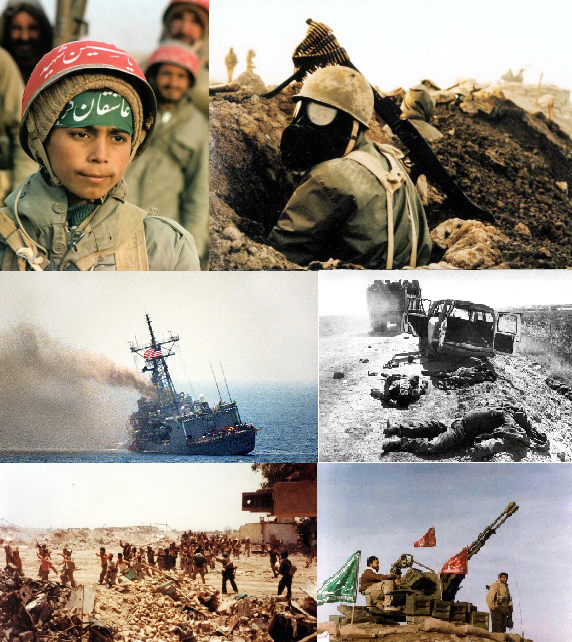
Iran–Iraq War
WarWikipedia
304
MENTIONS
131
EPISODES
122
PODCASTS
Search complete. 304 mentions across 131 episodes found for "Iran–Iraq War".
Oct 28, 2026

Ari TabatabaiGUEST
Now, what's important to understand, though, is that since its beginning, the Iranian system has had this kind of mix of formal and informal processes that have been in place.
Ari TabatabaiGUEST
And a lot of those processes were formalized at the end of the Iran-Iraq war and throughout the 1990s.
Ari TabatabaiGUEST
And now we're kind of seeing a similar transition where the regime is having to rethink how it's done things.
Ari TabatabaiGUEST
And while it's doing that, I would assume that it is actually doing a lot more of the informal side of things.

speaker_0HOST
The Gulf has something different.
speaker_0HOST
The Gulf Cooperation Council was founded in 1981 by six monarchies, Bahrain, Kuwait, Oman, Qatar, Saudi Arabia, and the United Arab Emirates two years after Iran's revolution and in the first year of the Iran-Iraq War.
speaker_0HOST
Gulf officials have described it as a response, in part, to threats from Iran, and it deliberately left out both Iran and Iraq.
speaker_0HOST
Members signed a joint defense agreement in 2000, and in March of 2024, the Council published what a Stimson Center analysis called the first explicit articulation of a collective security vision in its 43-year history.
speaker_0HOST
A call for all the states around the Gulf to join one collective system.
speaker_0HOST
and for outside powers to stay out.
speaker_0HOST
It drew on a United Nations resolution from 1987 that helped end the Iran-Iraq war.
speaker_0HOST
Russia floated its own collective security concept for the Persian Gulf the same year and reintroduced it in October of 2020, proposing an organization of the eight shoreline states with Russia, China, the United States, the European Union, India, and others as observers or associates.

Karim SadjadpourGUEST
Right.
Karim SadjadpourGUEST
You know, others will liken it to the early days of the Iran-Iraq war when you had a revolutionary regime which decided for domestic political expediency to actually prolong the war because it helped them consolidate power, helped the revolution consolidate power.
Karim SadjadpourGUEST
So that is really a fundamental question, Aaron, which is difficult to answer.
Karim SadjadpourGUEST
The final thing I'd say, though, here is that...

speaker_0NARRATOR
Of course, being next to Afghanistan when the poppy cultivation exploded was a stroke of awful luck, but the Iranian people have been under enormous strain since the 1979 revolution, and in truth, probably well before that.
speaker_0NARRATOR
The revolution was followed almost immediately by the Iran-Iraq War, an eight-year conflict that killed hundreds of thousands of Iranians and left many more wounded, shell-shocked, and never quite the same.
speaker_0NARRATOR
Then came decades of international sanctions, periodic economic crises, inflation, unemployment, and an increasingly isolated economy.
speaker_0NARRATOR
More recently, the country has experienced repeated waves of protests, violent government crackdowns, and growing frustration among younger Iranians over political and social restrictions.

speaker_0HOST
I think I remember it was a few years ago, but you read the book, but you discuss that maybe in the biggest frame of concerns for Saddam, Iran is the absolutely terrifying power.
speaker_0HOST
The United States is a bad power that beat it badly in the Gulf War, but the Iran-Iraq War in the 1980s was catastrophic.
speaker_0HOST
that in some ways to show weakness, to show to the region, I don't have weapons of mass destruction, I don't have this, that was maybe more worrisome, and that you mentioned not keeping great records, they did destroy huge amounts of those weapons of mass destruction, but they didn't keep any records, and there's no way they could show to the West they'd actually done it.
speaker_0HOST
Was that in his mindset?

Larry JohnsonGUEST
At least in the world of special operations, this kind of thing was never envisioned.
Larry JohnsonGUEST
Back in 1988, 87, at the end of the Iran-Iraq War, Iran started laying mines in the Persian Gulf.
Larry JohnsonGUEST
And so we, the United States, a group of Navy SEALs, set up a floating base off the coast of Bahrain that was called the Hercules Barge.
Larry JohnsonGUEST
And they conducted what at the time we called oil escort operations.

Amir ZargaraGUEST
It's a very specific place.
Amir ZargaraGUEST
It's where like all the oil comes from, but also like, it's where like the war took place, like the Iran-Iraq war and, and yeah, you know, and, um, and then now being in Canada and, and how, uh, so now I've been in Canada for like longer that I've been in Iran.
Amir ZargaraGUEST
The, by a year.
Amir ZargaraGUEST
So like, what does that mean? What does that feel like? You know? And I was also like, uh, I was born with the stutter as well, which, uh, it's, it's a character.
Amir ZargaraGUEST
I had to channel it into something.
Amir ZargaraGUEST
And I guess the whole process, like, again, it's an Iranian film, A Good Day Will Come, you know, it's a, and, and like, I haven't lived in Iran for the last, like, you know, 15 years.
Amir ZargaraGUEST
So, and then I'm like, all safe and sound in Canada, you know, doing these interviews or in other places, you know, and, talking about the film and it just all felt very and it all like helps helps my situation like helps my uh sure like I'm putting a light on what's going on and I felt like I had to do it because of my privilege that I have here which is like you can't make that film back home so like and I have the funding system here so if I don't do it like uh if I don't do it then who will you know so it's like yeah but then it's like you know but then i reap the rewards of that you know which is like uh it's like you know it's okay well like it's like the it might help my career you know or whatever you know so as a filmmaker so and and that's where like the uh metaphor for vital uh I was looking for metaphors to channel that through.
Amir ZargaraGUEST
And then the Oregon trade, which is very specific to Iran because of the laws that we have.

Matt BrackenGUEST
So the military commander of Iran is a guy named General Rezai.
Matt BrackenGUEST
And he was literally a battlefield promoted guy back in the 1980s Iran-Iraq War, when he rose from being a junior officer to a general in just a couple of years by having battlefield success.
Matt BrackenGUEST
And that doesn't happen very often.
Matt BrackenGUEST
After the 80s, he was in the military.

Hugh HewittHOST
It's more savage than Korea.
Hugh HewittHOST
More savage than the Iraq-Iran War.
Hugh HewittHOST
It's savage in a way that we moderns are not used to.
Hugh HewittHOST
I think it disturbs the present, disturbs me.

Hugh HewittHOST
It's more savage than Korea.
Hugh HewittHOST
More savage than the Iraq-Iran War.
Hugh HewittHOST
It's savage in a way that we moderns are not used to.
Hugh HewittHOST
I think it disturbs the present, disturbs me, I'm sure it disturbs you, but there's an inevitability of trying to take high ground from low ground with infantry, especially with drone warfare.
121 more episodes mention Iran–Iraq War.
Create an account to see the whole feed, search across every transcript, and follow the entities you care about.