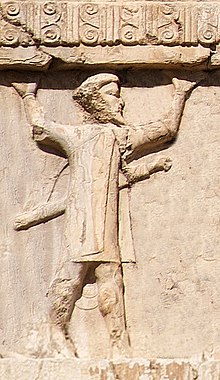
Ionians
TribeWikipedia
336
MENTIONS
42
EPISODES
30
PODCASTS
Search complete. 336 mentions across 42 episodes found for "Ionians".
Oct 29, 2026

speaker_12NARRATOR
The one he loved was Favorit.
speaker_12NARRATOR
Oh, Favorit, thou hast Ionian lips.
speaker_12NARRATOR
There was a Greek painter named Euphorion who was surnamed the painter of the lips.
speaker_12NARRATOR
That Greek alone would have been worthy to paint thy mouth.
speaker_16NARRATOR
By the word fortune we mean chance, to some extent.
speaker_16NARRATOR
That pygmy kneaded out of common earth, ignorant, unlettered, giddy, vulgar, low, Will that become an Ionian or Brotian? Wait.
speaker_16NARRATOR
Curatorota, the spirit of Paris, that demon which creates the children of chance and the men of destiny, reversing the process of the Latin potter, makes of a jug an amphora.
speaker_16NARRATOR
The gammon loves the city.

Jim NolanHOST
He had thus accessible for his history the tongue which had already been consecrated to prose literature.
Jim NolanHOST
But while he wrote their language, he could not rid himself of a strong native prejudice against the Ionians.
Jim NolanHOST
They are practically the only people in his whole narrative to whom he is almost consistently unfair.
Jim NolanHOST
They, quote, have built their cities in a region where the air and climate are the most beautiful in the whole world, for no other region is equally blessed with Ionia, neither above it nor below it, nor east nor west of it, unquote.
Jim NolanHOST
The Athenians and most of their other Ionic states over the world went so far in their dislike of the name as actually to lay it aside, and even at the present day, the greater number of them seem to me to be ashamed of it, unquote.
Jim NolanHOST
Thus he brings his neighbors into the story, borrowing their tongue to do it, and once in it they fare no better.
Jim NolanHOST
His jibes sometimes become a sneer, deftly driven home by the rhetorical device of having someone else, a Scythian for instance, say, by way of reproach, that the Ionians are the basest and most dastardly of all mankind, but the faithfulest of slaves.
Jim NolanHOST
There is a touch, a shadow, of something Dante-esque in this strength of local antipathy, quite out of keeping with the breadth of sympathy and interest he shows elsewhere.

Mark SelickHOST
Those within Athens feared this might be the fate of the city, while many outside saw the decline as almost inevitable.
Mark SelickHOST
Sparta, Persia and the Ionian Greeks all now saw an opportunity to act against Athens, though each had their own motivations and interests.
Mark SelickHOST
Their shared desire to see Athens' power weakened would bring all three together, albeit in a somewhat disorganised fashion, as they attempted to strike at the base of Athenian strength, the empire and the member states that made it possible.
Mark SelickHOST
The expectation was that once key member states revolted from Athens, others would quickly follow.

John BatchelorHOST
So we now go to a battle, the first big battle, the invasion by, not Cyrus, he's gone, a man named Darius is the king of kings.
John BatchelorHOST
And he finally conquers the Ionian coast.
John BatchelorHOST
That includes Croesus.
John BatchelorHOST
Remember, rich as Croesus? And the Medeans, he conquers them.

TriciaGNARRATOR
and flaming barbarians we do not know whether the old hellenes had any general word to denote the surrounding peoples palatians and divers other barbarous tribes whom they conquered or accepted as allies in any case by the time of the persian wars say five hundred b c all these tribes together considered themselves hellenized bore the name of hellenes and formed a kind of unity against hordes of barbaroi surrounding them on every side and threatening them especially from the east let us consider for a moment the dates in political history this self-realization of the greek tribes as hellenes against barbarians seems to have been first felt in the ionian settlements on the coast of asia minor where the sons of javan yawan i clashed as invaders against the native hittite and semite it was emphasized by a similar clash in the further colonies in pontus and in the west if we wish for a central moment as representing this self-realization of greece
TriciaGNARRATOR
I should be inclined to find it in the reign of Pisistratus, 560-527 BC, when that monarch made, as it were, the first sketch of an Athenian
TriciaGNARRATOR
empire based on alliances and took over to Athens the leadership of the Ionian race.
TriciaGNARRATOR
In literature, the decisive moment is clear.
TriciaGNARRATOR
It came when, in Mr. McHale's phrase, quote, Homer came to Hellas, unquote.
15 MINS LATER
TriciaGNARRATOR
the ionians are defined by herodotus as those tribes and cities who were sprung from athens and kept the apaturia they recognized delos as their holy place and worshipped apollo patros as their ancestor the ionian homer has naturally brought us the ionian god and significantly enough though the tradition makes him an enemy of the greeks and the poets have to accept the tradition there is no tendency to crab or belittle him he is the most splendid and
TriciaGNARRATOR
awful of homer's olympians the case of pallas athene is even simpler though it leads to a somewhat surprising result What Apollo is to Ionia, that, and more, Athena is to Athens.
TriciaGNARRATOR
There are doubtless foreign elements in Athena, some Cretan and Ionian, some northern.
John BatchelorHOST
Although they called themselves Partu or Pythia, we sometimes called them different names.
John BatchelorHOST
The Greeks called them Medes because they'd conquered Croesus of the Ionian coast, and he was a Medean to the Greeks.
John BatchelorHOST
Everybody has different names, but you know Athens and you know Sparta.
John BatchelorHOST
Sparta doesn't have anything to look at today.
13 MINS LATER
John BatchelorHOST
She was from Miletus.
John BatchelorHOST
It's one of the city-states that the Spartans...
John BatchelorHOST
It's on the Ionian coast, yeah.
John BatchelorHOST
That the Spartans picked on.

Alexandra SillsHOST
Can you explain what that is, what it means and what it means for Athenian history?
Christy ConstantakopoulouGUEST
So as you said, the Persians invade and the Greeks manage to defeat them over the course of two invasions.
Christy ConstantakopoulouGUEST
And when the Persians withdraw, and that is a year of 478 BCE, which is an important year because that's the beginning of our story, there is no guarantee that they're not going to come back for a third invasion.
Christy ConstantakopoulouGUEST
So the coalition of Greeks who fought the Persians decide to continue the war and take it over to the Persian side over the other side of the Aegean Sea.
Christy ConstantakopoulouGUEST
So they've defeated the Persians on the Greek mainland side.
Christy ConstantakopoulouGUEST
But of course, the Greeks living in Asia Minor, that is the modern coast of Turkey, are still under Persian rule.
Christy ConstantakopoulouGUEST
So the Greeks... decide to take the war to the Persians, liberate the Greeks of Ionian, and they need a military leadership to do that.
Christy ConstantakopoulouGUEST
Now, for traditional military terms, Sparta was the leader during the present wars because it was the biggest military power, especially for land warfare.

James R. HedrickNARRATOR
The Liparian Isles, from about 580 BC to the time of the Roman conquest, were practically a republic of the Greek corsairs.
James R. HedrickNARRATOR
Similarly, the Ionians and the Lycians were notorious for their piratical activities.
James R. HedrickNARRATOR
After the period of Thucydides, Corinth endeavored to put down piracy, but in vain.
James R. HedrickNARRATOR
The irregularity went on until the conquest of Asia by the Romans, in spite of all the precautions that were taken.

Dave FarinaHOST
But there were two very large conflicts during the 5th century BCE that put the Dorian and Ionian alliances to the test.
Dave FarinaHOST
At the beginning of that century, the Greek cities of Ionia rebelled against the Persian Empire, which had subjected them to its authority, and the Athenians, who were themselves Ionians, sent soldiers to help them do it.
Dave FarinaHOST
The result was that a large Persian army invaded Greece in 490 BCE, which was repelled almost solely by Athens, who were famous for their navy.
Dave FarinaHOST
But the decisive Greek victory in this war was the land battle that the Athenians fought at Marathon.
32 more episodes mention Ionians.
Create an account to see the whole feed, search across every transcript, and follow the entities you care about.