Investigative genetic genealogy
22
MENTIONS
3
EPISODES
3
PODCASTS
Search complete. 22 mentions across 3 episodes found for "Investigative genetic genealogy".
Nov 10, 2026

Paul Jack FronczakHOST
For more than 90 years, that's where the story ended, until now.
Tracey HastingsHOST
Today, an active cold case investigation and investigative genetic genealogy are giving this boy something investigators in 1932 could never give him, another chance to be identified.
Paul Jack FronczakHOST
And today we're joined by two of the people trying to make that happen.
Paul Jack FronczakHOST
Detective Matt Hefner, lead investigator on the case with the Charlotte Mecklenburg Police Department Homicide Cold Case Unit, and Karen Binder, director of the Investigative Genetic Genealogy Center at Ramapo College of New Jersey.
Tracey HastingsHOST
We'll hear how a case from 1932 is reopened, what it takes to investigate someone who has been unidentified for nearly a century, and how DNA could finally lead investigators to the family and the name of the boy Charlotte refused to forget.
Paul Jack FronczakHOST
Welcome back to the Franzar Files, the search for the missing.
15 MINS LATER
Matt HefnerGUEST
Yeah, so I did a little work on it before I knew a lot about genealogy.
Matt HefnerGUEST
And then I was fortunate to be trained by a college in New Jersey, Grand Waco College of New Jersey, their IGG program.

Simon McCormackHOST
Got it.
Simon McCormackHOST
And Beth, I want to talk about something that Aaron mentioned earlier, forensic genetic genealogy.
Simon McCormackHOST
Can you talk about what's going on there at the state level with law enforcement?
Beth HaroulisGUEST
Sure.
Beth HaroulisGUEST
genetic genealogy or forensic investigative genetic genealogy because the state police have already started to use this technique to address unsolved crimes where they have allegedly, they claim, exhausted other investigative leads.
Beth HaroulisGUEST
It's a little bit backwards because the commission seems to have already allowed this technique to go forward in terms of certifying the laboratory and their protocols, even though no one's seen their policies and the like.
Beth HaroulisGUEST
But this forensic genetic genealogy is just the tip of the iceberg here in terms of not only solving crimes allegedly where the data does not support that except in very, very small number of cases, but exposing people to this genetic dragnet situation effectively They can build out the family trees.
Beth HaroulisGUEST
It has all of the dire consequences with none of the guardrails.

Sally CohenHOST
So I thought we would start with the science here.
Sally CohenHOST
So for listeners who've never heard the term, Joanne, can you explain what is forensic genetic genealogy and how is it different from the sort of DNA lab test tube analysis that people might have in their head from TV or otherwise?
Johanne KarizamimbaGUEST
Of course.
Johanne KarizamimbaGUEST
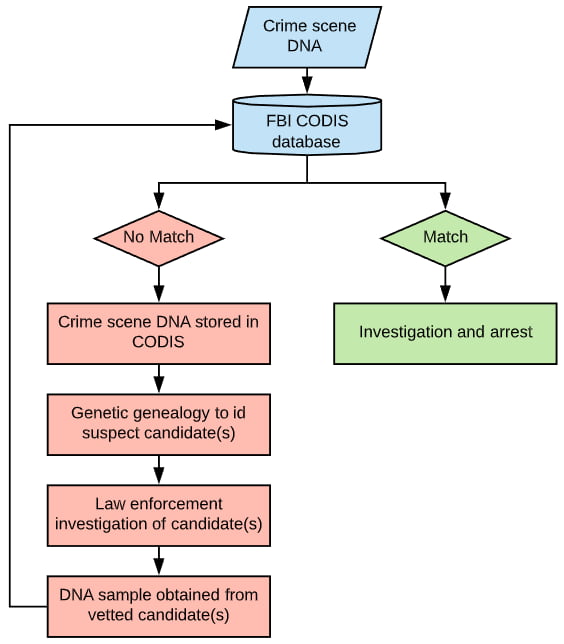
So kind of right off the bat, forensic genetic genealogy and its distinction from traditional DNA testing really boils down to a matter of profiles, right? So the type of DNA analysis testing that is done most commonly in forensic labs, you know, the type of testing we see depicted in TV, relies on what's known as STR DNA profiles.
Johanne KarizamimbaGUEST
And it's been used for decades at this point, and it's actually the basis for the CODIS system.
Johanne KarizamimbaGUEST
Right, so this type of traditional DNA testing is built around the concept of comparison.
Johanne KarizamimbaGUEST
So now what happens when a person is not a known individual or their STR DNA profile is not contained in a database, right? Without a candidate or a database match, the evidence is often not helpful, uninformative.
Johanne KarizamimbaGUEST
You're not going to be able to figure out who it is.