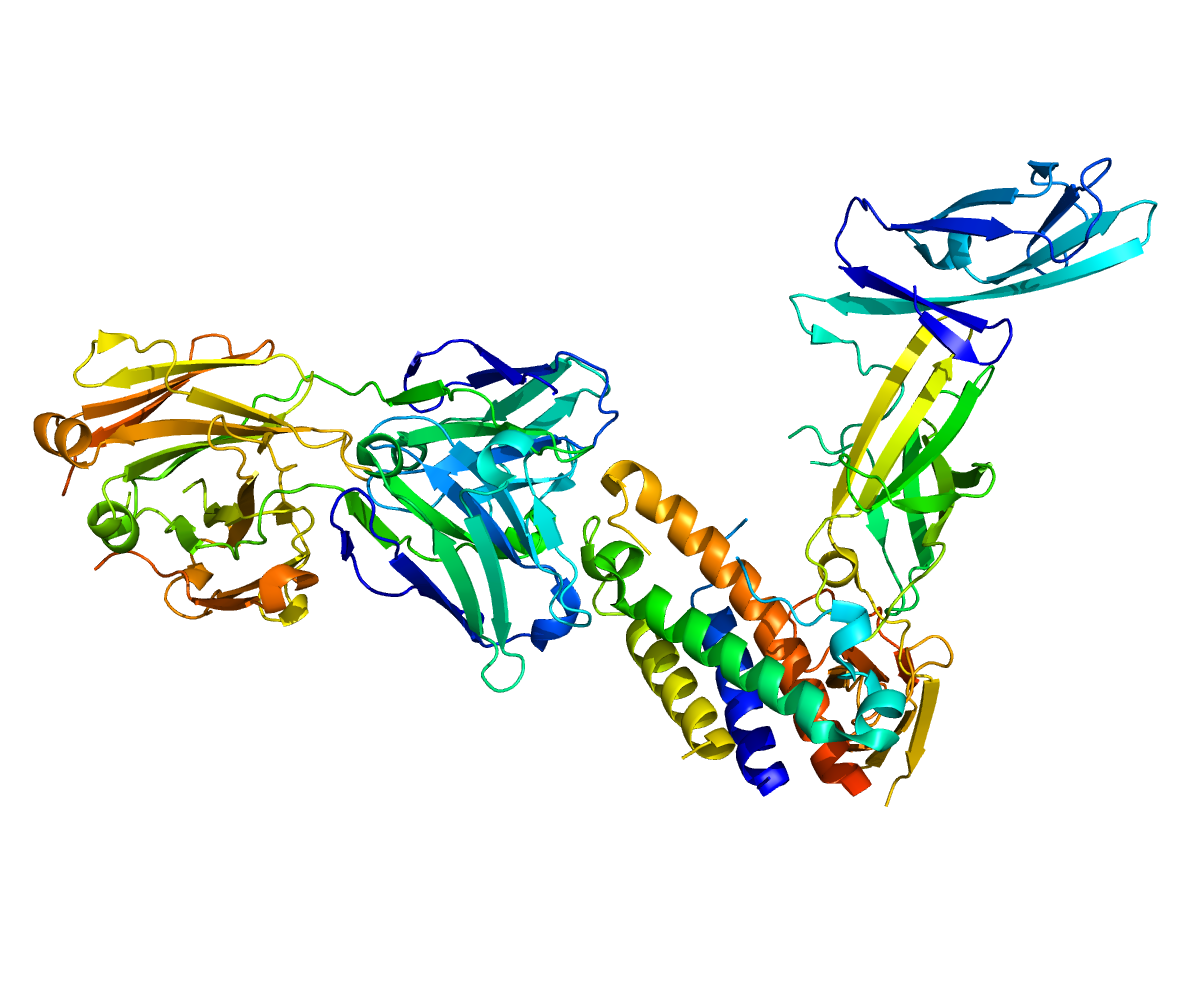
Interleukin 23
ProteinWikipedia
108
MENTIONS
37
EPISODES
26
PODCASTS
Search complete. 108 mentions across 37 episodes found for "Interleukin 23".
Nov 1, 2026

Maya PatelHOST
In the Daily Roundup, Sun Pharma's Illumia now has FDA approval for adults with active psoriatic arthritis, a chronic, immune-mediated disease of painful, swollen joints.
Maya PatelHOST
Illumia is an IL-23 inhibitor already approved for plaque psoriasis.
Maya PatelHOST
This approval rests on its own arthritis evidence.
Maya PatelHOST
Two randomized, placebo-controlled Phase III trials in about 800 adults.

Jack CushHOST
Every day, every month, Room Now publishes news and information on JAK inhibitors, IL-17s, IL-23s, lupus, myositis, scleroderma, all the stuff that could change your practice of dermatology.
Jack CushHOST
I'm Jack Cush, executive editor of RoomNow.com, and this is a podcast for you, Derm on Room Now.
Jack CushHOST
This week, the podcast will scratch the surface and find new drugs for dermatographism, hydradenitis, lupus, discoid lupus, and psoriatic arthritis.
Jack CushHOST
for use in active psoriatic arthritis.
Jack CushHOST
This extends its indication beyond moderate to severe plaque psoriasis, and the indication is going to be based on two very large phase three trials, INSPIRE 1 and 2, with over 800 patients in a 52-week set of studies.
Jack CushHOST
That's good news for those of us who like the IL-23s.
Jack CushHOST
It's getting to be a busy therapeutic area.
Jack CushHOST
The FDA has also been active.
Jack CushHOST
What they showed was for every 5% kilograms per meter square BMI, there was a 37% increase in the failure rate.
Jack CushHOST
The lowest failure rate was seen with IL-17 inhibitors and IL-23 inhibitors, especially compared to TNF inhibitors, about a 50% lower rate compared to TNF inhibitors.
Jack CushHOST
And again, obesity did not associate with secondary failures or toxicity failures.
Jack CushHOST
I found that to be a new wrinkle, a And, you know, the problem with therapies in psoriasis, psoriatic arthritis is we've got a lot of them, yes, but we also have what I think are somewhat disappointing survival therapies.

Jeff StewartGUEST
And when they look, of course, it's cross-study comparisons.
Jeff StewartGUEST
When they look across not just IL-23 induction, but every single induction study that's been done to date, it really stands out.
Jeff StewartGUEST
So as we've talked about over the last few quarters, the in-play share is roughly 50-50 in IBD versus the main competitor.
Jeff StewartGUEST
We would anticipate certainly an acceleration in Crohn's where we have that approval.

Jason HawkesGUEST
And if you have a propensity, such as a patient who has a family history of atopic dermatitis or a family history of psoriasis, for example, then we have this propensity towards a specific type of pattern.
Jason HawkesGUEST
And therefore, we're going to see roles for cytokines like IL-23, which are helping get this naive T cell to become one of these high-producing cells that make signals like IL-17s, for example, which are going to give us that propensity for disease.
Jason HawkesGUEST
So this kind of lays out that you can look at the cytokine, like IL-12, IL-4, IL-23, as driving type 1, type 2, and type 3, respectively.
Jason HawkesGUEST
Or you can look at a transcription factor like STAT6, which which is critical to driving the differentiation to type two versus like stat three driving type two inflammation.
Jason HawkesGUEST
So as we learn these different signals, it helps us learn some of the soup, as you mentioned, that's helping push us towards a propensity for a certain type of an immune response, which tends to manifest in reproducible patterns.
Jason HawkesGUEST
And then type three, we tend to see more of the more classic hyper proliferative conditions like psoriasis, really classic there.
Jason HawkesGUEST
But we also start to see it play out in other conditions.
Jason HawkesGUEST
like some of the ankylosing spondylitis, for example, and even inflammatory bowel disease, which can have both a type three IL-23 component, but also a type one with a TNF and IL-12 component.

Philip J. MeaseGUEST
And this allows us to, it appears, to get around the issue of problems with lipid elevation or LFT abnormalities, as well as being much more specific for inhibiting inflammation.
Philip J. MeaseGUEST
Specific cytokines that are inhibited by Ducrevacidinib are IL-23, IL-12, and also interferon.
Philip J. MeaseGUEST
And one of the things that the interferon inhibition has to do with is going to be its potential benefit if approved in treating systemic lupus erythematosus, as well as Sjogren's syndrome, which the drug is in phase three trials for.
André Lucas RibeiroHOST
Those are very interesting points as well.
11 MINS LATER
Philip J. MeaseGUEST
And this agent would be ideal for slotting into that position where a person is being introduced to using a systemic medication for the first time.
Philip J. MeaseGUEST
And this is a safe and effective medication that can be used early on and probably has its best effects when used earlier in the treatment ladder.
Philip J. MeaseGUEST
However, we also are using it in the context of patients who have tried multiple different mechanisms before TNF inhibition, IL-17 inhibition, IL-23 inhibition, and so on, and have had inadequate response to several of these mechanisms and thus looking for a new mechanism to see if it will work.
Philip J. MeaseGUEST
We tend not to get as good response in those patients that have tried everything, but nonetheless, it's a safe and potentially effective drug to try.

Adam FayeGUEST
I should say, first of all, I have no problem continuing it if the disease activity warrants that we continue the TNF or JAK inhibitor for whatever reason.
Adam FayeGUEST
If they're in remission and otherwise doing well from their inflammatory bowel disease standpoint and about to start chemotherapy, you could consider a switch to an IL-23, an IL-1223, or an anti-integrin.
Adam FayeGUEST
But I've also had it the other way around, where either you have to go back to an anti-TNF or a JAK, or this is a person who's really not done well in these other therapies, and for their colitis or for their Crohn's disease, they really do need an anti-TNF or a JAK therapy.
Adam FayeGUEST
And that's when it's really a discussion with...

Manuel Barreiro de AcostaGUEST
Perhaps you know it's a lovely ancient city that is known because it's the end of the way.
Manuel Barreiro de AcostaGUEST
I'm so happy to be here in the UEG in order to share with the gastroenterology community What we have done today, I've been the chair in the symposium about the use of guselcumab in UC, and I think that will be amazing, speaking about all this new data that is IL-23, it's true that it's a mechanical faction that I've been using in recent years, and we have observed that it's a very new mechanical faction, for patients, for example, that have failed TTNF.
Manuel Barreiro de AcostaGUEST
Why? Because in that subgroup of patients, it has been shown that they have very good results, but also in Bionave patients.
Manuel Barreiro de AcostaGUEST
One of the strengths of this drug, I think that is that they have a double induction regimen.
Manuel Barreiro de AcostaGUEST
You can use intravenous, but it's the first IL-23 that we can use subcutaneous.
Manuel Barreiro de AcostaGUEST
And you see something really different because with anti-TNF in the past, we have observed that patients treated with subcutaneous hazelis response rate.
Manuel Barreiro de AcostaGUEST
But in this case, we have seen very high response rates and revision rates in patients treated with Gucel-Kumar.
Manuel Barreiro de AcostaGUEST
And that's a target that we have achieved because of healing and we have proved in a study we have performed a long time ago that patients with MeO0, they are not going to develop symptoms in the following months.
Remo PanaccioneGUEST
In other jurisdictions, you need to use biosimilar anti-TNF, but this is a drug that you should consider certainly after an anti-TNF failure if you're in that position in your own country.
Remo PanaccioneGUEST
Now, I'm going to transition to maybe speaking about where do IL-23 inhibitors fit and what is some of the new data? So one of the most exciting things here at UEGW is the study, the AFIRM study.
Remo PanaccioneGUEST
So we've been using risin-kizumab intravenously in our practices around the world for a long period of time.
Remo PanaccioneGUEST
These drugs are highly effective, they're safe and well-tolerated, and in many places, they've become the cornerstone of first-line therapy.
Remo PanaccioneGUEST
As practicing gastroenterologists, we have to make a lot of decisions.
Remo PanaccioneGUEST
We're constrained, perhaps, by what we can use by certain situations in our own countries.
Remo PanaccioneGUEST
But anti-IL-23s and JAK inhibitors need to be part of your decision making, and they should be used as early as possible, as is allowed
Remo PanaccioneGUEST
in your own jurisdiction.
Christopher MaGUEST
But I think it's still a proving ground.
Christopher MaGUEST
So we've seen recently the publication of a study called DUET, which evaluated the combination of an IL-23 in gasulcamab and a TNF antagonist in golimumab, which showed an improvement in achievement, particularly of harder-to-treat endpoints and deeper endpoints in patients, particularly with two or more advanced therapy exposures.
Christopher MaGUEST
We've also seen an open label study called EXPLORE that looked at triple combination therapy with betalizumab, adalimumab, and methotrexate in patients with moderate to severe Crohn's disease that's at least at moderate risk for high-risk progression.
Christopher MaGUEST
And in that study, we also saw achievement of relatively high rates of steroid-free endoscopic remission.
27 more episodes mention Interleukin 23.
Create an account to see the whole feed, search across every transcript, and follow the entities you care about.