Infrastructure Investment and Jobs Act
25
MENTIONS
18
EPISODES
18
PODCASTS
Search complete. 25 mentions across 18 episodes found for "Infrastructure Investment and Jobs Act".
Sep 17, 2026

Jesse LehrichGUEST
...
Jesse LehrichGUEST
Infrastructure Act and stuff, and he's just like, when he goes to South Carolina now, like, he's getting, like, welcomed by the mayor who's like, "This is the guy that built the bridge-
Tim MillerHOST
The bridge
Jesse LehrichGUEST
... that, like, brought back the downtown," and he's just like...

Ben MadisonGUEST
EPA and USDA.
Ben MadisonGUEST
And so when the IIJA, the, when the big, uh, bipartisan infrastructure bill came out, they said, "Look, we're gonna be giving out all this other money for all these other projects."
Travis KennedyHOST
Yeah.
Ben MadisonGUEST
Let's apply a similar set of rules to that money, and all the other federal money that goes out.
9 MINS LATER
Leanne HolmesGUEST
... that affect us primarily.
Travis KennedyHOST
Yeah.
Leanne HolmesGUEST
The infrastructure funding, w- which was the IIJA Act-
Travis KennedyHOST
Yeah

JRHOST
Here's a video posted by Mays Moore on X, and then she says, Brandon's total Build Back Better plan didn't get passed as one bill, but they broke it up into chunks and passed much of what was in the original bill.
JRHOST
The Infrastructure Act, the Inflation Reduction Act, that spent $2 trillion.
JRHOST
It's widely regarded as fact now by economists that the Inflation Reduction Act did not reduce inflation.
JRHOST
The Nobel laureate geniuses were wrong.

Nick Perloff-GilesHOST
We're at an interesting point in the rollout of electric vehicle charging infrastructure.
Nick Perloff-GilesHOST
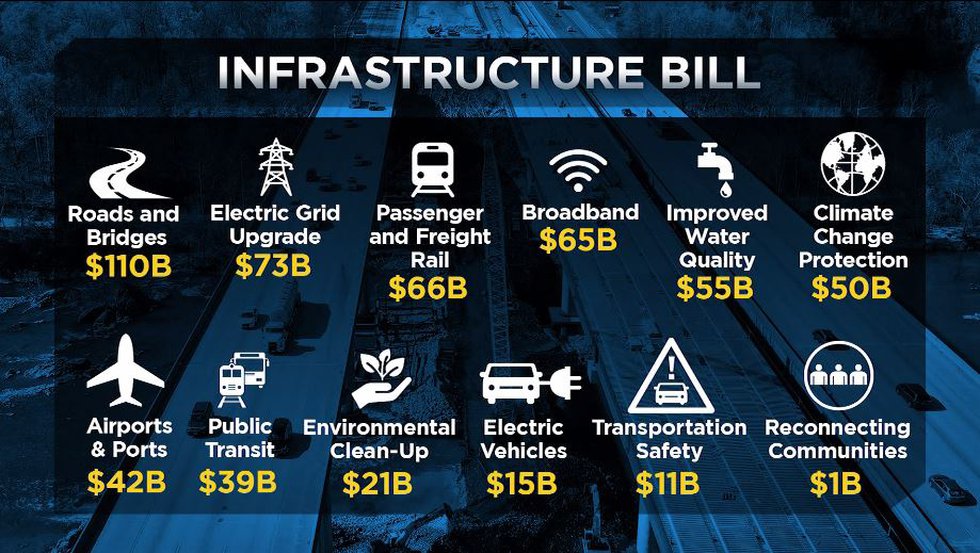
While early chargers were nearly all located in single-family homes, the billions of dollars allocated to them in the Infrastructure Act had a bold vision of EV chargers as ubiquitous and available as gas stations.
Nick Perloff-GilesHOST
That vision, however, has yet to fully materialize.
Nick Perloff-GilesHOST
As of 2026, there are roughly 800 operational Nevi charging stations across the country.

Shannon FarrenHOST
Now, they said since that lion crossed the 101 and the 405, a thousand of these new wildlife corridors have come up across the country.
Shannon FarrenHOST
A lot of them created based on the Infrastructure Act that was passed in 2021.
Shannon FarrenHOST
But all of this, they said, there's an overpass for elk.
Shannon FarrenHOST
along I-25 in Colorado.

JohnHOST
Explain that to me.
JohnHOST
How did Joe Biden pass the Infrastructure Act? How did he pass the Chips and Science? I was sorry.
JohnHOST
That was an effective political leader.
JohnHOST
Sorry.

Jeff WoodHOST
But now, you know, we know that systemic change is actually what will drive this making systems that actually allow people to drive less.
Jeff WoodHOST
than they need then they might have otherwise done or you know giving people uh subsidies for solar panels or e-bikes or whatever it might be to get the adoption rates higher to get more people in the system doing these things together and so her idea here for her book is this thing about the carbon wave which basically is like let's make large systemic change like the carbon the climate bill the IIJA and the Inflation Reduction Act, which he was apparently a part of, to make those big changes instead of just making individuals responsible for their carbon footprint while everybody is kind of forced into this car-oriented paradigm in cities.
Jeff WoodHOST
So I think it's really fascinating to think about it in that perspective because we can do so much to reduce everybody's carbon footprint by making these carbon waves.
Jeff WoodHOST
Feedback loops.

Jonathan W. EmordGUEST
Number one, you have to dramatically cut government spending.
Jonathan W. EmordGUEST
These spending programs that they have adopted over the last year $1.9 trillion for the American Rescue Plan, $1.2 trillion for the Infrastructure and Jobs Act, $800 billion to a trillion dollars for the waiver of student loans, another $800 billion for the Inflation Reduction Act.
Jonathan W. EmordGUEST
These are all massive government spending programs.
Jonathan W. EmordGUEST
We've got to cut them dramatically.

Steve AbramowiczHOST
Now let's be clear, this was never a magic wand.
Steve AbramowiczHOST
Even after the IIJA, FERC cannot just build transmission wherever it wants, states still have enormous power.
Steve AbramowiczHOST
Permitting still takes years, environmental reviews still happen, local opposition still matters, and eminent domain remains politically radioactive no matter which party is in charge.
Steve AbramowiczHOST
But what changed was the floor.

Chuck BakerGUEST
And so that was good, but that was like a B plus back then.
Chuck BakerGUEST
And then in IIJA, the infrastructure bill or the bipartisan infrastructure law that was signed, you know, bipartisan bill passed by Congress in 2021, signed by President Biden, the CRISI program really got supercharged.
Chuck BakerGUEST
And it went to a billion dollars a year minimum plus whatever we could get in discretionary annual appropriations.
Chuck BakerGUEST
But the billion a year minimum was the magic.
Chuck BakerGUEST
And so some of the people who wrote this bill say, Chuck, where's our congratulatory press release? We are authorizing this huge amount of money.
Chuck BakerGUEST
But the problem is it's not real money.
Chuck BakerGUEST
The IIJA, the last bill, provided real money, advanced appropriations.
Chuck BakerGUEST
This bill so far just contemplates providing an authorization.
8 more episodes mention Infrastructure Investment and Jobs Act.
Create an account to see the whole feed, search across every transcript, and follow the entities you care about.