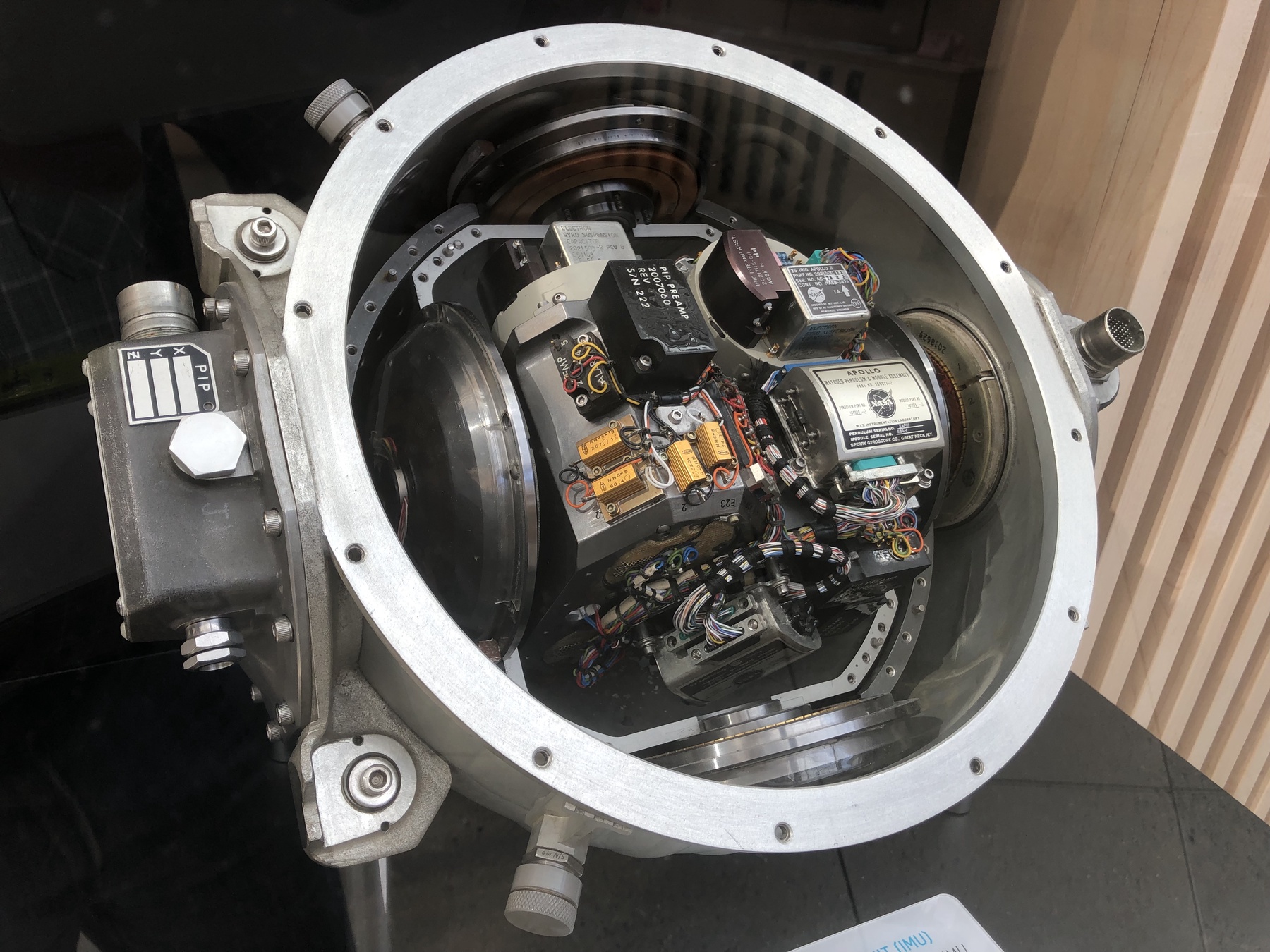
Inertial measurement unit
49
MENTIONS
15
EPISODES
12
PODCASTS
Search complete. 49 mentions across 15 episodes found for "Inertial measurement unit".
Nov 1, 2026

Chris HeckmanGUEST
In this case, we also added a flash LiDAR for terrain classification capabilities, but we could have conceivably done that with our automotive grade LiDAR.
Chris HeckmanGUEST
We used an IMU, Parker IMU GX515.
Chris HeckmanGUEST
Many of you have probably used it before.
Chris HeckmanGUEST
And actually, I need to credit CSIRO's Matt Hudson with the idea of using gigi cameras as the solution to USB vision.
19 MINS LATER
Chris HeckmanGUEST
And so what we do is we actually decide what we're going to jointly estimate the system's state's velocity over several time steps, also using an inertial measurement unit in order to correct or provide short-term spatio-temporal constraints here.
Chris HeckmanGUEST
This is shown in this factor graph, wherein we connect Doppler targets to individual states, in this case, velocities of the robot.
Chris HeckmanGUEST
And then we use these binary constraints in change of those velocities as the IMU factors here.
Chris HeckmanGUEST
So if we want to be able to set up our full state vector, that is actually just the velocity of the robot, or in this case, just the radar, the quaternion orientation of the radar rig, and then also the biases on the accelerometer and gyroscope in order to accurately forecast or estimate what the velocity motion of the platform is.

Peril CrosserHOST
After doing some digging, I discovered that the moment you introduce a multi-camera setup, the hardware and embedded engineers start losing hair by the handful.
Peril CrosserHOST
I learned that there is a critical bottleneck here, which is timestamp synchronization between multiple cameras along with the IMUs or inertial measurement units soldered onto the boards.
Peril CrosserHOST
These are essentially the six-axis gyroscopes and accelerometers found in our smartphones.
Peril CrosserHOST
You might ask, Why make it so complicated just to record some video? Well, consider that when a worker is operating, their head and body are constantly moving.

Tzeno GalchevGUEST
It combines a high-performance triaxial gyroscope and a triaxial accelerometer into really a very compact, fully calibrated MEMS inertial measurement unit that's really easy to integrate in many different types of systems.
Tzeno GalchevGUEST
And in fact, as of the recording of this video, now the product is in production and available for customers worldwide.
Tzeno GalchevGUEST
What makes this product especially significant is that it delivers the kind of performance customers have traditionally associated with much larger connectorized industrial IMU systems, but in a much smaller surface mount package, which really helps reduce the kind of integration, complexity, size, weight, power, all of these system constraints that customers have.
Tzeno GalchevGUEST
we're seeing a big shift now especially evident towards autonomous and intelligent machines you know we've we've been investing towards this goal now for quite some time and the 16607 is just the latest imu in a multi-generational effort to support our customers as they have gone from prototypes to production whether that be in drones or robotics or industrial automation equipment, navigation systems, you know, all of these things need motion sensing that is not only accurate, but is also reliable and easy to deploy.
Tzeno GalchevGUEST
And so the ADI-S16607 was really designed with those needs in mind.

JasminHOST
So this is a much more powerful, old, but still powerful board.
JasminHOST
This one is intended to be a 9-axis IMU, so inertial measurement unit.
JasminHOST
It not only is able to show you the acceleration in different axes, but also has a gyroscope.
JasminHOST
it has accelerometer and it has a magnetometer so it is able to actually detect changes in magnetic field things like these are used when you need to have precise controls for example what I was thinking about using this for is to just put it somewhere on the wall fix it probably by gluing it so doing some sort of semi-permanent but hard fix and then to measure it and see what I can measure when it comes to earthshaking, earthquakes, passing cars, and so on.

Gregor WillhauckGUEST
So if you're out of visualization or out of line of sight for the instrument, the instrument can still track you because it tracks position through the GPS.
Gregor WillhauckGUEST
It has an IMU, so you don't have to basically have it in flight with the bubble, which again makes it a lot faster to capture a point.
Gregor WillhauckGUEST
And it also removes a major source of error that was available before, which is if you change the height of your prism, you had to key that in manually into the system.
Gregor WillhauckGUEST
This new system has a laser inside the pole, which is quite the engineering feature, which automatically measures the height.

Gregor WillhauckGUEST
So if you're out of visualization or out of line of sight for the instrument, the instrument can still track you because it tracks position through the GPS.
Gregor WillhauckGUEST
It has an IMU, so you don't have to basically have it in flight with the bubble, which again makes it a lot faster to capture a point.
Gregor WillhauckGUEST
And it also removes a major source of error that was available before, which is if you change the height of your prism, you had to key that in manually into the system.
Gregor WillhauckGUEST
This new system has a laser inside the pole, which is quite the engineering feature, which automatically measures the height.
Reza Nasiri MahalatiHOST
Let's do a quick review of lecture five and remind ourselves where we left off.
Reza Nasiri MahalatiHOST
So we started talking about IMUs or inertial sensors.
Reza Nasiri MahalatiHOST
And we kind of broke it down into two main types of sensors, accelerometers and gyroscopes.
Reza Nasiri MahalatiHOST
So far we've only talked about accelerometers, specifically mechanical accelerometers, and we said that from a mechanical architecture point of view, these are just damped spring mass systems in an enclosure, or a damped harmonic oscillator in an enclosure.

Amit GoelGUEST
You need to also understand what is the state of each of its actuators.
Amit GoelGUEST
You need to understand some of the other sensors like IMU, which is an inertia measurement unit that tells you the pose of the different parts of the robot.
Amit GoelGUEST
And once you capture the information, first you need to synchronize all of this.
Amit GoelGUEST
What that means is my camera is observing at this particular time.
Amit GoelGUEST
At the same time, what was the state of my motors? What was the state of the IMUs? And you need to fuse them together.
Amit GoelGUEST
The next thing you have to do is if you're given a task, let's assume we are running a vision language action model.
Amit GoelGUEST
You need to tokenize this data, all of this data, the data from the current frame, but also the data from the past frames, because your next action is dependent on not just what you're currently seeing, but also a little bit of history.
Reza Nasiri MahalatiHOST
So a fixed bias in acceleration, you integrate it twice, it gives you a quadratic error in position.
Reza Nasiri MahalatiHOST
So errors can really, really blow up if you just purely do orientation tracking with INSs or IMUs over long periods of time.
Reza Nasiri MahalatiHOST
Very important to know.
Reza Nasiri MahalatiHOST
So you get position errors growing quadratically in time.
Reza Nasiri MahalatiHOST
And somehow, through a signal processing technique like, say, Kalman filtering, for instance, You can fuse in your odometry that you're getting from accelerometer and gyros, and also fuse that with your GPS measurements.
Reza Nasiri MahalatiHOST
So what happens is that GPS measurements come in slowly.
Reza Nasiri MahalatiHOST
It's a slower update rate than IMUs, but they don't have any bias in them.
Reza Nasiri MahalatiHOST
IMU measurements come much faster, but there is bias.

Elecia WhiteHOST
Uh, you deep- you deeply covered a few areas that I often see people struggle with.
Elecia WhiteHOST
Um, your IMU chapter, which I expected to be just here's how you use an IMU, went into a lot more detail about sensor fusion and even Kalman filters.
Elecia WhiteHOST
But how is that machine learning? That's all very heuristics.
David SuchGUEST
Right.
David SuchGUEST
Mm-hmm
Elecia WhiteHOST
...
Elecia WhiteHOST
some other filters and how to deal with the data and how to calculate or how to use quaternions and all the things that I have done with IMU so many times.
Elecia WhiteHOST
It was kind of a joy to be able to say, "Oh, well, now I'm gonna have to...
5 more episodes mention Inertial measurement unit.
Create an account to see the whole feed, search across every transcript, and follow the entities you care about.