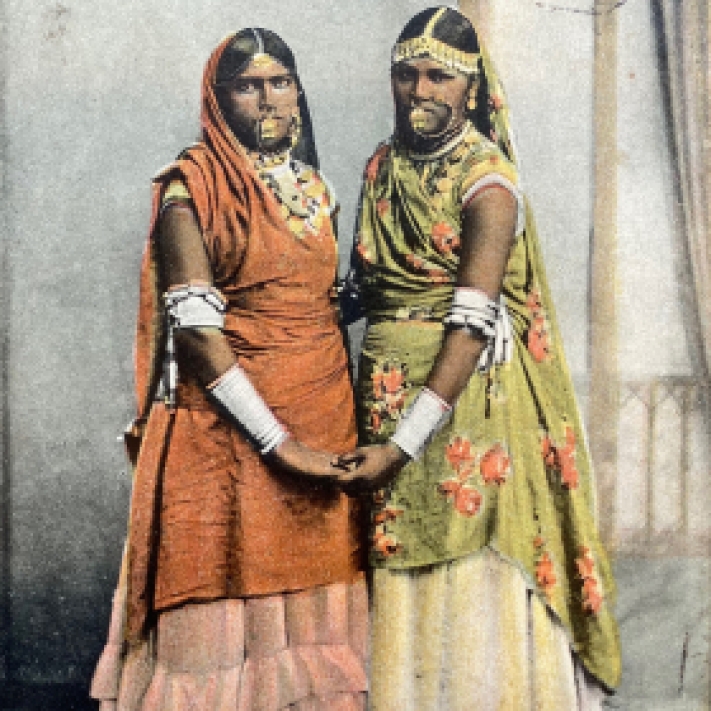
Indo-Caribbean people
PeopleWikipedia
38
MENTIONS
8
EPISODES
7
PODCASTS
Search complete. 38 mentions across 8 episodes found for "Indo-Caribbean people".
Oct 28, 2026

Alexandria MillerHOST
I know Nikolai personally, but I think, again, as he was sort of motioning us towards, one thing that drew me to really having you on the show is your chapter in the book, The Asian Caribbean in the Caribbean Diaspora, Essays on Migration, Identity, and literary and cultural representation.
Alexandria MillerHOST
And so I think, you know, for our listeners wanting to learn more, that's just one of the many resources I'll throw up there on our Strictly Facts syllabus for you all to check out before diving really deep into even your own personal history i do sort of want to foreground us in this understanding as you were talking about of indentureship and colonialism and so in a lot of ways we tend to center and more so focus on conversations about indentureship in the caribbean on Indo-Caribbean communities or, you know, the movement of people from India serving as indentured servants in the Caribbean.
Alexandria MillerHOST
And I, you know, of course can understand why, because there's obviously a difference in numbers significantly.
Alexandria MillerHOST
And so that's not to discount that importance or anything at all, of course.
12 MINS LATER
Nikolai AttaiGUEST
They come to a country, no community, they can barely speak English, like we talk about the English Caribbean.
Nikolai AttaiGUEST
You know, they have to, you know, kind of just function on their own and rely on their very small networks.
Nikolai AttaiGUEST
So yeah, and land violence has always been a part of just our communities in general in the Caribbean, but there are really interesting stories that you hear about the violence that the Chinese community has endured over time, right? When we think about racialized violence, not necessarily as physical violence, but being outcast and all these things, which is a large part of a lot of the stories we hear, not only in Chinese communities and in the Indo-Caribbean communities and Black communities, right? That racialized violence is a part of our history that we continue to contend with.
Nikolai AttaiGUEST
And that's actually something that I discovered in my granddad's story.

HemaHOST
And it is similar to... to a lot of people that I've talked about in the Indo-Caribbean diaspora, where, first of all, the way we look and the fact that we're from the Caribbean is confusing for a lot of people who don't understand the history of the Caribbean and the fact that there are people from all walks of life and all different skin tones, different ancestries in the Caribbean for varying reasons.
HemaHOST
But I know for a lot of the younger people Indo-Caribbean people that I've spoken to, trying to parse out and understand the difference between Indo-Caribbean and Indian sometimes is difficult.
HemaHOST
And I think it, for me growing up, you know, I grew up in Toronto in the 70s where racism was rampant and self-preservation meant that I didn't identify with anything except for just being Canadian.
HemaHOST
It's not dissimilar to what I've heard from a lot of people in the same position.
12 MINS LATER
Keisha BissramGUEST
You can be seen, you can be heard, you can be loved, you can be everything that you want to be, despite everything that we were taught.
HemaHOST
I think short films like yours and some of the other people that I talk to, writing stories and books and educating through entertainment, I think is so important because the truth of the matter is you and I can break out of that colonial mindset and move forward in the world, but we also have to deal with how the world reacts to us.
HemaHOST
And those reactions are changing through the generations and people are becoming more accepting and more understanding but there's still a long road to go through educating people so that they really, truly understand who we are as not only just Indo-Caribbean people, but people from the Caribbean, because there's such a long, rich history that I think is hidden behind the doubles and jerk chicken and sun and sand and beaches and resorts.
HemaHOST
There's people that live behind that and whole lives behind all of that.

Devala ReesGUEST
I
Mat McDermottHOST
was going to say, I think in Queens, which is a high Indo-Caribbean Guyanese population, I've seen like flyers stapled to telephone poles and things along the way.
Devala ReesGUEST
Yeah, that he does exorcisms.
Devala ReesGUEST
Yeah, you'll see that in India too.

CamouflageGUEST
Ravi Singh, whatever it was.
CamouflageGUEST
So in India, we don't say Ravi, we say Ravi, right? So it was new to us when we first came and we met, you know, Indo-Caribbean people and they said and they would say they would say they're not Indian it was new to us yo that's a bull fly
DanielHOST
that's a horse fly
CamouflageGUEST
anyways I was saying I was saying why I fit in with Guyanese people so much and then also you know if you come if you grew up in Toronto you're going to be very West Indian, no matter what.
5 MINS LATER
SanjayHOST
Oh, yeah.
CamouflageGUEST
And especially it's going back now.
CamouflageGUEST
And if you look at Indo-Caribbean people, black Caribbean people, like everybody, they're actually, as time goes by, everyone's unifying more.
SanjayHOST
Yeah.

Natasha BolvinGUEST
And it wasn't conscious, it was just, it's, I think it's more of a traditional thing.
Natasha BolvinGUEST
I'm Indo-Caribbean.
Natasha BolvinGUEST
There's, it's a thing.
Natasha BolvinGUEST
You know, we talk about dreams as though they're messages and journeys, who visited, things like that.

Machel St Patrick HewittHOST
If, if you are playing an Asian subcontinent team in the Caribbean, the two places you don't want to play them are in Guyana and in Trinidad.
Machel St Patrick HewittHOST
You may want to play them there because they may feel, because of the huge Indo-Caribbean communities, um, within those two countries, it may be that they feel more at home there in terms of food, culture, et cetera.
Machel St Patrick HewittHOST
I don't know.
Machel St Patrick HewittHOST
I'm spitballing, but I'm s- I'm assuming so, right? So for all I know, Pakistan requested for games to be in Trinidad, if not in Guyana.
HemaHOST
And for me, I think it's important to document a time and a place with some of these recipes because I see so much changing.
HemaHOST
I went to an event in the summer, and it was an Indo-Caribbean Canadian showcase of artists and musicians and writers, and there was a family attending, and their son, who was, I wanna say about 13 or 14, asked a question, and his question to the artists that were on stage was, "You keep saying this word Indo-Caribbean.
HemaHOST
I don't even know what that means." And so if he doesn't even understand what that means, I feel like there needs to be something that these people can refer to if they choose to.
Stephanie RamloganGUEST
I'm in the middle, too, of, like, this sort of Indo-Caribbean identity and what it means to me and how closely I hold it.
Stephanie RamloganGUEST
So I guess my very incomplete response is when it comes to books, and I am a writer, right? I take my tech- my style in writing, I take a really long time before I put anything down on paper because I feel like it's so permanent, right? And a lot of my process is in the thinking.
Stephanie RamloganGUEST
And so with Indo-Caribbean, for example, I feel like there is still so much discussion around what it means because it is, uh, rooted in race and ethnicity, but we're still, um, as a sociological study, exploring, well, what is race, and then what is race in the Caribbean, which is such a particular context, right? So to, to, to start writing [laughs] about, you know, terms like this, um, at least for me, I'm not ready to commit to any sort of definition.
Stephanie RamloganGUEST
And with cookbooks or books about food, even there I feel it feels so final [laughs] to just say, "This is how to make pepperpot," without the context of there is pepperpot in Guyana and Antigua and Jamaica, and they do it like this.
Stephanie RamloganGUEST
And, you know, like, I am just not that type of writer to be, like, to, to declare this is what this is.

Richie BillingHOST
Oh, you're very welcome to be here.
Richie BillingHOST
Um, if you're yet to come across Premee and her books, um, she's a Nebula, World Fantasy, and Aurora Award-winning Indo-Caribbean scientist and speculative fiction author based in Edmonton, Alberta.
Richie BillingHOST
And I understand you write all kinds of books, science fiction, fantasy-
Premee MohamedGUEST
[laughs]