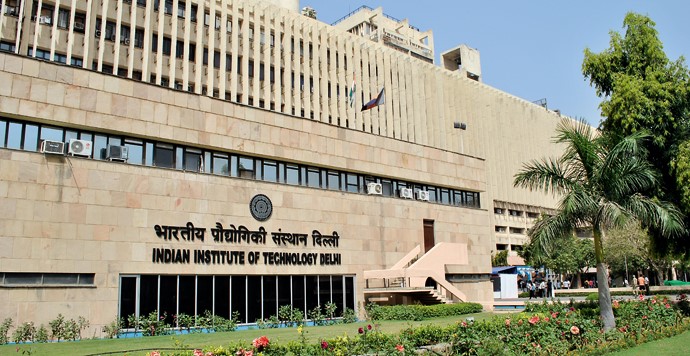
Indian Institute of Technology Delhi
Institute of technology in New Delhi, IndiaWikipedia
19
MENTIONS
17
EPISODES
14
PODCASTS
Search complete. 19 mentions across 17 episodes found for "Indian Institute of Technology Delhi".
Sep 10, 2026

Ashutosh GargHOST
Very interesting.
Ashutosh GargHOST
You trained as an electrical engineer and completed an M.Tech from IIT Delhi.
Ashutosh GargHOST
How did an engineer become a student of consciousness and human development?
Amul S. BahlGUEST
That's a tricky one.

Vansh UpadhyayGUEST
So they- And this is subconscious or conscious, I don't know, but they put that pressure on you.
Vansh UpadhyayGUEST
"Chalo humse toh nahin hua koi baat nahin, but hamara bacha yeh kar dega." Like why do you think IIT and IIMs and AIIMS jaane ke liye itna pressure hai? Like what even is IIT? IIT Delhi, by the way.
Vansh UpadhyayGUEST
Just, just saying.
Vansh UpadhyayGUEST
Just saying.
Mudit NarainGUEST
And that software will need to be re-engineered, which is what we are building.
Mudit NarainGUEST
We are working with scholars from IIT Delhi, IIT Bombay, ETH Zurich, and IIT Kanpur, and then a team at BITS Pilani to build that software layer which sits on the hardware and the storage.
Mudit NarainGUEST
All of these things will have to work together.
Mudit NarainGUEST
This is not a one, two-year journey.

Nikita HariGUEST
So...
Nikita HariGUEST
During the time, I was also having some short research stints in the Institute of Technology, IIT Delhi, during which time some of the professors and research scholars there really encouraged me to apply abroad.
Nikita HariGUEST
And that's how, obviously, there are the personal aspects and what who we are as a female and as somebody growing up in Kerala and all that.
Nikita HariGUEST
But sticking on to the technical elements, I would say that's how I ended up applying for Cambridge and my doctoral research at the University of Cambridge, where I was a Nehru and Google scholar.

Ravin MirchandaniHOST
Thank you.
Ravin MirchandaniHOST
Pravir, you're a PhD from IIT Delhi.
Ravin MirchandaniHOST
You have a management degree from IIM in Ahmedabad, and you are also a master of business law.
Ravin MirchandaniHOST
Before becoming the CEO of Tata Power, you were in fact the MD of Tata Power Delhi distribution, and then you moved here to head the parent business, a 110-year-old utility, which is now very difficult to describe as a conventional utility because you have transformed the company.

G SampathHOST
Why is this so? Why is it that we tend to dismiss government expenditure on health and education and social security measures as a rave-dee or freebies or just a burden on the exchequer? Is there something we need to rethink here? No, there's a new book called Freebies or Rights? Understanding Social Policy in India.
G SampathHOST
It's by Hrithika Khera, who is a professor of economics at IIT Delhi.
G SampathHOST
She joins us today to unpack the nature and trajectory of India's social policy.
G SampathHOST
Hrithika, welcome to InFocus.

KedarHOST
Yeah, this has been like a common theme which I found out.
KedarHOST
I was speaking to a road safety engineer and like he works in IIT Delhi and even he was saying that we all have been trying to move vehicles, but we are not thinking fundamentally that we have to move people, right? And when you like shift that perspective, it totally changes how you design roads, how you design public transport and the rest of the infrastructure.
Prem ChandavarkarGUEST
So Paris, for example, is looking at rezoning the city to create what they call a 15-minute city.
Prem ChandavarkarGUEST
Yeah, to create these enclaves where everything you need for day to day urban life can happen within a 15 minute walk.
Jacob KoshyHOST
With all of these achievements, why is D.D. Kosambi so little known outside niche historical discussion groups? Why is Homi Bhabha's compatriot barely remembered even in the TIFR? To probe these questions, we have with us the author of arguably what I think is the best biography of D.D.
Jacob KoshyHOST
Kosambi, and it has just been released a few weeks ago, authored by scientist Professor Ram Ramaswamy, who's taught the life sciences primarily, and the physical sciences at JNU, IIT Delhi, and was formerly a VC at the University of Hyderabad.
Jacob KoshyHOST
Professor Ram Ramaswamy is with us in the studio today to distill and elucidate Kosambi's life, achievements, eccentricities, and obscurity.
Jacob KoshyHOST
So welcome to the show, Professor Ramaswamy.

Ayesha MehtaHOST
Well, we're seeing another kind of ultimatum playing out right now, but this one is on a premier college campus, and it's heartbreaking.
Karan RaoHOST
You're talking about IIT Delhi.
Ayesha MehtaHOST
Yeah.
Ayesha MehtaHOST
The Indian Express has been covering this standoff.
Ayesha MehtaHOST
And it really shows the growing chasm between the administration and the students.
Karan RaoHOST
It's a classic example of how institutional language is often used to mask intense on-the-ground panic.
Karan RaoHOST
The IIT Delhi director, Rangan Banerjee, warned students of disciplinary action after a midnight protest.
Karan RaoHOST
The administration claimed the slogans were threatening and unsavory.

PranavHOST
From how our PSUs, our public sector banks work, to the role of big business versus MSMEs, to the division of power between center and state.
PranavHOST
Dr. Chandra is an assistant professor at the School of Public Policy in IIT Delhi.
PranavHOST
He completed his PhD thesis at the Harvard Kennedy School.
PranavHOST
The PhD thesis is titled Adaptive State Capitalism in the Indian Coal Industry, and personally, I could not recommend it more.
7 more episodes mention Indian Institute of Technology Delhi.
Create an account to see the whole feed, search across every transcript, and follow the entities you care about.