Incarceration in the United States
16
MENTIONS
5
EPISODES
5
PODCASTS
Search complete. 16 mentions across 5 episodes found for "Incarceration in the United States".
Oct 1, 2026

Gavin NewsomHOST
and the injustices of people with severe mental illness or dementia being condemned to death.
Gavin NewsomHOST
The death penalty itself, the death penalty specifically a vestige of a narrative that we haven't Fully advanced convict leasing, lynching, obvious death penalty, mass incarceration.
Gavin NewsomHOST
Talk to us a little bit about that.
Gavin NewsomHOST
I mean, I remember visiting you, and just briefly before you do, I was completely stone cold ignorant when I was with my kids visiting your museum just a few years ago about convict leasing.

Hunter ParnellHOST
We're sort of recognizing that these early models don't work.
Hunter ParnellHOST
What are some of the major changes that occur in this progressive era before we get into the more modern mass incarceration era throughout the country?
C.J. CiaramellaGUEST
yeah by like the 1870s it was pretty apparent that the like jacksonian wave of prisons like eastern state penitentiary auburn weren't really working and weren't really going to work um especially the pennsylvania model which was almost complete isolation required solitary cells and it was unworkable during crime waves especially because you know they had nowhere to put everyone So they started working on different models.
C.J. CiaramellaGUEST
In the 1870s, you start seeing the first sort of reformatories, quote, unquote.
12 MINS LATER
Hunter ParnellHOST
It starts with how do how prevalent do people think these sensational stories are in our society? I wish there were more magazines out there like yours that spend the majority of time talking about the sensational thing that the government does to people and then tying that to bigger government policies.
Hunter ParnellHOST
That to me is more important, but we're not quite there yet.
Hunter ParnellHOST
So let's move on into the mass incarceration era.
Hunter ParnellHOST
where we see really a convergence between the North and the South and the reactionary ways of the Nixonians, the Reagan, and so on into the modern day really start to take hold.

Matthew Vernon WhalanGUEST
Actually, my next book is a short book about him, the, which Ben is writing the introduction for.
Matthew Vernon WhalanGUEST
But in between, I have, you know, I started to branch out to more prisons and also covering communities, too, like how mass incarceration impacts families and, you know, friends, former employers, churches, things like that.
Matthew Vernon WhalanGUEST
And so that was in the, you know, the late 2010s, I guess.
Matthew Vernon WhalanGUEST
I covered homelessness for a while and then went back to covering prisons more broadly than the d- than just focusing on the death penalty.
9 MINS LATER
Matthew Vernon WhalanGUEST
One is that, like, you know, we, we kind of l- we, we kind of let this happen, you know? Like you said, like, it is interesting that, like, more people don't care about this more, es- especially on the left.
Matthew Vernon WhalanGUEST
I thought even at the time that like, and 'cause I was reporting on it so heavily, it seemed to me, and prisoners, you know, told me in interviews, that they felt sort of, like, left out of the Black Lives Matter movement in the early 2020s, which, uh, because it focused so heavily on policing, which is obviously really important.
Matthew Vernon WhalanGUEST
But they were surprised, and I was surprised, that, like, mass incarceration was not more of a focus of, of that protest movement.
C. Derick VarnHOST
Mm-hmm.

Nathan RobinsonHOST
Yeah, there is a way in which, and this is one of the reasons I was so keen to publish your article because this is such an important point, There is a way in which the extremity of Trump's abuses of the law can make us think that the law was fine before, that we just need to get back to regular old legality and procedure.
Nathan RobinsonHOST
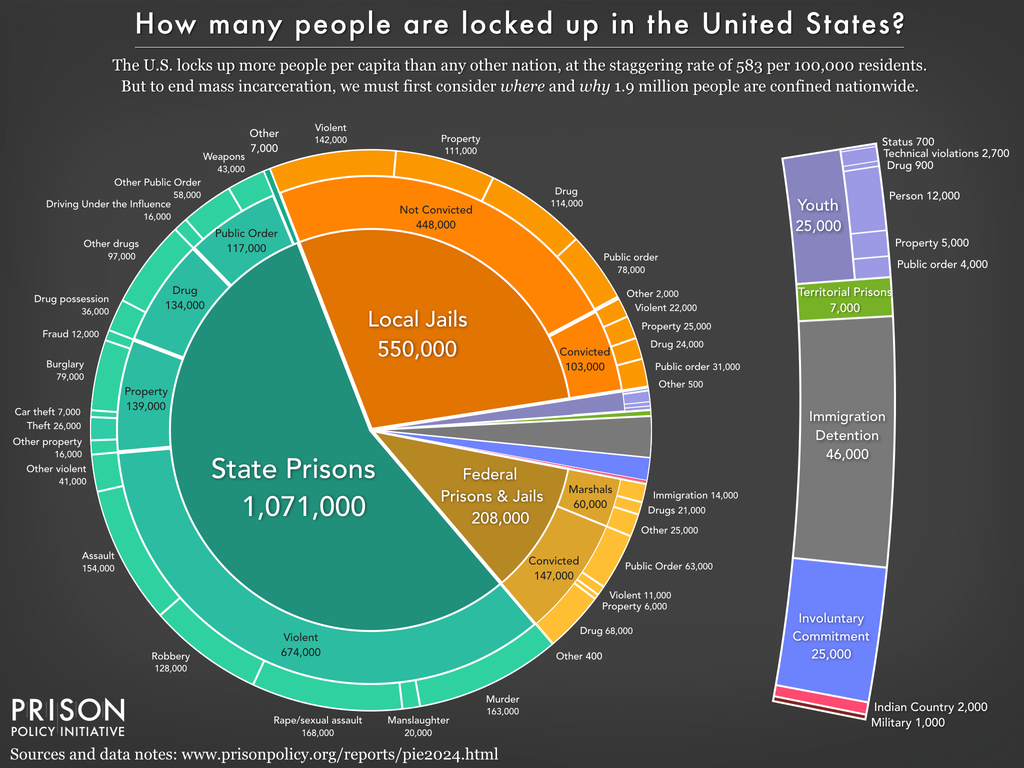
Whereas, in fact, in the United States, we have mass incarceration.
Nathan RobinsonHOST
It's a problem.
Nathan RobinsonHOST
It's been a problem.

C.J. CiaramellaGUEST
And I was looking for a history of U.S. prisons and.
C.J. CiaramellaGUEST
There are a lot of really good sort of academic books, especially on the early history of U.S. prisons and a lot of really good books on sort of the 70s and 80s with Attica and mass incarceration.
C.J. CiaramellaGUEST
But I couldn't really find this sort of just broad overview of the of the history and different cycles of American prisons, which is was kind of funny to me because.
C.J. CiaramellaGUEST
Prisons are this considered an American invention.
28 MINS LATER
Nick GillespieHOST
after a series where the system had gotten more and more degraded, partly because of overcrowding around the country.
Nick GillespieHOST
But then we come back to this moment again of reform.
Nick GillespieHOST
And I guess one of the things I'd like to talk with you about is we seem to be, are we coming out of the age of mass incarceration? Because that It seemed like in the 60s and 70s, and this is partly a function of rising crime rates, but more and more people were going away.
Nick GillespieHOST
And certainly in the 70s, 80s, to a certain degree, the 90s, people like Bill Clinton, as governor of Arkansas, was tough on crime.