Immigration Restriction Act 1901
16
MENTIONS
8
EPISODES
8
PODCASTS
Search complete. 16 mentions across 8 episodes found for "Immigration Restriction Act 1901".
Oct 27, 2026

Mark CullyGUEST
Again, that's another really good question.
Mark CullyGUEST
The way I... talk about this in the book, I have this idea that I borrowed from Alfred Deakin when he was the Attorney General talking about the Immigration Restriction Act and the use of that act to exclude people from coming.
Mark CullyGUEST
And he talked about people being inside or outside the charm circle.
Mark CullyGUEST
So we think about this charm circle, it's It's got a fence around it.
Mark CullyGUEST
So the first restrictions were put on Chinese gold miners in Victoria in 1855.
Mark CullyGUEST
And then progressively what you see is almost all of the colonies, except I think Tasmania didn't put restrictions on the arrival of Chinese migrants between 1855 and Federation in 1901.
Mark CullyGUEST
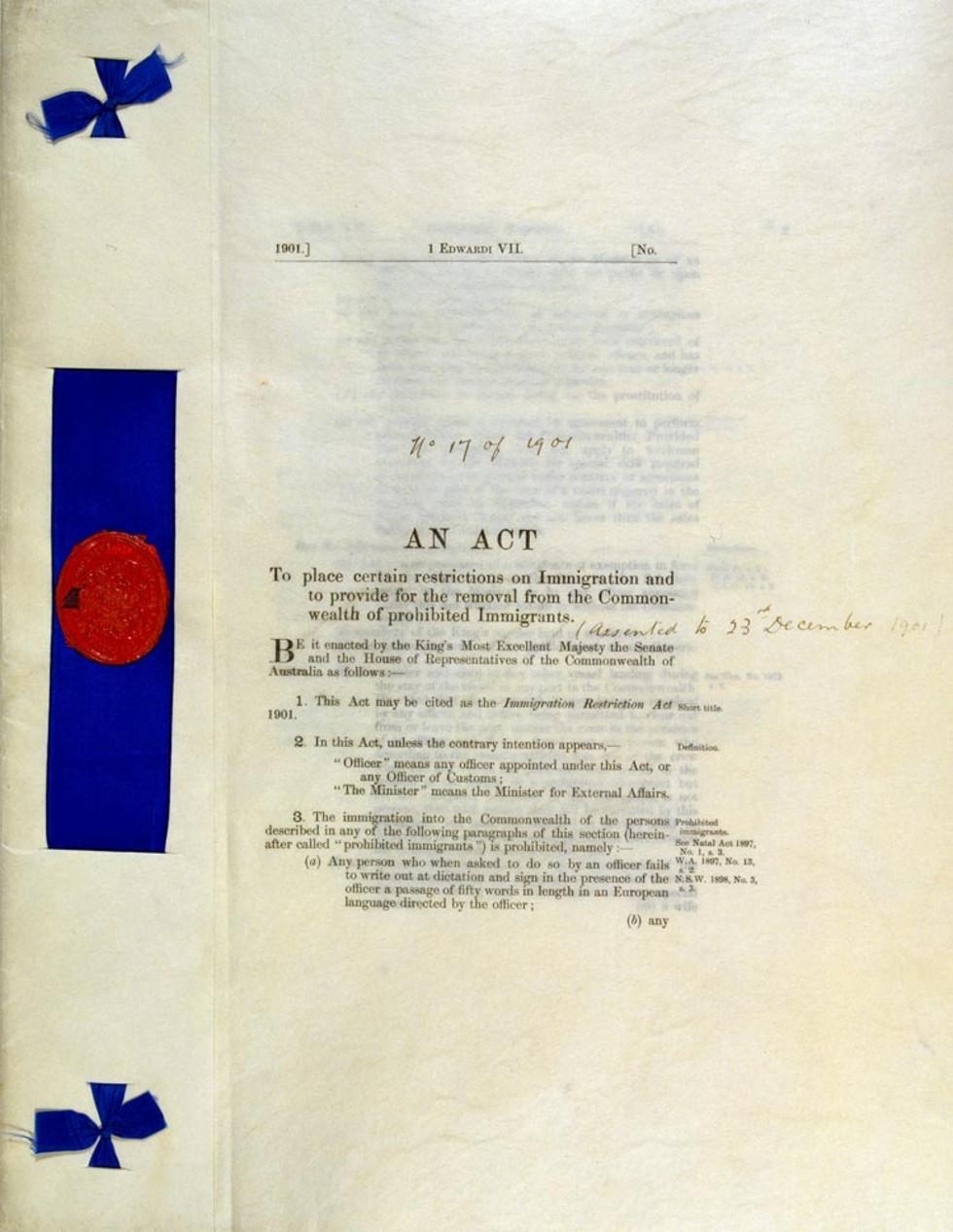
And then the second substantive act that was passed by the new federal parliament in 1901 was the Immigration Restriction Act.
Mark CullyGUEST
And that prevented natives of Asia, Africa and the Pacific Islands from migrating to Australia.

Colin ColeHOST
It was designed that way institutionally.
Colin ColeHOST
One of the, the first acts of the new Australian government after the six states federated into one country was the Immigration Restriction Act, which laid the foundation for what would become the literal white Australia policy.
Ruth GreenwoodHOST
Yeah, which is exactly as it sounds.
Ruth GreenwoodHOST
They wanted Australia to be full of white people only.
17 MINS LATER
Frank BongiornoSOUNDBITE_SPEAKER
But then in that sort of age of nationalism and rising racism that you get, I suppose, from the 1870s, 1880s, there's a move back in towards racial exclusion, and that's really when the term White Australia comes into use.
Frank BongiornoSOUNDBITE_SPEAKER
Uh, and it's- it becomes a national policy with Federation.
Frank BongiornoSOUNDBITE_SPEAKER
So Australia only federates on the 1st of January, 1901, and certainly among the earliest legislation is the Immigration Restriction Act, which, uh, imposes a- what's called a, a dictation test.
Frank BongiornoSOUNDBITE_SPEAKER
It was a, an expedient, a very dishonest expedient that had already been used in the colonies, it had been used in Southern Africa, and it basically required, uh, a- any, any migrant could be asked to, um, take dictation of 50 words in, uh, a European language, um, was the, the requirement.

Mark CullyGUEST
That's right.
Mark CullyGUEST
So one of the seven clauses in the Immigration Restriction Act that was passed in 1901 banned the use of temporary workers except where the minister gave, uh, special permission for that to happen, and it basically didn't happen.
Mark CullyGUEST
So Australia didn't have temporary migrants up until the 1990s, really, and we certainly did not have anything like the guest worker programs, as you mentioned, that operated in places like Germany, where, uh, Turkish migrants went and worked in German factories and were denied rights of citizenship for decades and decades, including their children and their grandchildren.
Mark CullyGUEST
But we started to change that almost by default.

Georgina DownerHOST
They're very concerned about... from China because there's a sense that it brings in cheap labour and that's not in the interests of Australian workers or at least the workers of the Victorian colony, New South Wales colony, South Australian colony.
Georgina DownerHOST
How important do you think the 1890s depression is for setting us up for the Immigration Restriction Act of 1901, which of course is the White Australia policy, more commonly known name?
Mark CullyGUEST
So I think it would have happened earlier.
Mark CullyGUEST
we don't get the chance to run counterfactuals.
Mark CullyGUEST
But my reading of the history is that the impetus for something like the Immigration Restriction Act was already very well in train before 1891.
Mark CullyGUEST
And in particular, there's this fascinating episode around a ship of Chinese migrants coming in 1888.
Mark CullyGUEST
The ship was called the SS Afghan.
Mark CullyGUEST
And he then initiated what was called an intercolonial conference of the premiers to agree uniform legislation to prevent further Chinese immigration to Australia.

Ryan ButtaGUEST
Like, we're not gonna stop this." And th- that was a big debate.
Marc FennellHOST
And then within a year after federation comes the Immigration Restriction Act.
Marc FennellHOST
Now, this is legislation that is specifically designed to limit non-British migration to Australia, but these days we know it better as...
Ryan ButtaGUEST
The White Australia Policy Queensland think they're gonna have 15 years to phase out Black labor, but the colonies, "No, we wanna have racial purity right away." So the legislation's passed in 1901, and by 1904, no more Pacific Islanders are allowed to come to Australia.

LiamHOST
In the same way, the white men here proposing federation were very concerned with keeping Asian people out of the country.
LiamHOST
right that was a a key concern um and you know one of the first pieces of business in the new um in the new parliament would be the immigration restriction act which is the the legislation which underpins the white australia policy that was in 1901 like one of the first orders of business and it was voted uh and it was universally supported no one voted against it yeah So, the negotiations got worked out, and it was agreed that Melbourne would be the Canberra capital until a new capital could be built.
LiamHOST
So, did you know that? That Melbourne was our
Jesse BlackHOST
capital? I thought it was always Canberra, but I guess not, huh? Well, we hadn't made Canberra yet, so it couldn't be Canberra.

Mark CullyGUEST
Uh, one was, uh, an act called the Pacific Island Labourers Act, uh, which was designed to stop the use of South Sea Islanders as cutting sugarcane as very, very cheap labor in working in Queensland sugarcane farms, and to repatriate, forcibly repatriate, uh, several thousand of them back to their, their countries of birth.
Mark CullyGUEST
The second one was the Immigration Restriction Act in 1901.
Mark CullyGUEST
It had seven clauses in it to restrict certain types of people from, um, migrating to Australia.
Mark CullyGUEST
And the catch-all clause, which was the very first one, um, allowed an immigration official to a- ask, um, somebody who's coming off a boat to write down, uh, a 50-word passage, um, in whatever language was specified by the immigration official at the time.
9 MINS LATER
Mark CullyGUEST
So Victoria was the first colony to try to restrict Chinese immigration in 1855.
Mark CullyGUEST
Uh, it then kind of pulled back a bit from that in the early 1860s, but you see this kind of ripple around the, ripple around the different colonies.
Mark CullyGUEST
And, uh, Queensland adopted restrictive policies against Chinese immigration in the 1870s, [lip smack] and it wasn't until 1888 that there was, that there was a solid agreement across the colonies for uniform, uh, restrictions against, uh, Chinese immigrants, which then led to the form of, of, of the Immigration Restriction Act, which I already mentioned.
Mark CullyGUEST
I, I think the thing, though, that you would want to just be cautious about thinking about states and their ability to kind of direct migration flows is they don't think clearly enough about where the migrants wanna go.

Andrew GodwinGUEST
Two pieces of legislation were particularly the target of his, uh, attention.
Andrew GodwinGUEST
One was the Immigration Restriction Act, and that was the notorious legislation that imposed the dictation test on people arriving in Australia, particularly those who- whose first language wasn't English.
Andrew GodwinGUEST
Upon arrival, they'd have to complete the dictation test in any European language as chosen by the customs officer.
Andrew GodwinGUEST
And, uh, if they failed, then they weren't allowed to disembark.