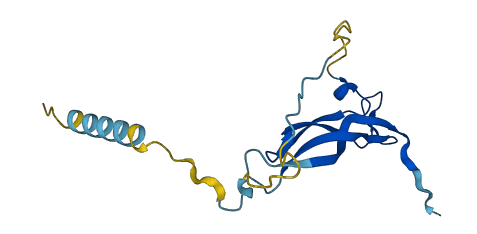
Interleukin-17A
ProteinWikipedia
27
MENTIONS
8
EPISODES
7
PODCASTS
Search complete. 27 mentions across 8 episodes found for "Interleukin-17A".
Oct 2, 2026

Tae OhGUEST
What they found was that in HS lesions, right, you have all these inflammatory cytokines that are extremely increased.
Tae OhGUEST
You know, things like IL-17A, F, uh, TNF-alpha.
Tae OhGUEST
You have interferon gamma.
Tae OhGUEST
You have interleukin, uh, IL-1 beta in there, which is really, uh, highly control... or highly kind of associated with neutrophil chemotaxis.
17 MINS LATER
Tae OhGUEST
And what they found was that that is also just a huge, giant mass of different inflammatory cells.
Tae OhGUEST
And so you have that, and you have the tunnels, and that's causing a lot of inflammation as well.
Tae OhGUEST
And what we're seeing is this extreme increase in the different inflammatory cytokines that I was talking about earlier, things like IL-17A and F.
Tae OhGUEST
And what's interesting is I always get asked the question about, like, why does F matter so much, e- especially in HS? And it's because we found that when you do, like, these different biopsies, that there are cells, uh, that are only expressing IL-17F.

Devin CurtisHOST
Oh, sorry.
Devin CurtisHOST
So TH17, IL-17A, and IL-17F.
Devin CurtisHOST
So those three are associated.
Devin CurtisHOST
These cytokines act directly on the keratinocytes, prompting them to release other chemokines like CXCL1 and CXCL8.
Devin CurtisHOST
Dendritic cells secrete IL-23.
Devin CurtisHOST
That IL-23 is what's required for the survival, expansion, and maintenance of the Th17 cells.
Devin CurtisHOST
So then those Th17 cells that are surviving because of IL-23 produce IL-17A, IL-17F, and IL-22.
Devin CurtisHOST
Those cytokines are directly responsible for driving the keratinocyte hyperproliferation.

John GarrettHOST
It binds to the IL-23 receptor on responsive immune cells.
John GarrettHOST
That contributes to downstream signaling and the release of inflammatory mediators, including IL-17A, IL-17F, IL-19, and IL-22.
John GarrettHOST
Those signals can drive abnormal activation and proliferation of keratinocytes, the major cells in the outer layer of the skin.
John GarrettHOST
The visible result is thickened, inflamed, scaly plaque associated with psoriasis.

Jack CushHOST
We need to teach more on this.
Jack CushHOST
An open-label study of calcinosis cutis in juvenile dermatomyositis patients.
Jack CushHOST
You know, we see calcinosis in our scleroderma patients.
Jack CushHOST
We see it occasionally in dermatomyositis.
Jack CushHOST
It's a bigger problem in JDM in the pediatric population.
Jack CushHOST
And this study of open-label study of 20...
Jack CushHOST
JDM patients, 11 boys, age 10.
Jack CushHOST
They had calcinosis cutis for 31 months.

speaker_0NARRATOR
The first article, entitled Asthma in Older Adults, Clinical Patterns, Inflammatory Phenotypes, and Practical Management, explains that asthma in older adults is shaped by immunosenescence and inflammaging, which shift airway disease toward neutrophilic or mixed, often T2 low inflammation, and may help explain reduced responsiveness to inhaled corticosteroids.
speaker_0NARRATOR
It contrasts older adults with younger patients, noting that older patients more often show higher neutrophils and inflammatory mediators such as IL-6, IL-8, IL-1 beta, and IL-17A, though eosinophilic phenotypes still occur in some late-onset or severe cases.
speaker_0NARRATOR
Clinically, it supports practical management strategies such as leukotriene receptor antagonists as add-on or steroid-sparing therapy and summarizes evidence that biologics including omelizumab, mepolizumab, benrolizumab, reslazumab, depilumab, and tezopelumab can remain effective and reasonably safe in older adults with severe asthma.
speaker_0NARRATOR
The overall conclusion is that older adult asthma is biologically and therapeutically distinct enough that management should be phenotype aware, comorbidity aware, and designed to limit corticosteroid burden.
Tay OhGUEST
And I worry about that because we need to understand that it is complex.
Tay OhGUEST
Like, for example, my biggest thing about this is, you know, that one study that I was talking about earlier out of Jim Kruger's lab, what they found was that in HS lesions, right, you have all these inflammatory cytokines that are extremely increased, you know, things like IL-17A, F, TNF-alpha, you have interferon gamma, you have interleukin IL-1 beta in there, which is really highly kind of associated with neutrophil chemotaxis.
Tay OhGUEST
And so it's like, what does that do? And then what's crazy is what they found was that You have that in the HS lesion.
Tay OhGUEST
And then when you go to perilesional skin, so about two centimeters out from the end of the inflammatory lesion.

Laure GossecHOST
but we also have a little bit of true head-to-head trials.
Laure GossecHOST
The head-to-head studies that we do have in PSA up to very recently were the trials available for the IL-17A inhibitors either ixekizumab or secukidumab against adalimumab.
Laure GossecHOST
Now, we all know these trials, which were published a few years ago, and which showed very comparable efficacy for ixekizumab or cecukinumab against adalimumab on the joint outcomes, which were ACR20 or ACR50.
Laure GossecHOST
On the other hand, both of these trials showed superiority on the skin for either ixekizumab or cecukinumab against adalimumab, showing, as we've said in the first episode, that we can rank the drugs in terms of efficacy on skin.
20 MINS LATER
April ArmstrongGUEST
And I would say based on the latest B-BOL data that we reviewed, Bumikizumab would be a very reasonable option to consider because it shows a very strong efficacy across those domains.
April ArmstrongGUEST
I would, of course, screen for IBD history and discuss candidiasis risk with the patient.
April ArmstrongGUEST
But in the absence of those concerns, I would say an IL-17A and F inhibition is a very reasonable first biologic choice.
April ArmstrongGUEST
And Laura, I would love to get your thoughts on the second case.

Laure GossecGUEST
but we also have a little bit of true head-to-head trials.
Laure GossecGUEST
The head-to-head studies that we do have in PSA up to very recently were the trials available for the IL-17A inhibitors either ixekizumab or secukidumab against adalimumab.
Laure GossecGUEST
Now, we all know these trials, which were published a few years ago, and which showed very comparable efficacy for ixekizumab or cecukinumab against adalimumab on the joint outcomes, which were ACR20 or ACR50.
Laure GossecGUEST
On the other hand, both of these trials showed superiority on the skin for either ixekizumab or cecukinumab against adalimumab, showing, as we've said in the first episode, that we can rank the drugs in terms of efficacy on skin.
20 MINS LATER
April ArmstrongGUEST
And I would say based on the latest B-Bowl data that we reviewed, Bumikizumab would be a very reasonable option to consider because it shows a very strong efficacy across those domains.
April ArmstrongGUEST
I would, of course, screen for IBD history and discuss candidiasis risk with the patient.
April ArmstrongGUEST
But in the absence of those concerns, I would say an IL-17A and F inhibition is a very reasonable first biologic choice.
April ArmstrongGUEST
And Laura, I would love to get your thoughts on the second case.