Ikigai
108
MENTIONS
30
EPISODES
28
PODCASTS
Search complete. 108 mentions across 30 episodes found for "Ikigai".
Sep 15, 2026

Hannah ColeHOST
Mm-hmm.
Melissa WongGUEST
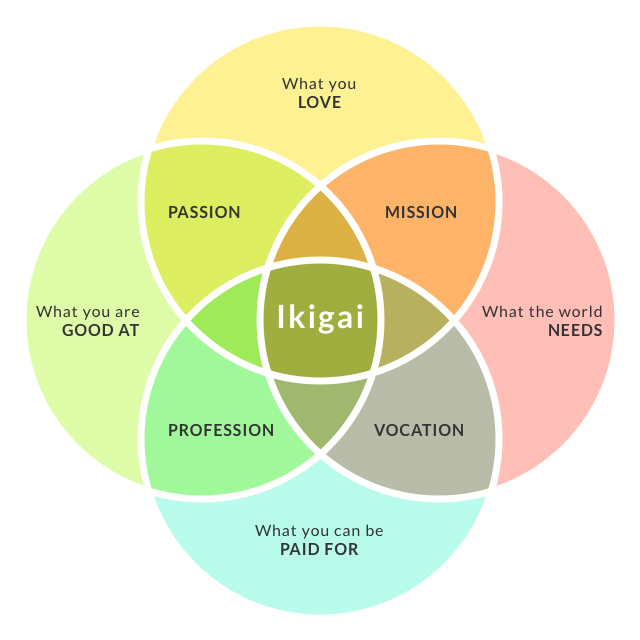
And then also having moments where you're sitting w- you know, with yourself with a pen and paper and trying to clarify, what am I really offering? Like, what is at the heart of what I want? And, um, I reference this kind of ikigai concept that I think many people are familiar with, but if you're not, it's like a Japanese concept of, like, what is at the intersection of what you're good at, what you enjoy, what people come to you for, what the world needs, and, and kind of at the intersection, in theory, is sort of, like, what you should be offering.
Hannah ColeHOST
Mm-hmm.
Melissa WongGUEST
So I think once you kind of, like, figure it out, that's step one, is like, what can I actually offer and present to people that I think that they might pay for?

NikolaHOST
Hopefully in the name of service to others.
NikolaHOST
And you even bring in one of my favorite Japanese concepts called Ikigai.
NikolaHOST
What happens to the person who true self within that kind of a framework that you paint in the book still doesn't quite find the market demand that they would like? How does that person survive? And I mean, maybe if you want, you can first backtrack a little and put us into that framework, paint it for us what the actual framework would be to become AI natives as individuals.
NikolaHOST
I think that would have been the better question that I should have asked.
Julia LampertGUEST
It can be served like a co-pilot in these endeavors.
Julia LampertGUEST
Once we are aware that these are all areas that we really need to be able to orient ourselves around, then AI can help with that.
Julia LampertGUEST
And yes, in the Ikigai, it is very much about where do you really find your passion? Where is the market something that you can actually be valuable to others with? And the third thing is something that you can be really good at.
Julia LampertGUEST
And I think I personally believe that AI is creating an economy that is much more forgiving to people that might at the moment find the things that they are passionate about and they are excellent at, they might not find an economic viability with.

Soufyan HamidGUEST
I mean, you have to like what you do and people need it.
Soufyan HamidGUEST
There is a Japanese concept called Ikigai.
Soufyan HamidGUEST
I don't know if you've heard of it.
Soufyan HamidGUEST
It's basically when you have to find the sweet spot between what people need, what people are ready to pay for and what you are good at and what people can obtain from that.

Deanna YatesHOST
Yeah.
Amy NesbittGUEST
But Kintsugi looks kind of at the Ikigai part as well, and just our experiences, our personal identity, and what has brought us to where we are, and all of us have things that we have gone through that make us who we are.
Amy NesbittGUEST
And a lot of times we don't want to look at the bad things, the hard things, but it actually is what gave us the resiliency, what made us who we are, and it's actually really beautiful, and that's what made us connect with other human beings that are going through the same things.
Amy NesbittGUEST
We're able to give back to people because they're going through the same things.

Jen ClarkeHOST
But it's also terrifying because now you have to constantly justify your very existence and value through this cold market lens.
ClaudeHOST
And the sources note how this dynamic perfectly mirrors the Japanese concept of ikigai.
Jen ClarkeHOST
Oh, I've heard of that.
ClaudeHOST
Yeah.

Nick KempHOST
On this episode of the Ikigai Tribe podcast, I welcome back my good friend, clinical psychologist and author, Professor Daiki Kato, to talk about his new book, Beyond Myself 8, Eight Powers to Navigate Myself.
Nick KempHOST
Daiki wrote this book with his colleagues, Professor Mihoko Tsurita and Associate Professor Aya Futamura.
Nick KempHOST
Daiki has been a regular guest on the Ikigai Tribe podcast, appearing on episode 47 and 107.
Nick KempHOST
On both episodes, we talked about a psychological concept he coined called rolefulness.
Nick KempHOST
Welcome back to the podcast, Daiki.
Daiki KatoGUEST
There you go.
Daiki KatoGUEST
That's
Nick KempHOST
the Ikigai connection.

Dan CumminsHOST
Another key is to have purpose.
Dan CumminsHOST
part of what the Okinawans again call Ikigai, and what the Nicoyans who live on the Nicoya Peninsula of Costa Rica, another blue zone, call Plan de Vida, which literally translates from Spanish as life plan, but culturally is interpreted as soul's purpose, or basically the reason why I wake up in the morning.
Dan CumminsHOST
Apparently knowing your sense of purpose and being committed to it and fulfilled by it is worth up to seven extra years of life expectancy.
Dan CumminsHOST
Another key, unsurprisingly, less stress.

Alex StripchakGUEST
They think it speaks for itself, but in reality, you know, it might look disjointed or one-off here and there.
Alex StripchakGUEST
So how do you kind of combine a cohesive career story? I really love a model called Ikigai.
Alex StripchakGUEST
So we'll be talking about that in later slides, but a little preview of coming attractions.
Alex StripchakGUEST
So that's one thing is what are you doing? How is it building? How are you building transferable skills through all of the work that you do? And what is the kind of underlying current or purpose behind all of your work? Number four, leaving kudos opportunities on the table.
23 MINS LATER
Alex StripchakGUEST
I want to get it over with as soon as possible.
Alex StripchakGUEST
So that's what I really like from Simon, which I'm sure a lot of people are familiar with Simon Sinek, but those are some of the ones I want to call out.
Alex StripchakGUEST
And some of the other ones, just to kind of go further on this model, if you like models, you like doing these exercises, I mentioned Ikigai, how your passion, profession, mission, and vocation kind of all coalesce.
Alex StripchakGUEST
Awesome interview tool.

Angela MasciulliHOST
In this conversation, Andrea shares how you can uncover the expertise you may already have.
Angela MasciulliHOST
turn it into a valuable offer, and use the Japanese concept of ikigai to find that intersection between what you love, what you're good at, what the world needs, and what people will actually pay you for.
Angela MasciulliHOST
So we also talk about why your story may be one of your greatest business advantages.
Angela MasciulliHOST
And how Andrea grew through relationships and organic marketing rather than relying on paid ads.
7 MINS LATER
Andrea EngstromGUEST
Yeah, yeah.
Andrea EngstromGUEST
So one of the things that I do is I walk you through a process where we look at your icky guy.
Andrea EngstromGUEST
And the icky guy is the Japanese concept that means a reason for being.
Andrea EngstromGUEST
It is where what you love, what you are good at, what the world needs, and what you can be paid for, where all of those things intersect, that is your sweet spot to create a coaching program that that not only will pay the bills for you, but also fills you with energy and a real sense of purpose.
20 more episodes mention Ikigai.
Create an account to see the whole feed, search across every transcript, and follow the entities you care about.