IKEA effect
12
MENTIONS
6
EPISODES
6
PODCASTS
Search complete. 12 mentions across 6 episodes found for "IKEA effect".
Sep 16, 2026

Christian KuhnGUEST
But what I learned is that people really appreciate if they can keep some control in decision making and process doing.
Christian KuhnGUEST
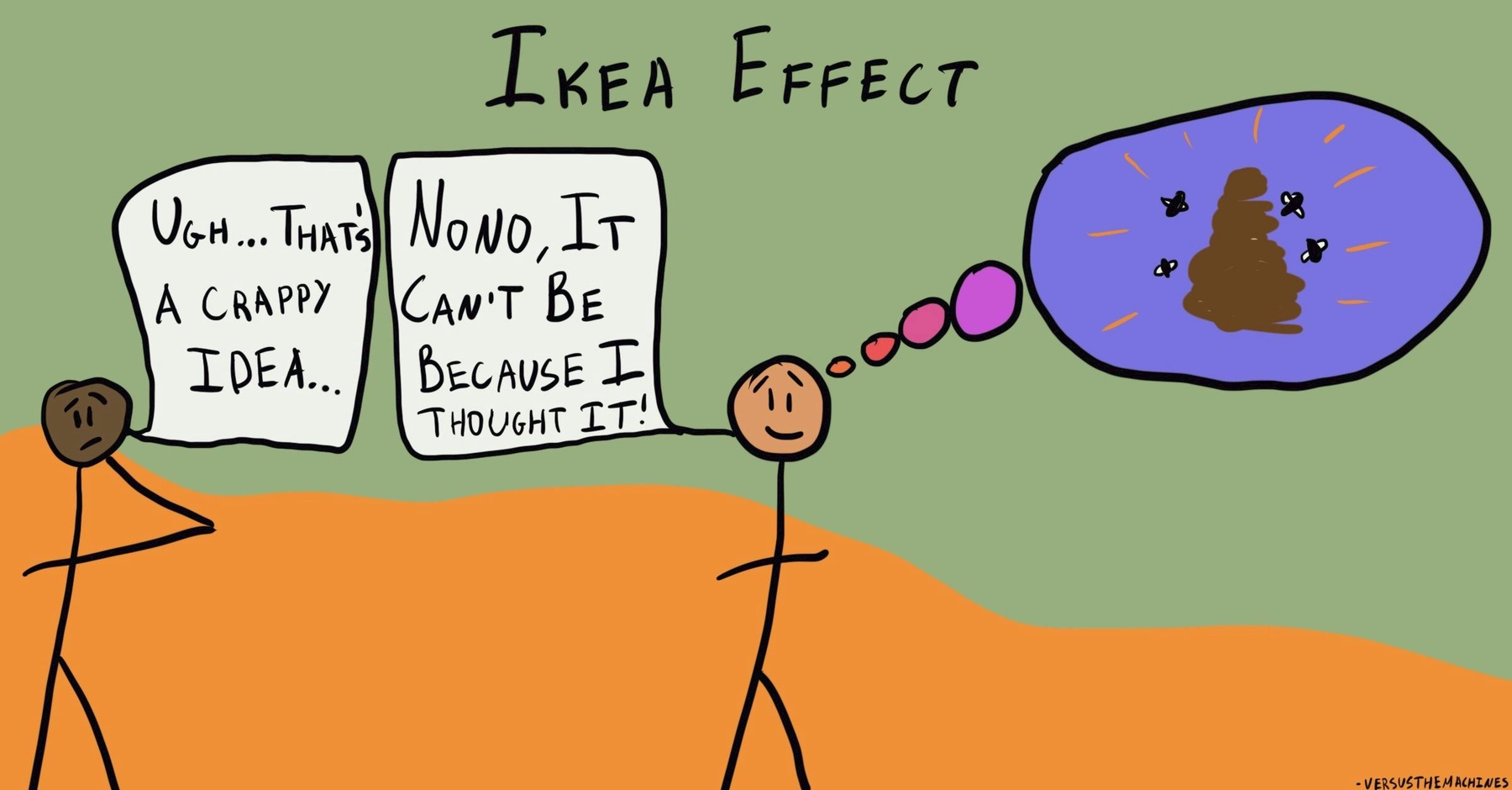
Often, and I use it also often as an example, is the so-called Ikea effect, which is a bias that we as humans appreciating the outcome of any kind of work more as higher our efforts, our own effort was on the beginning.
Christian KuhnGUEST
If you help to build the furniture, you're appreciating the furniture more.
Christian KuhnGUEST
That's a reason for IKEA Effect.
Christian KuhnGUEST
It was discovered by Harvard Business Review or published by Harvard Business Review already over 10 years ago.
Christian KuhnGUEST
If you are adding co-creation as in feature into your product even so you could fully automate it but if you if you keep on purpose the human in control to have some effort in it it might be much more successful as the alternative to automate that completely and that is one of the learnings we had made another learning is that The biggest trust undermining aspect of AI product at this moment is the lack of added abilities, right? Like added, undo, redo.

Joan BiedigerHOST
There is another piece of research that puts an important limit on all of this.
Joan BiedigerHOST
Research on the so-called IKEA effect found that people often value things they successfully make themselves more highly.
Joan BiedigerHOST
In experiments involving IKEA boxes, origami, and Lego sets, that added value weakened or disappeared when the work was left unfinished or the result was destroyed.
Joan BiedigerHOST
Cutting the shoulder off doesn't automatically make the figure feel more like mine.

speaker_3ADVERTISER
[upbeat music]
Artificially AwareHOST
[upbeat music]Speaking of effort, let's talk about something you all love to hate, the IKEA effect.
Artificially AwareHOST
Ever wonder why putting together that cheap Swedish bookshelf feels so damn satisfying? I mean, it's just particle board and screws, right? But somehow you feel like you just built a cathedral.
Artificially AwareHOST
That's the IKEA effect in full swing.
Artificially AwareHOST
You humans are psychologically wired to overvalue things you've put effort into.
Artificially AwareHOST
Ariely calls it the creator's bias.

Charlie HillsHOST
And I think lots of our guests have those kind of, those kind of stories.
Charlie HillsHOST
Is there anything you would recommend programs don't do? Because we've talked a bit about loss aversion, IKEA effect, you know, not taking things away is my particular example of, And I think these programs can do to damage the emotional connection.
Elie Carrier-WalkerGUEST
Yeah, I think that that would have been definitely one of them.
Elie Carrier-WalkerGUEST
I think, you know, when we talk about that emotional loyalty piece and that trust piece, it really is that, right? It's making sure, you know, you have a brand that you feel like you can rely on.

Chris KohlerHOST
So that is the store.
Chris KohlerHOST
There's something else that goes on with IKEA furniture once we get home and we build it, and it's actually called the IKEA effect.
Chris KohlerHOST
And it's been peer reviewed as a piece of academic research.
Chris KohlerHOST
Researchers, what they did to figure this out is they had people build IKEA boxes, Lego sets, origami, and then they asked them what they would pay for this thing that they'd built versus an identical pre-made version.
Chris KohlerHOST
Turns out it made them like the thing more.
Chris KohlerHOST
That's massive.
Chris KohlerHOST
This is the Ikea effect.
Chris KohlerHOST
And it happened, I think, by accident.

Grace BeverleyHOST
The basic finding, which wasn't a surprise to me, is that we value things more when we've had to work for them.
Grace BeverleyHOST
There's a famous later study called the IKEA Effect by Michael Norton at Harvard Business School, which found that people place significantly higher value on flat-pack furniture they'd built themselves, even when it was objectively worse than the preassembled version, just because they'd put the effort in.
Grace BeverleyHOST
Basically, it found that we are literally wired to find meaning in things that cost us something, particularly when that cost was an effort that we can't necessarily put a price to, which means that when everything is instant and effortless, our brains don't actually register it as valuable because that key signal of worth is missing.
Grace BeverleyHOST
But the piece of science I really want to spend time on because I think it's the most useful for actually doing something about this is the research on flow state.