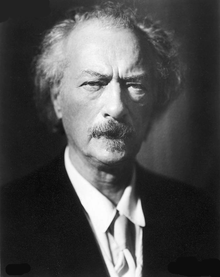
Ignacy Jan Paderewski
Pianist and former Prime Minister of PolandWikipedia
33
MENTIONS
13
EPISODES
13
PODCASTS
Search complete. 33 mentions across 13 episodes found for "Ignacy Jan Paderewski".
Sep 9, 2026

speaker_5UNKNOWN
For understanding these artists,
Norman CorwinNARRATOR
What she said was, I don't know if all musicians are such politicians as Paderewski was, so I doubt it very much.
Norman CorwinNARRATOR
It was a reference to the late pianist Paderewski, who was also a pre-war premier.
Norman CorwinNARRATOR
Not long before we arrived in Poland, there had been a national referendum.
Norman CorwinNARRATOR
Signs telling people how to vote were still evident on whatever walls were standing.

speaker_1NARRATOR
A shabby piano at home, kicked below by many childish feet, but mellow and sweet, like an old violin.
speaker_1NARRATOR
And herself sitting practicing over and over the part of Paderewski's minuet, where, as everyone knows, the fingering is rather difficult.
speaker_1NARRATOR
And outside the open window, leaning on his broom, worthless Johnny Fraser staring in with friendly eyes and an extremely dirty face.
speaker_1NARRATOR
To 22's unbounded amazement, she flung down the cushion and made for the little ward linen room.

Edward R. MurrowNARRATOR
World's fairs closed for the season at Flushing Meadows and the Golden Gate, and the phony war opened for the season along the Maginot Line.
Edward R. MurrowNARRATOR
Although a Paderewski concert for Polish relief could fill Carnegie Hall, America first rallies were packing Madison Square Garden.
Edward R. MurrowNARRATOR
Lindbergh gave them the word.
speaker_3SOUNDBITE_SPEAKER
These wars in Europe are not wars in which our civilization is defending itself against some Asiatic intruder.

speaker_11NARRATOR
O is for Oliver, casting aspersion on Omar, that awfully dissolute Persian, though secretly longing to join the diversion.
speaker_11NARRATOR
P is for Peter, who hollers no no through the keyhole to Payne, Paderewski, and Poe.
speaker_11NARRATOR
Q is the Queen, so noble and free, for further particulars look under V. R is Rubenstein, playing that old thing in F, to Rollo and Rembrandt, who wish they were deaf.
speaker_11NARRATOR
S is for Swinburne, who, seeking the true, the good, and the beautiful, visits the zoo, where he chances on Sappho and Mr. Sardou and Socrates, all with the same end in view.

speaker_9NARRATOR
O is for Oliver, casting aspersion on Omar, that awfully dissolute Persian, though secretly longing to join the diversion.
speaker_9NARRATOR
P is for Peter, who hollers no no through the keyhole to Paine, Paderewski, and Poe.
speaker_9NARRATOR
Q is the Queen, so noble and free, for further particulars look under V. R is Rubenstein, playing that old thing in F, to Rollo and Rembrandt, who wish they were deaf.
speaker_9NARRATOR
S is for Swinburne, who, seeking the true, the good, and the beautiful, visits the zoo, where he chances on Sappho and Mr. Sardou and Socrates, all with the same end in view.

Edmund BloxhamNARRATOR
The late von Bülow, for instance, was well now universally conceded to be the representative Beethoven player of the age, for no better reasons, so far as I can discover, than that he was generally admitted to be a failure in the presentation of what most works of the modern school, and that cold, calculating, cynical intellectuality was the predominant feature of his personality and his musical work which made him the driest, most unideal, uninteresting pianist of his generation in spite of his phenomenal technique, memory, and mental power.
Edmund BloxhamNARRATOR
On the other hand, Paderewski, with all his infinitely magnetic personality, his incomparable beauty of tone and coloring, his blended nobility and refinement of conception, is described as a perverter of taste, a destroyer of traditions and precedents, because forsooth he plays Beethoven too warmly, too emotionally, too subjectively.
Edmund BloxhamNARRATOR
Les grâces, messieurs, what does it all signify? Are we then to accept perforce as final, in spite of our better instincts, the dictum of the long-since petrified Leipzig school which holds technique of the hand and head not only as the supreme but as the sole element in musical art, which relegates all emotion and its expression to the despised limbo of sickly sentimentality, and which epitomizes its highest encomium of an artist in the words, He allows himself no liberties.
Edmund BloxhamNARRATOR
That is to say, he plays merely the notes with the faultless precision and soulless monotony of a machine.
12 MINS LATER
Edmund BloxhamNARRATOR
or his later works, declaring that anyone who had sense enough to play them at all would know that it was demanded without being told.
Edmund BloxhamNARRATOR
True, Beethoven's works have been edited well nigh to death since his time, but of course without his sanction or revision.
Edmund BloxhamNARRATOR
And as no two editions agree, who shall decide which is infallible? And why, I ask, is not the audible interpretation the piano of a Liszt, a Rubinstein, or Paderewski just as likely to be legitimate as the printed interpretation of a Bülow or a Lebew.
Edmund BloxhamNARRATOR
Has not one artist as good a right to his conception as another? And in heaven's name, what possible reason is there for assuming in regard to an intensely emotional composer-player like Beethoven that the coldly, stiffly, scholastic reading of his works is more in accordance with his original intention than a more warm and subjective one? Moreover, even if there were a complete, corrected, authorized edition of Beethoven carefully revised by the composer himself, anyone who has ever written out, proofread, and finally published the simplest original composition knows well by experience how utterly impossible it is to indicate definitely with our imperfect system of marking just how each strain should be rendered.

Great Pianists on Piano Playing - James Francis Cooke
Aug 26 · 14 Mentions
Top 40%Val RothNARRATOR
He comes to dread the trains as we might a prison van.
Val RothNARRATOR
Paderewski resorts to a private car, but even this luxurious mode of travel may be very monotonous and exhausting.
Val RothNARRATOR
The great distances must certainly account for some of the evidences of strain which deform the faces and exhaust the minds of so many virtuosos.
Val RothNARRATOR
The traveling salesman seems to thrive upon miles of railroad travel, as do the crews of the trains.
8 MINS LATER
Val RothNARRATOR
Some years later, this man succumbed to alcoholism.
Val RothNARRATOR
The pianist of today.
Val RothNARRATOR
Contrasted with a type of this kind may be mentioned such men as Sohr, Rachmaninoff, D'Albert, Paderewski, Godowsky, Backus, Rosenthal, Power, Joswi, Scharwenka, Gabrilowitsch, Hofmann, Bauer, Levine, to say nothing of the ladies, Bloomfield-Zeigler, Carreño, Gutzon, et al., many of whom are intellectual giants.
Val RothNARRATOR
Most all are exceedingly regular in their habits, and at least two are strong temperance advocates.

Devorah AllenVOICE_ACTOR
While much of my time and close attention must necessarily be given to study, for this reason, when there is any diverting influence, I prefer occasionally to forget everything of a serious nature, and like the bee that goes from flower to flower to sip of each its sweetness, so I enjoy passing from one subject to another, discussing only lightly each in turn.
Devorah AllenVOICE_ACTOR
So you see, whether it is salads or pâtés, Mrs. Campbell or Paderewski, shirred gowns or pleated, these subjects at times may prove interesting and diverting.
Cavan S.VOICE_ACTOR
But when a person is deeply interested in some special study that counts, I cannot see how he can find much satisfaction in the discussion of topics so very foreign to his specialty.
Devorah AllenVOICE_ACTOR
As I have just implied, the specialist finds it necessary to relax.

speaker_3NARRATOR
A shabby piano at home, kicked below by many childish feet, but mellow and sweet, like an old violin.
speaker_3NARRATOR
And herself sitting practicing over and over the part of Paderewski's minuet, where, as everyone knows, the fingering is rather difficult.
speaker_3NARRATOR
And outside the open window, leaning on his broom, worthless Johnny Fraser staring in with friendly eyes and an extremely dirty face.
speaker_3NARRATOR
To 22's unbounded amazement, she flung down the cushion and made for the little ward linen room.

speaker_5ADVERTISER
Chapter six, At a Pianoforte Recital, part one.
John Thomas CoosNARRATOR
No clearer illustration of the magical power which lies in music, no more convincing proof of the puissant fascination which a musical artist can exert, no greater demonstration of the capabilities of an instrument of music can be imagined than was afforded by the pianoforte recitals which Mr. Paderewski gave in the United States during the season of 1895-96.
John Thomas CoosNARRATOR
More than three score times in the course of five months in the principal cities of this country did this wonderful man seat himself in the presence of audiences whose numbers ran into the thousands and were limited only by the seating capacity of the rooms in which they gathered and hold them spellbound from two to three hours by the eloquence of his playing.
John Thomas CoosNARRATOR
Each time the people came in a gladsome frame of mind, stimulated by the recollection of previous delights or eager expectation.
John Thomas CoosNARRATOR
Each time there was the same growth in enthusiasm which began in decorous applause and ended in cheers and shouts as the artist came back after the performance of a Herculean task and added piece after piece to a program which had been laid down on generous lines from the beginning.
John Thomas CoosNARRATOR
The careless saw the spectacle with simple amazement, but for the judicious it had a wondrous interest.
John Thomas CoosNARRATOR
I am not now concerned with Mr. Paderewski beyond invoking his aid in bringing into court a form of entertainment which, in his hands, has proved to be more attractive to the multitude than symphony, oratorio, and even opera.
John Thomas CoosNARRATOR
What a world of speculation and curious inquiry does such a recital invite one into, beginning with the instrument which was the medium of communication between the artist and the hearers.
3 more episodes mention Ignacy Jan Paderewski.
Create an account to see the whole feed, search across every transcript, and follow the entities you care about.