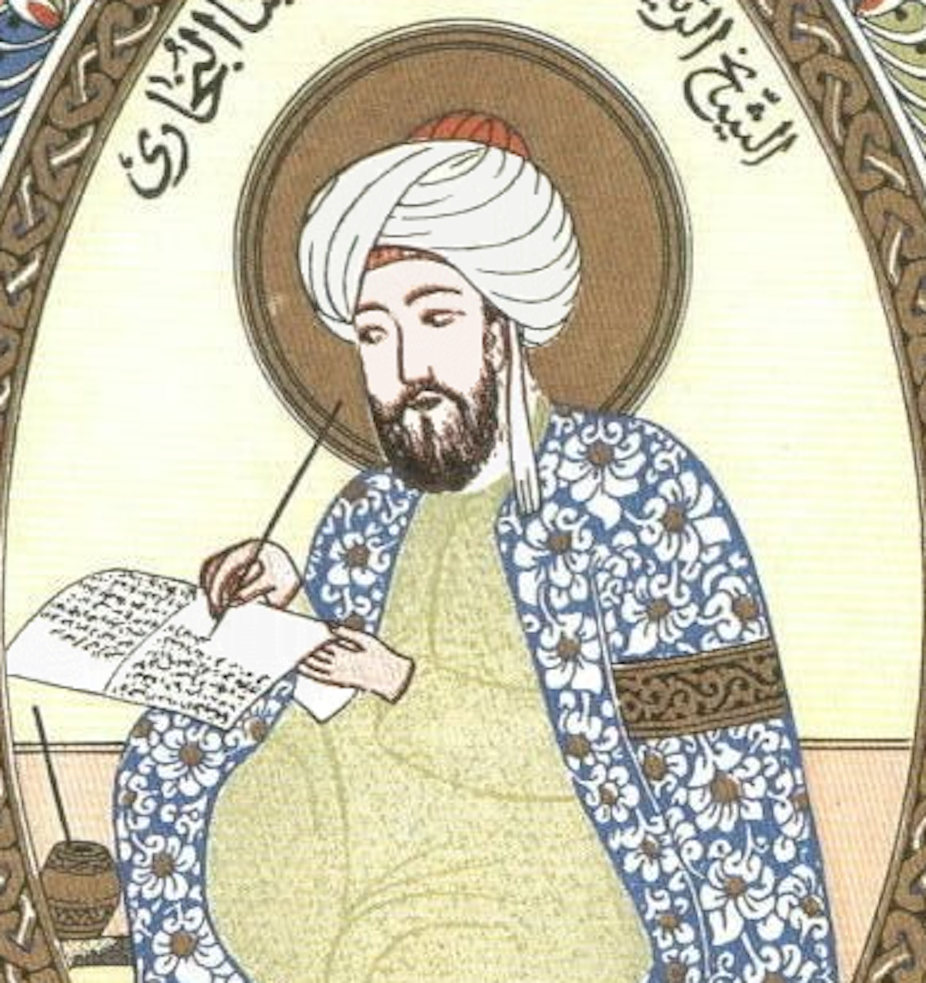
Ibn Sina
Philosopher and physicianWikipedia
174
MENTIONS
80
EPISODES
68
PODCASTS
Search complete. 174 mentions across 80 episodes found for "Ibn Sina".
Sep 21, 2026

speaker_0HOST
Jabir ibn Hayyan founded modern chemistry, built the world's first laboratory in the 8th century.
speaker_0HOST
Look at Ibn Sina, whose medical encyclopedia served as the ultimate authority in European universities for half a millennium.
speaker_0HOST
Look at Al-Jazari, the father of robotics and mechanical engineering.
speaker_0HOST
Look at Ibn Khaldun, the founder of sociology and historiography.

John GreenHOST
Some communities believed the disease was genetic, others thought it was contagious, some thought it was caused by foul air, others by a disharmony of fluids within the body.
John GreenHOST
Some even approached a germ theory of disease, like hundreds of years before humans invented the microscope, the great Persian scholar and poet Ibn Sina wrote that diseases such as TB were caused by tainted foreign organisms that are not visible by naked eye, which Very impressive, but no way to confirm it pre-microscopy.
John GreenHOST
I want to pause here to note a defining feature of humans, which is that we like to know why things happen, especially why really bad things happen.
John GreenHOST
And if a reason is not...
7 MINS LATER
John GreenHOST
Stigmatizing away an illness becomes harder when everyone seems to be getting it, not just the poor or the vulnerable, but even the rich.
John GreenHOST
I mean, the richest individual of the 19th century died of TB at the age of 56.
John GreenHOST
It killed presidents and kings and poets and actresses.
John GreenHOST
And so suddenly, consumption became a romanticized disease, a disease of beauty and refinement and intellectual sophistication.

GregHOST
The advancement of science was driven by iconic polymaths, each contributing a distinct pillar to laboratory practice.
GregHOST
These polymaths were Jabir ibn Hayyan, al-Razi, al-Kindi, and ibn Sina.
GregHOST
Jabir ibn Hayyan, circa 721-815 CE, is commonly regarded as the father of chemistry.
GregHOST
Jabir prioritized absolute laboratory precision.
GregHOST
Alkindi, circa 801 to 873 CE.
GregHOST
applied chemical isolation directly to commerce medicine and consumer goods he wrote the book of the chemistry of perfume and distillations it contained more than 100 recipes for fragrant oils salves and aromatic waters he was one of the first major scholars to write scientific treaties refuting the alchemical myth that base metals could be magically transmuted into gold, arguing that chemical reactions could only create clever imitations, not true elemental changes.
GregHOST
Then, a little over 100 years later came Ibn Sina, and Ibn Sina cemented the scientific split between fraudulent gold making and real chemical therapy.
GregHOST
In his monumental The Canon of Medicine, he detailed how to distill essential oils and plant extracts to create standardized purified pharmaceuticals.

Tom Davis BealeNARRATOR
God suffices to protect the faithful in war.
Tom Davis BealeNARRATOR
Quran 33.25 aristotle also contended with success against the theories of plato socrates and the theists who had preceded him and separated himself entirely from them but he could not eliminate from his doctrine the strains of infidelity and heresy which disfigure the teaching of his predecessors We should therefore consider them all as unbelievers, as well as the so-called Musulman philosophers, such as Ibn Sina, Avicenna, and Farabi, who have adopted their systems.
Tom Davis BealeNARRATOR
Let us, however, acknowledge that among Musulman philosophers none have better interpreted the doctrine of Aristotle than the latter.
Tom Davis BealeNARRATOR
What others have handed down as his teaching is full of error, confusion, and obscurity adapted to disconcert the reader.

Nicholas James BridgewaterNARRATOR
Aristotle, for instance, who made a special study of the digestion, died of a gastronomic malady.
Nicholas James BridgewaterNARRATOR
Avicenna was a specialist of the heart, but he died of heart disease.
Nicholas James BridgewaterNARRATOR
God is the great compassionate physician who alone has the power to give true healing.
Nicholas James BridgewaterNARRATOR
All creatures are dependent upon God, however great may seem their knowledge, power, and independence.

Phil ChenevertNARRATOR
Diogenes, Anaxagoras and Thales, Zeno, Empedocles and Heraclitus.
Phil ChenevertNARRATOR
Of qualities I saw the good collector, hight Discorides and Orpheus saw I, Tully and Livy and moral Seneca, Euclid, geometrician and Ptolemy, Galen, Hippocrates and Avicenna, Averroes, who the great comment made.
Phil ChenevertNARRATOR
I cannot all of them portray in full, because so drives me onward the long theme, that many times the word comes short of fact.
Phil ChenevertNARRATOR
The sixfold company in two divides, another way my sapient guide conducts me, forth from the quiet to the air that trembles, and to a place I come where nothing shines.

Nicholas James BridgewaterNARRATOR
Aristotle, for instance, who made a special study of the digestion, died of a gastronomic malady.
Nicholas James BridgewaterNARRATOR
Avicenna was a specialist of the heart, but he died of heart disease.
Nicholas James BridgewaterNARRATOR
God is the great compassionate physician who alone has the power to give true healing.
Nicholas James BridgewaterNARRATOR
All creatures are dependent upon God, however great may seem their knowledge, power, and independence.

Tim HarrisonGUEST
The most famous philosophical fiction of subtraction would be Descartes meditations, right, where Through hyperbolic skepticism, the meditator brings himself back to absolute basics and tries to subtract away the world to reveal the condition for the appearance of the world as such, which is the so-called cogito.
Tim HarrisonGUEST
I think the most interesting fiction of subtraction, and I think it's a fiction, a philosophical fiction of subtraction that Descartes read, certainly Hobbes read, and I have evidence to suggest that it was well known, is Ibn Sina, the 10th century Arabic and Persian philosopher who in his Kitab al-Shifa, The Book of the Cure and a number of other works develops this thought experiment with which I'm sure you're both familiar.
Tim HarrisonGUEST
The Flying Man, right? And this is a philosophical thought experiment, right? A kind of radical thought experiment.
Tim HarrisonGUEST
Some people think he wrote it while he was in prison.
Tim HarrisonGUEST
He's incapable of opening his eyes.
Tim HarrisonGUEST
He's incapable, you know, there's no touch, there's no sight, there's nothing.
Tim HarrisonGUEST
And he asks, what does this man, what a man in such a position, of any awareness of his own existence? Would he be able to affirm his existence? And Ibn Sina says, well, yes, obviously he would.
Tim HarrisonGUEST
Other people have disagreed.

Alison CraigHOST
I love these bits, yeah.
David RobsonGUEST
In the 11th century by a Persian chap called Avicenna, who was also Arabian.
David RobsonGUEST
Avicenna wrote a classic book, which was called The Canon of Medicine.
David RobsonGUEST
And it was the definitive book on medicine.
Alison CraigHOST
In the 11th century? In the
David RobsonGUEST
think that the anterior longitudinal ligament was mentioned then, and it's still called the anterior longitudinal ligament.
Alison CraigHOST
They
David RobsonGUEST
mentioned it first in the 11th century, Avicenna.

TriciaGNARRATOR
Aristotle corrected the errors of earlier thinkers.
TriciaGNARRATOR
Avicenna and Averroes have corrected Aristotle in some matters, and have added much that is new, and so it will go on till the end of the world.
TriciaGNARRATOR
And Bacon quotes passages from Seneca's physical inquiries to show that the acquisition of knowledge is gradual.
TriciaGNARRATOR
Attention has been already called to those passages, and it was shown how perverse it is, on the strength of such remarks, to claim Seneca as a teacher of the doctrine of progress.
70 more episodes mention Ibn Sina.
Create an account to see the whole feed, search across every transcript, and follow the entities you care about.