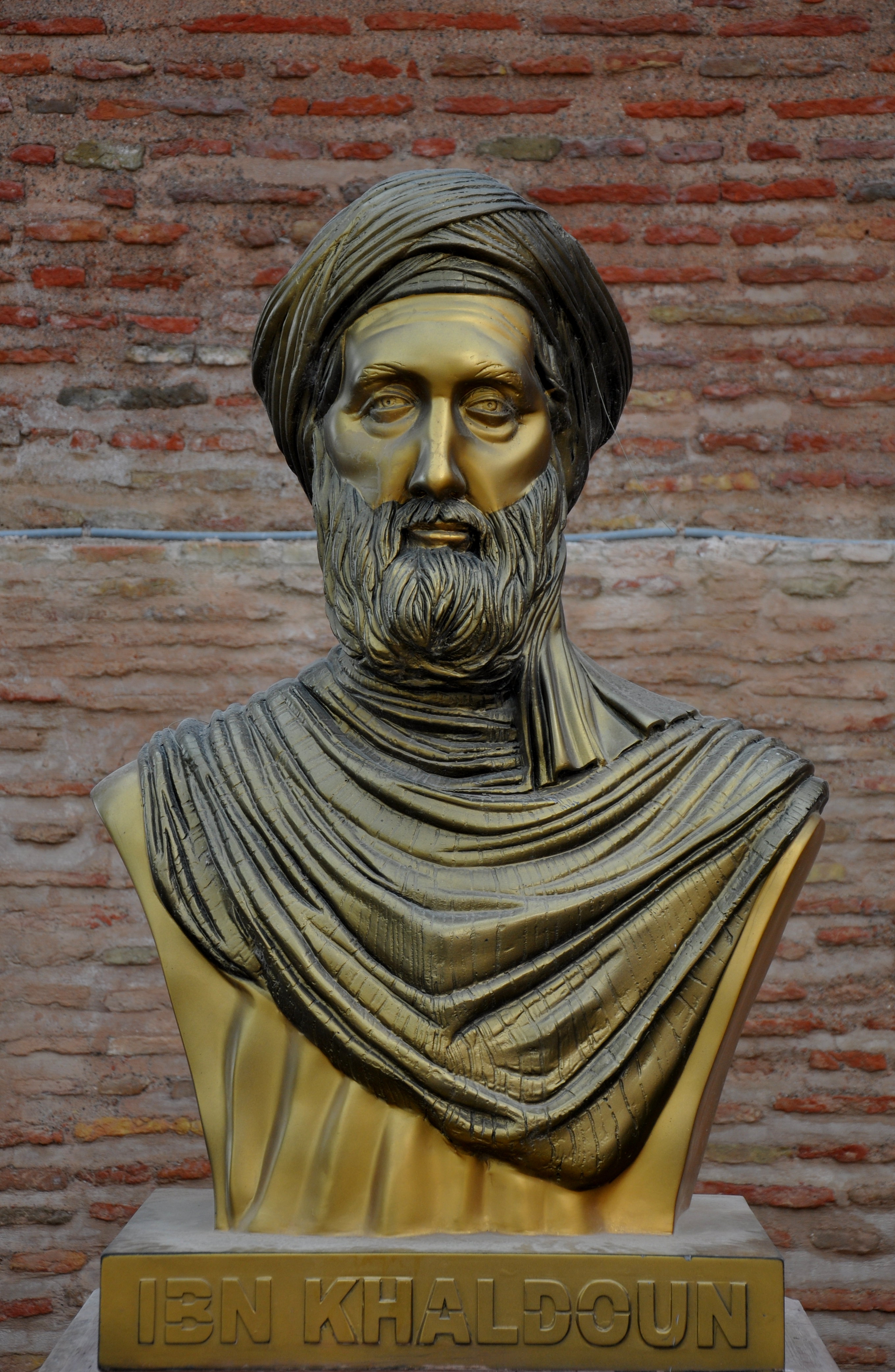
Ibn Khaldun
Historian and philosopherWikipedia
67
MENTIONS
38
EPISODES
36
PODCASTS
Search complete. 67 mentions across 38 episodes found for "Ibn Khaldun".
Oct 30, 2026

Waleed AlyGUEST
There's empires rise and then they fall and then, you know, something else comes along and whatever.
Waleed AlyGUEST
And I quote specifically in the Ibn Khaldun, who is often described as the father of sociology.
Waleed AlyGUEST
And his whole thing was civilizations or empires last about 250 years.
Waleed AlyGUEST
How old's America this year? What a coincidence.

Ammar ShahinHOST
So what evil did they carry? when they came down to test people's faith might have been different from magic based on the recitation of Wama and what they were brought to differentiate between that sentence and the sentence before and in the famous introduction that seven evilness that Allah has sent down to test people with.
Ammar ShahinHOST
In Ibn Khaldun's intro of his book that is well known, Muqaddimat Ibn Khaldun, he mentioned some of them are tests like magic, that there is evil that came down to earth, yoga, and other things that people learned and practiced as evil.
Ammar ShahinHOST
So here that they came down with something evil that is a test for people, meaning for people to be tested in their faith if they were to do it or not do it.
Ammar ShahinHOST
And evil exists on earth, but we're not tested.

Waleed AlyGUEST
And then it shakes out however it shakes out.
Waleed AlyGUEST
My darkest version of it, and it's not a prediction, but my darkest version of it is the Ibn Khaldun version of it.
Waleed AlyGUEST
Bibin Khaldun, who's the, you know, in so many ways the father of the social sciences, sort of, you know, North Africans, Algeria, that sort of area.
Waleed AlyGUEST
And his basic prediction or his basic observation was that civilizations last, or empires or whatever, last roughly 250, 280 years.
Waleed AlyGUEST
That there are cycles to these things and that one of the points just before the collapse is that we become extravagantly wealthy and we replace duty and fellow feeling and a sense of obligation with our individual pursuits and our individual fancies.
Waleed AlyGUEST
That sounds like a familiar society to me.
Waleed AlyGUEST
So if Ibn Khaldun's right, it's all about to end at some point.
Waleed AlyGUEST
I don't

Amir LebdiouiGUEST
know so Laffer curve Arthur Laffer is not the first one to have discussed that relationship Marx is not the first one to have a labor theory of value Adam Smith is not the first guy to have explain the law of supply and demand.
Amir LebdiouiGUEST
It's Ibn Khaldun, the 14th century North African scholar who developed very clearly each of those concepts in his book, Al-Muqaddimah.
Amir LebdiouiGUEST
And I think that's mind-blowing because you realize that the ideas that have built the economics as a discipline have actually are not from Europe or the US at all.
Amir LebdiouiGUEST
And I think that helps to show that ideas have come from many different places and that gives a bit of confidence that solutions to today's problems might also come from many different places.
Amir LebdiouiGUEST
know so Laffer curve Arthur Laffer is not the first one to have discussed that relationship Marx is not the first one to have a labor theory of value Adam Smith is not the first guy to have explain the law of supply and demand.
Amir LebdiouiGUEST
It's Ibn Khaldun, the 14th century North African scholar who developed very clearly each of those concepts in his book, Al-Muqaddimah.
Amir LebdiouiGUEST
And I think that's mind-blowing because you realize that the ideas that have built the economics as a discipline have actually are not from Europe or the US at all.
Amir LebdiouiGUEST
And I think that helps to show that ideas have come from many different places and that gives a bit of confidence that solutions to today's problems might also come from many different places.

Abdullah Hakim QuickGUEST
And so this was an amazing achievement.
Abdullah Hakim QuickGUEST
Abdur Rahman Ibn Muhammad, known as Ibn Khaldun, He was a qadi, a judge, a scholar, a diplomat, economist, philosopher.
Abdullah Hakim QuickGUEST
And they call him the father of sociology.
Abdullah Hakim QuickGUEST
Because his theories of history and the relationship of people is the basis of the science of sociology.

Amine NasraouiGUEST
To Uriqa, for example, or to any village, where is it? People are short.
Amine NasraouiGUEST
So actually, that's why also a lot of historians, specifically like Ibn Khaldun in the 11th century, he's the founder of sociology, by the way, back to the 11th century.
Amine NasraouiGUEST
He says that the Berber people may come from Asia in the time of Alexander the Great.
Amine NasraouiGUEST
Because Alexander the Great, when he attacked China, there is a group of people, they escaped.

Hatem al-HajHOST
Procedural knowledge.
Hatem al-HajHOST
In fact, Ibn Khaldun pointed this out when he spoke about the difference between knowing Sewing in the sense of being able to describe it and knowing how to sew.
Hatem al-HajHOST
You know, you could speak about carpenting better than any carpenter, but if we give you the tools and the wood and everything, you'll be lost.
Hatem al-HajHOST
You could speak about swimming.

ShamsiHOST
Can I give you a certain paradigm to view this lens through? Paradigm away.
ShamsiHOST
Are you familiar with Ibn Khaldun?
AdamHOST
Yes.
AdamHOST
I think you're familiar with Ibn Khaldun.
AdamHOST
You know who you're talking to.
AdamHOST
You know who you're talking to.
ShamsiHOST
So in his history...
ShamsiHOST
I am Ibn Khaldun.

Anthony FatseasHOST
yeah i think it's the problem of what we've experienced you know for myself 30 years for people longer i guess for most people who are still alive today we have had a large period of stability which is you know not not very common in in history i guess if you look at it yeah it seems like almost people as you say take take all our systems take all our institutions for granted but it's actually something you have to continue to work on continue to fight and fight for to for them to know continue to be or even evolve with with
Barry StraussGUEST
absolutely absolutely yeah you can't you can't take it for granted um and history shows us that you can't take these for granted because if you do someone will take it away from you um one of the historians or one of the thinkers i really admire uh is um an arab um thinker from the middle ages named ibn khaldun he talks about a cycle of civilization in which you have cities that are wealthy and luxurious and people become soft and then you have hard tough people in the desert who are united by a sense of cohesion a sense of social cohesion they turn their eyes on the cities the soft cities and they ride in and they conquer them and they take it take them over and they help themselves to their wealth but then their children become soft and they begin to decline and they lose their sense of cohesion and the cycle goes on and on and on now you might say that's kind of simplistic it's a simple explanation of complex phenomena and that's a point it's it's not the only explanation but I
Anthony FatseasHOST
think
Barry StraussGUEST
there's a certain amount of that in in history and in every civilization I think to some extent We in the West have been guilty of that.
28 more episodes mention Ibn Khaldun.
Create an account to see the whole feed, search across every transcript, and follow the entities you care about.