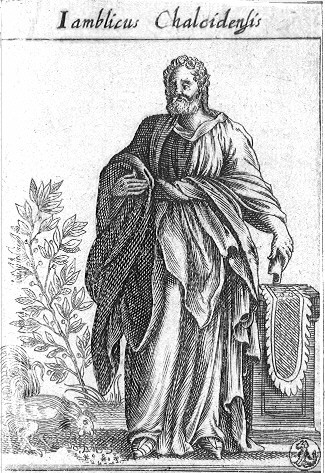
Iamblichus
PhilosopherWikipedia
66
MENTIONS
26
EPISODES
23
PODCASTS
Search complete. 66 mentions across 26 episodes found for "Iamblichus".
Oct 12, 2026

Robert PodgurskiGUEST
I may do some things online with it.
Robert PodgurskiGUEST
And I may do an expanded edition, depending on how it goes down the road, because I stuck with the primary Neoplatonists that Deep would have dealt with most outstandingly based on the library catalog, which isn't complete, but Plotinus, Iamblichus, Porphyry, Michael Sellis.
Robert PodgurskiGUEST
I had a chapter where I was dealing with Damascus and the latter at the tail end of Neoplatonism, but that wound up getting left out because it was a little bit at the periphery.
Robert PodgurskiGUEST
And I figured at this stage, I wanted to zero in and keep it a little bit more focused at this stage, especially for the beginner.
1 HR 2 MINS LATER
Robert PodgurskiGUEST
One, the egregore, the thought form, the build up of years, you know, of eons behind the what archangels actually represent i think as part of that reservoir there's an energy that undoubtedly has contributed to by
speaker_6ADVERTISER
you know
Robert PodgurskiGUEST
by countless practitioners feeding belief into it there's without a doubt another aspect of it which i'm i'm more and more convinced of uh that working with archangels and perceiving them as such a lot of times this is sort of a necessary stepping stone insofar as what the mind is able to deal with and conceive of, okay? If you look closely at the Neoplatonic tradition, when you're looking, especially somebody like, yeah, Iamblichus and Proclus both, there is a fabric, there is a covering given to an energy thought form or a genius, okay? And so, this fabric is something that can take the form that that is incorporated within the construct of an archangel as we penetrated through meditation and through consciousness and dealing with the news we are in essence unraveling that fabric we're approaching the core of what actually is what the supporting energy of it now when i think of um the vehicle of the soul And as I was, it's funny, I hadn't even really, I'm always so careful about language.
Robert PodgurskiGUEST
And I looked the other day, Akema, the chariot of the soul.

speaker_4NARRATOR
In the main, he reproduces what he has received.
speaker_4NARRATOR
We are able to compare his Pythagoras with those of Iamblichus and Porphyry, his Plato with that of Olympiadorus, his Solon with Plutarch's, and in none of these comparisons has he any reason to be ashamed.
speaker_4NARRATOR
End of Section 2 Section 3 of Lives of Eminent Philosophers, Volume 1 This is a LibriVox recording.
speaker_4NARRATOR
All LibriVox recordings are in the public domain.

JasonGUEST
So we'll see where that goes.
JasonGUEST
And I'm kind of at this point lost in the weeds a bit reading about like Iamblichus and theurgy and like, I don't know, then like some contemporary practitioners, like, uh, John Opsipaus, uh, is a contemporary theorist that, excuse me, that I admire.
JasonGUEST
So it's all over the place, but the, the book of banger will be a bit more focused of a project, I think.
Lux EstradaHOST
Yeah.

David BethGUEST
So-
Ike BakerHOST
... uh, uh, somebody once said to me, "Do you think Iamblichus would've charged his students?" And I said, "Listen, Iamblichus came from an Emesene dynasty of priest kings."
David BethGUEST
[laughs]
Ike BakerHOST
That's why [laughs] he was able-

Mads HøjmarkGUEST
It's-- it goes back to antiquity.
Mads HøjmarkGUEST
You find it in, uh, Neoplatonism, the, the concept of Hermetism in like Iamblichus and so on.
Mads HøjmarkGUEST
The-- oftentimes, the, the, the term itself, perennial philosophy or philosophia perennis, is associated sometimes with Leibniz.
Mads HøjmarkGUEST
People may know it from Aldous Huxley.
43 MINS LATER
Mads HøjmarkGUEST
...
Mads HøjmarkGUEST
the generating primal images.
Mads HøjmarkGUEST
Or, or maybe, again, I mentioned Iamblichus, the-
James EllisHOST
Mm

Nishanth SelvalingamHOST
And you'll see that like platonic ideals of like restraining the senses, of seeing the world as a fallen, ephemeral shadow realm, just an impression of the real all of those make their way into Christianity.
Nishanth SelvalingamHOST
So in the second century AD in Alexandria, you have all these Neoplatonists like Iamblichus and others, and they're all hanging out in Ptolemy's museum, right? Like Ptolemy wanted to attract all the great learned minds of the Hellenistic world.
Nishanth SelvalingamHOST
So he creates the most beautiful like university museum type hangout spot you could ever imagine.
Nishanth SelvalingamHOST
There's like a Bengal tiger in a cage and there are all these like reflective pools and gardens and shit.

Tim MackieHOST
Yep.
Tim MackieHOST
There's a guy named Iamblichus who called it a spirit of fire.
Jon CollinsHOST
Hmm.
Tim MackieHOST
A fiery pneuma-

speaker_0NARRATOR
Writing that this angel was the same presence other cultures had described under different names.
speaker_0NARRATOR
He equated it directly with the Orgoides of Iamblichus, the ancient Greek term for a radiant luminous self.
speaker_0NARRATOR
He equated it with the Atman of Hinduism, the very concept we traced earlier in this video, running straight back to the Upanishads.
speaker_0NARRATOR
And he equated it with the daemon the Gnostics described That spark of divine light supposedly trapped within physical matter.

Jay DyerGUEST
So after Plato, when you get into the first, second, third centuries of the early Christian era, there was a lot of debate and theological discourse between the budding Christian church of that time and various flavors of Platonists.
Jay DyerGUEST
So there's Plotinus, there's Iamblichus, there's these different figures that wrote a lot on kind of commenting on what Plato had said.
Jay DyerGUEST
And so sometimes this is called middle Platonism or neoplatonism.
Jay DyerGUEST
And so these figures tried to really continue the Hellenic approach as opposed to what Christianity was saying in terms of like the Bible and so forth.
Jay DyerGUEST
But my analysis of the Western Hermetic tradition is that it's just kind of other instantiations or iterations of Neoplatonism.
Jay DyerGUEST
So if you really want to understand Hermeticism, you have to read like Dionysus.
Jay DyerGUEST
Yeah, you have to read Plotinus, Dionysus, Iamblichus, these characters, Proclus.
Jay DyerGUEST
Um, because they're the skeletal outline for which all of the hermeticists draw from.

Ike BakerHOST
Pythagoras would be, you know, it was foretold.
Ike BakerHOST
I think it was in De Vita Pythagora, you know, by Iamblichus.
Ike BakerHOST
Where he told...
Ike BakerHOST
Porphyry wrote one about him too, I'm pretty sure.
Ike BakerHOST
That might have been Plotinus.
Ike BakerHOST
But anyway, Iamblichus, at least we attribute it...
Ike BakerHOST
We attribute the main biography that we get from Pythagoras to Iamblichus who wrote about him.
Ike BakerHOST
And I'm pretty sure in there it recounts this tale that was told to his mother that this would be one of the wisest men to walk the earth.
16 more episodes mention Iamblichus.
Create an account to see the whole feed, search across every transcript, and follow the entities you care about.