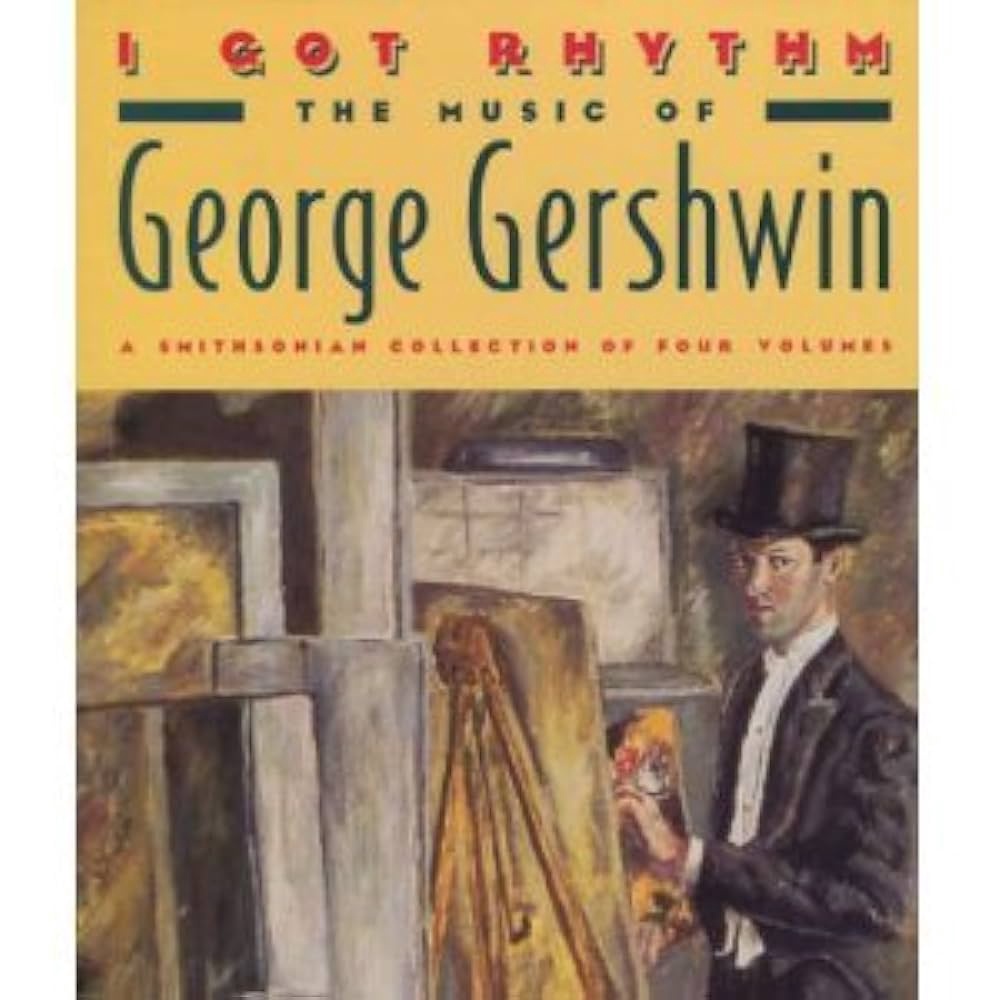
I Got Rhythm

I Got Rhythm

Song by George GershwinWikipedia

Search complete. 48 mentions across 23 episodes found for "I Got Rhythm".

Oct 15, 2026

Dan BarkerHOST
12:03
Their timeless standards include the songs "S'Wonderful," "Embraceable You," "The Man I Love," "Someone to Watch Over Me," and "Our Love Is Here to Stay."
Annie Laurie GaylorHOST
12:14
Stay."Born to a Russian Jewish immigrant family that was totally secular, both brothers were not religious, and who else but a free thinker would write the words, "The things that you're liable to read in the Bible ain't necessarily so." Let's hear Dan and D'arcy performing the Gershwin tune I Got Rhythm.
speaker_1UNKNOWN
12:35
[piano music] Days may be sunny with never a sigh.
speaker_1UNKNOWN
12:45
Don't need what money can buy.
speaker_1UNKNOWN
12:57
Why shouldn't we sing along? I'm chipper all the day, happy with my lot.
speaker_1UNKNOWN
13:14
How do I get that way? Look at what I got.
speaker_1UNKNOWN
13:24
I got rhythm, I got music.
speaker_1UNKNOWN
13:31
I got my man.
Dan BarkerHOST
12:03
Their timeless standards include the songs 'S Wonderful, Embraceable You, The Man I Love, Someone to Watch Over Me, and Our Love Is Here to Stay.
Annie Laurie GaylorHOST
12:14
Stay.Born to a Russian Jewish immigrant family that was totally secular, both brothers were not religious, and who else but a free thinker would write the words, "The things that you're liable to read in the Bible ain't necessarily so." Let's hear Dan and Darcie performing the Gershwin tune I Got Rhythm.
Darcy JohnstonGUEST
12:35
[singing] Days may be sunny with never a sigh.
Darcy JohnstonGUEST
12:45
Don't need what money can buy.
Darcy JohnstonGUEST
12:57
Why shouldn't we sing along? I'm chipper all the day, happy with my lot.
Darcy JohnstonGUEST
13:14
How do I get that way? Look at what I got.
Darcy JohnstonGUEST
13:24
I got rhythm, I got music.
Darcy JohnstonGUEST
13:31
I got my man.
speaker_0HOST
1:18
In 1930, the legendary George and Ira Gershwin musical Girl Crazy made its official Broadway debut at the Alvin Theatre.
speaker_0HOST
1:28
The production immediately launched its leading lady, Miss Ginger Rogers, into superstardom, and marked the debut of Ethel Merman, who stole the show by belting out the hit song, "I Got Rhythm".
speaker_0HOST
1:42
In 1939, Broadcast Music, Incorporated, better known these days as BMI, officially received its charter from the State of New York to begin operations as a performing rights organization.
speaker_0HOST
1:57
It was established by a coalition of broadcasters to serve as a competitive open door alternative to ASCAP, welcoming songwriters from genres like blues and country who had been previously excluded from songwriting organizations.
Ted GioiaGUEST
18:29
But the fact is, these are great jazz songs, whether he wanted them to be or not.
Nate WilcoxHOST
18:34
And what was it about a song like I Got Rhythm that became such a foundational building block, not just of swing jazz in the 30s, but of modern jazz in the 40s, 50s, and 60s?
Ted GioiaGUEST
18:46
Well, George Grossman wrote a lot of songs, and probably I could say that 10 or 20 of them are so good that jazz musicians still play them frequently in the current day.
Ted GioiaGUEST
19:00
But the one that had the greatest influence is I Got Rhythm, which curiously enough is one of the simplest songs that Gershwin wrote.
Ted GioiaGUEST
19:11
I mean, the melody could hardly be simpler.
Ted GioiaGUEST
19:13
I've got rhythm, I've got music.
Ted GioiaGUEST
19:30
The whole bridge just goes through the circle of fifths.
Ted GioiaGUEST
19:32
From a harmonic standpoint, there's not much to study here.

Unknown podcast

Bebop Breakthroughs: Contrafacts and the Birth of Jazz’s New Language

Oct 13 · 2 Mentions

speaker_3UNKNOWN
1:45
Those are what we call contrafacts.
speaker_3UNKNOWN
1:47
The first time I heard Charlie Parker riffing over a standard like I Got Rhythm, it felt like the music had just put on a new pair of shoes and started sprinting.
speaker_3UNKNOWN
1:57
Those contrafacts weren't just clever tricks.
speaker_3UNKNOWN
2:00
They were a practical way to avoid paying publishing royalties while giving soloists an instant playground for improvisation.
speaker_3UNKNOWN
3:58
Improvisation became less about embellishing a melody and more about exploring chord functions on the fly.
speaker_3UNKNOWN
4:05
And that brings us to the heart of Contrafax.
speaker_3UNKNOWN
4:08
They opened up an entire world of harmonic possibilities because you could take any familiar progression, say the 12-bar blues or I Got Rhythm Changes, and write a brand new head over it.
speaker_3UNKNOWN
4:22
That head was often shorter, more compact, and packed with chromaticism that demanded listeners to pay attention.
David GarfieldGUEST
57:44
The bass player's making up walking lines.
David GarfieldGUEST
57:47
He might play five choruses on I Got Rhythm changes.
Brad WilliamsHOST
57:50
Mm-hmm.
David GarfieldGUEST
57:51
Not gonna play the same bass line every time.
Brad WilliamsHOST
59:28
some people don't.
David GarfieldGUEST
59:30
Well, it's the harmonic structure.
David GarfieldGUEST
59:31
It's like, if you're playing I Got Rhythm, it's 1-6-2-5, 1-6-2-5, but you're not just gonna play that every time.
David GarfieldGUEST
59:39
I'm gonna throw in a 3.

Unknown podcast

Jazz in Wartime: Rhythm Shifts, Jimmie Noone’s Clarinet, and Billy Eckstine’s Bebop Revolution

Oct 13 · 1 Mention

speaker_0UNKNOWN
11:59
Harmony became an arena of rapid chord substitutions and extended voicings that stretched beyond the standard 2-V-I sequence.
speaker_0UNKNOWN
12:08
The Rhythm Changes Skeleton, derived from Gershwin's I Got Rhythm, was repurposed into new contrafacts, giving soloists a playground for reharmonization.
speaker_0UNKNOWN
12:18
Instrumentation shifted subtly, too.
speaker_0UNKNOWN
12:21
The guitar stepped forward as a comping voice, while the piano moved from block chords to sparse, syncopated left-hand patterns that kept time in a more conversational way.

Unknown podcast

Rhythm Changes: The 32‑Bar Backbone That Shaped Jazz

Oct 12 · 2 Mentions

speaker_1UNKNOWN
0:49
Let's start with a chord progression that's practically a jazz bible.
speaker_1UNKNOWN
0:54
Rhythm Changes The 32-bar form derived from Gershwin's I Got Rhythm.
speaker_1UNKNOWN
1:01
It first appeared on Broadway in 1930, but it was quickly ripped off by jazz musicians who saw its swing-friendly It-C-Z-5-V-I motion as perfect for improvisation.
speaker_1UNKNOWN
1:15
That simple sequence became a canvas upon which countless solos were painted, and its ubiquity has made it the backbone of modern jazz practice.
speaker_1UNKNOWN
2:50
From an economic standpoint, rhythm changes were more than just a musical tool.
speaker_1UNKNOWN
2:55
They became a commodity.
speaker_1UNKNOWN
2:58
Fake books started listing standards that included I Got Rhythm and its Contrafax, giving publishers a steady stream of sheet music sales.
speaker_1UNKNOWN
3:07
Musicians who could improvise on those chords commanded higher fees at gigs because they were in demand.

Unknown podcast

Contrafacts and the Battle Over What Jazz Could Become

Oct 12 · 1 Mention

speaker_1UNKNOWN
1:14
They're a legal loophole and a cultural statement about ownership in jazz.
speaker_1UNKNOWN
1:18
The thing is, the harmony of I Got Rhythm became a playground for bebop pioneers.
speaker_1UNKNOWN
1:24
they could improvise freely without paying royalties on the original melody.
speaker_1UNKNOWN
1:29
At the same time, there was an undercurrent of resistance, black musicians fighting for creative space in a white-dominated industry that prized danceable swing over experimental expression.

Unknown podcast

Storyville’s Blue Books: The Hidden Engine That Launched Early Jazz

Oct 12 · 1 Mention

speaker_2UNKNOWN
11:23
But there's an old backbone that keeps all those branches connected, rhythm changes.
speaker_2UNKNOWN
11:29
That 32-bar progression from Gershwin's I Got Rhythm has been the playground for improvisers since the swing era.
speaker_2UNKNOWN
11:37
It shows how a simple harmonic template can spark endless creative fire.
speaker_2UNKNOWN
11:41
The story begins in the early 1930s when big bands were pulling double duty as dance hall entertainers and touring houses of jazz.

13 more episodes mention I Got Rhythm.

Create an account to see the whole feed, search across every transcript, and follow the entities you care about.

We value your privacy

We use cookies to understand how you use our platform and to improve your experience. Click “Accept All” to consent, or “Decline non-essential” to opt out of non-essential cookies. Read our Privacy Policy.